



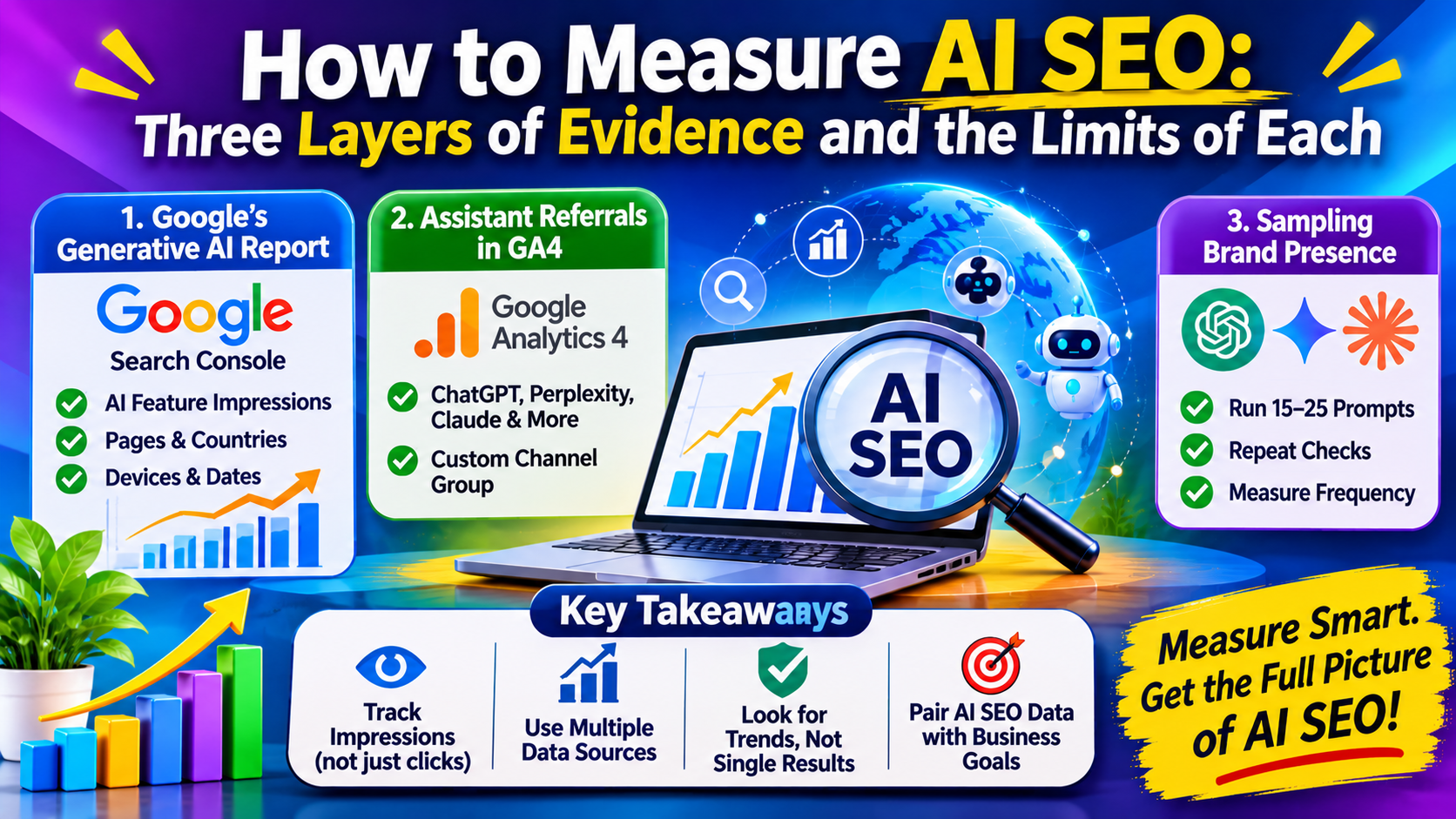
AI SEO is hard to manage because it is hard to measure. Google shows part of the picture in Search Console. Assistants such as ChatGPT or Perplexity show it only through scattered referral traffic, and their answers change from run to run. The workable approach is to combine three layers of evidence, treat each as incomplete, and report ranges rather than false precision.
Why familiar dashboards mislead
A Pew Research Center analysis of 900 U.S. adults’ browsing in March 2025 found that people clicked a traditional result link in 8% of visits when a Google AI SEO summary appeared. Without a summary, the figure was 15%. Only 1% of visits with a summary included a click on a link inside it. About two-thirds of searches ended without any click either way.
The lesson for measurement is that clicks can fall while your visibility holds. A page can be shown, even cited, and still earn fewer visits, so judging AI SEO on sessions alone undercounts exposure. Pew’s data is a U.S. snapshot from early 2025, so use it as a reference point, not a forecast for your market.
Layer one: Google’s generative AI report
Google launched Search Generative AI performance reports in Search Console in June 2026, with dedicated views for Search and Discover. The announcement lists impressions, pages, countries, devices and dates. It also says this data stays inside the overall performance report.
Use it to answer three questions: which URLs appear in AI features, in which countries, and whether appearances are rising. For a worldwide audience, the country view is the quickest way to spot markets where your pages rarely surface. The limit is that it reports appearances, not what the generated answer said about you.
Layer two: assistant referrals in GA4
By default, a visit from an assistant lands in generic Referral, or in Direct when no referrer is passed. Third-party analysts report that GA4 added a native AI Assistant channel on 13 May 2026. They also report that coverage is incomplete, with Perplexity apparently still routed to Referral. I could not confirm this from Google’s own documentation.
A custom channel group closes most of the gap. Create a channel whose source matches chatgpt.com, perplexity.ai, claude.ai, gemini.google.com and copilot.microsoft.com. Place it above Referral, because GA4 evaluates rules from the top down and stops at the first match. Whatever it counts is a floor, since mobile-app visits and copied links tend to arrive as Direct. A “How did you hear about us?” field on enquiry forms catches some of what analytics cannot.
Layer three: sampling brand presence
SparkToro and Gumshoe.ai studied 2,961 runs from 600 volunteers and found less than a 1-in-100 chance that ChatGPT or Google’s AI returned the same brand list twice for one prompt. A tool reporting your “AI rank” from a single run is therefore reporting noise. Coverage of the study notes that how often a brand appears is steadier than where it appears, so frequency is the metric worth tracking.
Frequency needs enough runs. Here is a worked example using standard binomial arithmetic, not data from any study. If your brand appears in 7 of 20 runs, the observed rate is 35%, but the 95% margin is roughly ±21 points. With 100 runs, the same rate carries about ±9 points. A reported jump from 35% to 45% on twenty runs is not evidence of anything.
Sarkar SEO’s minimum protocol:
- Write 15 to 25 prompts across informational, comparison and purchase intent, with several phrasings of each.
- Run every prompt many times in each assistant within one short window.
- Record whether you appear, which domains are cited, and whether the description of you is accurate.
- Report presence rate with its margin, and compare only like-for-like prompt sets.
Turning the data into actions
- Low presence, competitors cited: Look at which domains the assistants cite for those prompts. If they are independent publications, your own pages alone won’t close the gap.
- Good presence, wrong description: Correct the source pages that describe your services, then re-sample.
- Rising Google appearances, flat visits: This matches the Pew pattern. Check enquiries before assuming a problem.
Reading the numbers honestly
Compare equal time windows and log site changes beside each metric. With answers this variable, proving that one edit caused one shift is rarely possible. Sarkar SEO advises reading impression and click trends side by side, because rising impressions with a flat click line is consistent with Pew’s findings. Pair every visibility figure with a business measure such as qualified enquiries.
The bottom line
Measuring AI SEO means accepting partial data and being honest about error. Use Search Console for Google, GA4 for assistant visits, and repeated sampling for brand presence. If you want the GA4 channel and a prompt-sampling sheet set up properly, Sarkar SEO can build both with you.
