



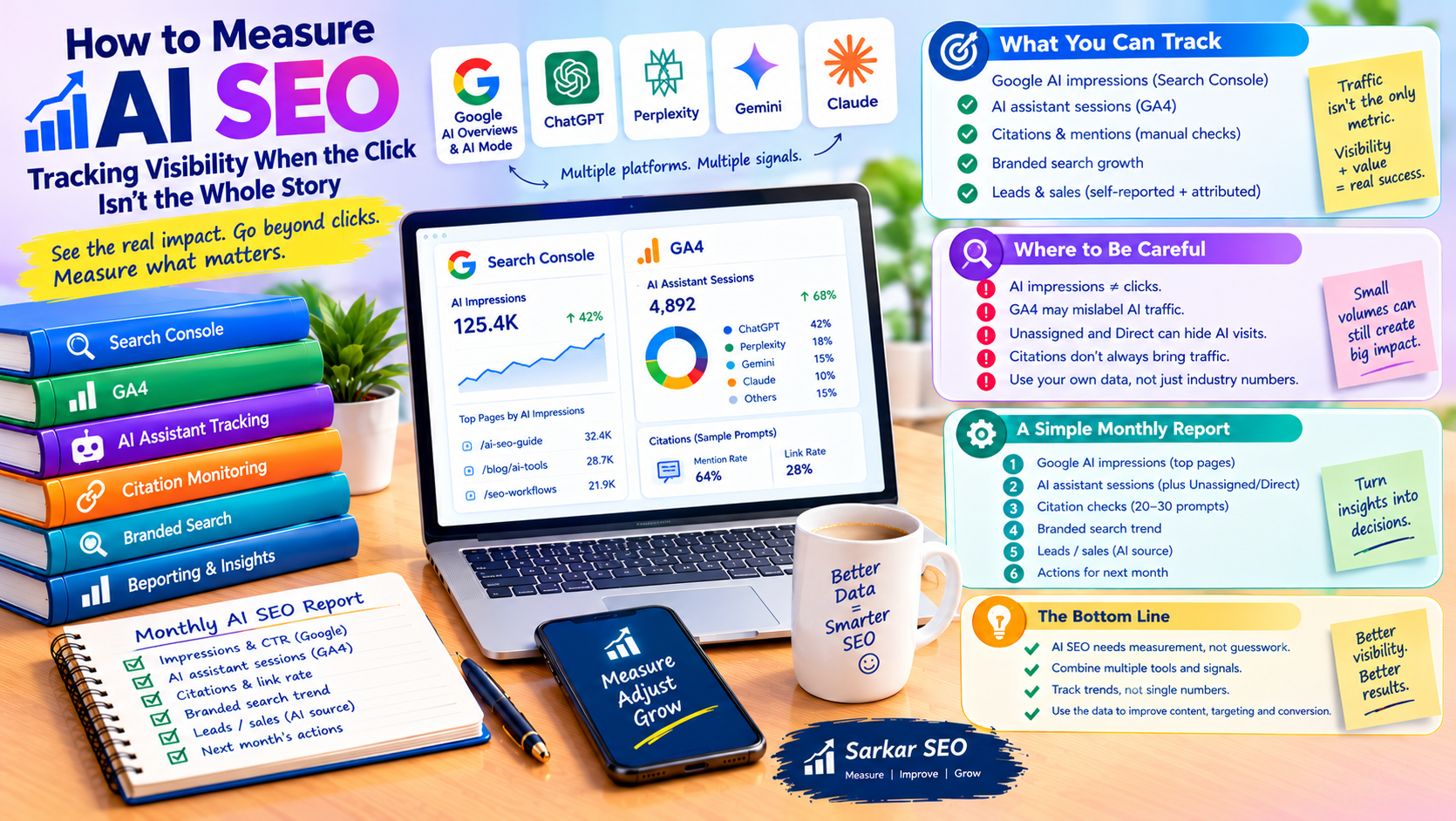
You publish a strong page. An AI assistant quotes it to thousands of people. Your analytics show nothing. This gap is the biggest operational problem in AI SEO today. Good optimization is only half the job. The other half is proving it works.
No single dashboard solves this yet, but a practical measurement stack exists. This guide shows what each tool can and cannot tell you, and how to turn scattered signals into one honest report.
Why the Usual Numbers Mislead
Classic SEO reporting leans on rankings and clicks. AI answers weaken both. A brand can be named in an answer without any click, and a click from an AI feature may arrive labeled as ordinary search traffic.
AI visibility also lives in three separate places, each measured by a different tool or by none. One analysis describes them as Google’s own AI features, third-party AI assistants, and untracked referrals. Treating them as one number is the first mistake to avoid.
Surface 1: Google’s AI Features
Google’s AI answers are the easiest to underestimate. Clicks from them carry the standard google / organic tag and blend into regular Search totals, so GA4 alone cannot separate an AI Overview click from a blue-link click.
Search Console has started to close the gap. In June 2026, Google announced generative AI performance reports that, according to one summary, report impressions for AI Overviews, AI Mode, and AI features in Discover, broken down by page, country, device, and date. The important limit is that these reports cover impressions only. Rollout may also vary by account, and at least one source noted they were not widely available yet, so check your own property. supermetricssusodigital
Use the data for direction, not precision. Pages gaining AI impressions without gaining clicks are candidates for stronger titles and clearer next steps for the reader.
Surface 2: AI Assistants
For ChatGPT, Gemini, Claude and similar tools, GA4 offers a more direct option. In May 2026 it added an AI Assistant default channel. Analytics describes it as covering visitors who arrive from sources like ChatGPT, Gemini, Copilot or Grok, and it excludes Google’s AI Overviews and AI Mode.
Expect imperfect attribution. One guide notes that OpenAI adds utm_source=chatgpt.com to some citation links, but without a matching medium these sessions can land in Unassigned instead of AI Assistant. Another points to the “dark traffic” problem, where AI visits show up as Direct.
Treat your GA4 figure as a floor, not a total. A sensible habit is to check the Unassigned and Direct buckets monthly for landing pages that suddenly gain visits.
Surface 3: Citations Without Clicks
Many AI mentions never produce a visit. This is the hardest area, and it needs a different method: testing prompts.
The approach is simple. List the questions your customers ask, run them across the main AI tools on a fixed schedule, and record three things: whether you were mentioned, whether you were linked, and who else appeared. Group related questions into topics so you can see patterns, as one guide advises, measuring visibility at the topic level instead of reacting to individual answers.
Keep expectations realistic. Answers change between sessions and users, so a single check proves little. Repeat the same prompt set each month and compare trends.
Don’t Forget Bing
Microsoft is more open about AI reporting than most platforms. In February 2026 it announced AI Performance reporting in Bing Webmaster Tools. If your audience uses Copilot, this is a free data source worth connecting.
Proxy Signals Worth Watching
When direct data is missing, look for indirect effects. People who see your brand named in an answer often search for it afterward, so branded query growth in Search Console frequently rises alongside citation growth even when direct referrals stay flat.
Useful proxies include:
- Growth in branded searches
- More direct visits to pages that AI tools tend to cite
- Sales or enquiry forms where people write “found you through ChatGPT”
- Rising impressions on question-style queries
Add a “How did you hear about us?” field to your lead form. It is cheap, and it captures influence that analytics cannot see.
Keep the Numbers in Proportion
AI referrals are still small for most sites. One analysis, using data from February 2026, reported that Google sent roughly 190 times more traffic to websites than ChatGPT, which then accounted for 0.21 percent of traffic. That is a single source and a snapshot, so check your own data before drawing conclusions.
The point is not that AI visibility is unimportant. It is that overreacting to small volumes can lead to bad decisions, such as abandoning proven organic work. Track both, and keep them separate in your reports.
A Simple Monthly Report
One summary of the current state sums it up well: no single tool reports AI search visibility end to end in 2026, so combine impression data from Search Console and Bing Webmaster Tools, citation data from a tracker, and referral data from GA4 into one report on a fixed monthly refresh. supermetrics
A one-page version might include:
- Google AI impressions from Search Console, with the top pages
- AI assistant sessions from GA4, plus a note on Unassigned and Direct
- Citation checks on 20 to 30 priority prompts, showing mention and link rates
- Branded search trend
- Leads or sales attributed to AI sources, including self-reported ones
- Actions for next month, each tied to a number above
At Sarkar SEO, we build reports around decisions, not dashboards. If a metric can’t change what you do next, it doesn’t belong on the page.
What to Do With the Findings
Measurement matters only if it changes the work. A few common patterns and responses:
- High AI impressions, low clicks: Improve the page’s promise and give readers a reason to continue, such as a tool, template or deeper analysis.
- Competitors cited, you aren’t: Compare their pages with yours. Look for original data, clearer definitions or stronger sourcing.
- Cited, but with outdated facts: Update the page and make the correct figures easy to find.
- Traffic arrives but doesn’t convert: Check that the landing page matches what the AI answer promised.
