



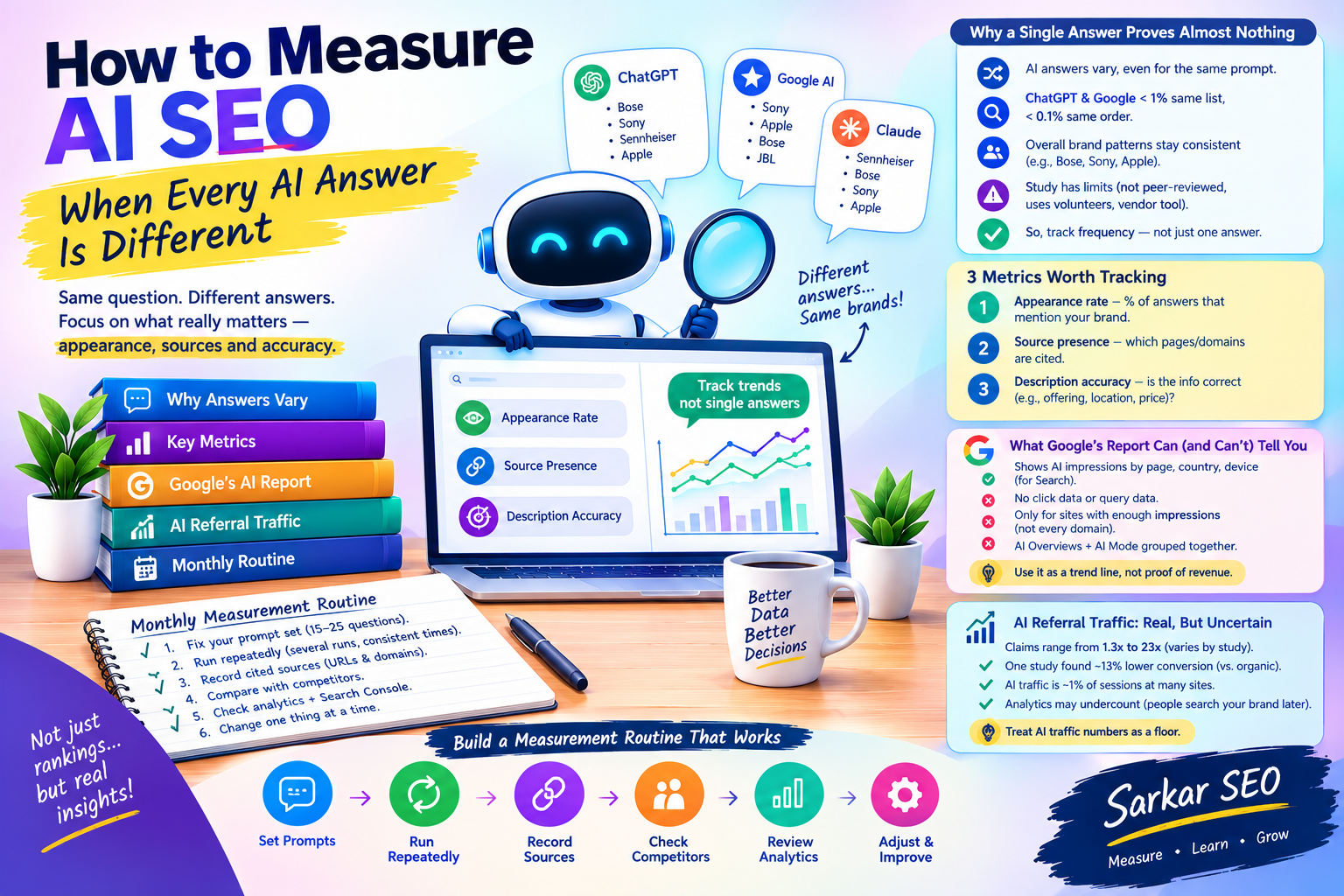
Ask an AI assistant for a product recommendation twice and you may get two different lists. That single fact breaks most of the reporting habits AI SEO teams built around rankings. If you cannot trust a one-off check, what can you trust? Sarkar SEO treats measurement as step one. This guide explains why AI answers vary, which metrics hold up, and how to build a measurement routine that survives the noise.
Why a Single AI Answer Proves Almost Nothing
SparkToro and Gumshoe.ai tested this in a study published in January 2026. They ran 12 brand-recommendation prompts, across categories such as headphones, chef’s knives and digital marketing consultants, 60 to 100 times each on ChatGPT, Claude and Google’s AI features. In total, 2,961 prompts were run with hundreds of volunteers.
ChatGPT and Google’s AI features returned the same list of brands less than 1% of the time. The same list in the same order appeared less than 0.1% of the time. Claude repeated lists slightly more often but was less consistent on order.
Yet the overall pattern held steady. In human-written headphone prompts, Bose, Sony, Sennheiser and Apple appeared in 55% to 77% of responses. The exact list changed constantly, but the group of brands under consideration did not.
Read this carefully. The study is not peer-reviewed, the volunteers used their own settings, and Gumshoe.ai sells AI tracking tools, which the authors disclosed. The researchers also left open how many runs are needed for reliable data. Still, the direction is clear: position in an AI answer is a weak metric, and frequency of appearance is a stronger one.
Three Metrics Worth Tracking
- Appearance rate. Run the same prompt many times and record the share of answers that mention your brand. This is the closest thing to a stable number, because it averages out the randomness.
- Source presence. Note which pages and domains the assistant cites, and whether yours is among them. A mention without a citation and a citation without a mention mean different things for your strategy.
- Accuracy of description. Check whether the answer states your offering, location or pricing correctly. A frequent mention that gets your service wrong is a problem, not a win.
Sarkar SEO recommends logging all three in a simple sheet, with the date, platform, exact prompt wording and a count of runs. Without those fields, month-to-month comparisons are guesswork.
What Google’s Own Reporting Can and Cannot Tell You
Google has been rolling out a generative AI performance report in Search Console. It shows how often your URLs appear in generative AI features in Search and Discover, broken down by page, country and, for Search, device.
The limits matter. According to coverage of the rollout, the report does not include click data or query data, and Google shows it only when a site has enough impressions in generative AI features. John Mueller confirmed it was “not yet every domain,” so you may not see it at all. Where it exists, it groups AI Overviews and AI Mode together, so you cannot separate them.
Use it as a trend line for pages, not as proof of revenue.
Reading AI Referral Traffic Without Overselling It
Analytics can show visits that arrive from AI assistants, and several reports claim these visitors convert well. The evidence is mixed, and the spread is wide.
A Pixis review of the available studies reported claims ranging from roughly 1.3 times organic conversion in low-consideration e-commerce to 23 times in B2B software. Its headline figure of four to five times rests mainly on one benchmark of 312 B2B technology firms. Meanwhile, an academic study of 973 e-commerce sites, published in Marketing Science in 2025, found ChatGPT referrals converting about 13% worse than organic. Pixis sells an AI visibility product, and it described its own comparison as directional, not like-for-like.
Two practical conclusions follow. AI referrals are still about 1% of sessions at many sites, so volume may be too small to judge. And analytics will undercount AI influence, because many people read an answer, then search your brand name later. Treat your AI traffic numbers as a floor.
A Monthly Measurement Routine
- Fix your prompt set. Choose 15 to 25 questions your buyers genuinely ask, covering category, comparison and problem-based wording.
- Run each prompt repeatedly. Use several runs per platform, at consistent times, and record the counts. Avoid drawing conclusions from one answer.
- Record cited sources. Capture the exact URLs and domains named.
- Compare against competitors. Your appearance rate means little without the rates of two or three rivals on the same prompts.
- Cross-check with analytics and Search Console. Look for movement in AI referrals, branded searches and page-level AI impressions.
- Change one thing at a time. If you update five pages and a rate moves, you will not know why.
Mistakes That Distort the Picture
- Reporting “rank in ChatGPT.” The order changes too often for the number to be meaningful.
- Running a prompt once. One sample shows luck, not performance.
- Ignoring tool incentives. Vendors that sell tracking have a reason to emphasize volatility or rank. Ask how many runs sit behind any score.
How many runs per prompt are enough? No published standard exists. The SparkToro researchers called it an open question, so choose a consistent number and compare like with like.
Can I measure AI SEO with Search Console alone? Not fully. The AI report does not show clicks or queries, and not every site sees it.
