



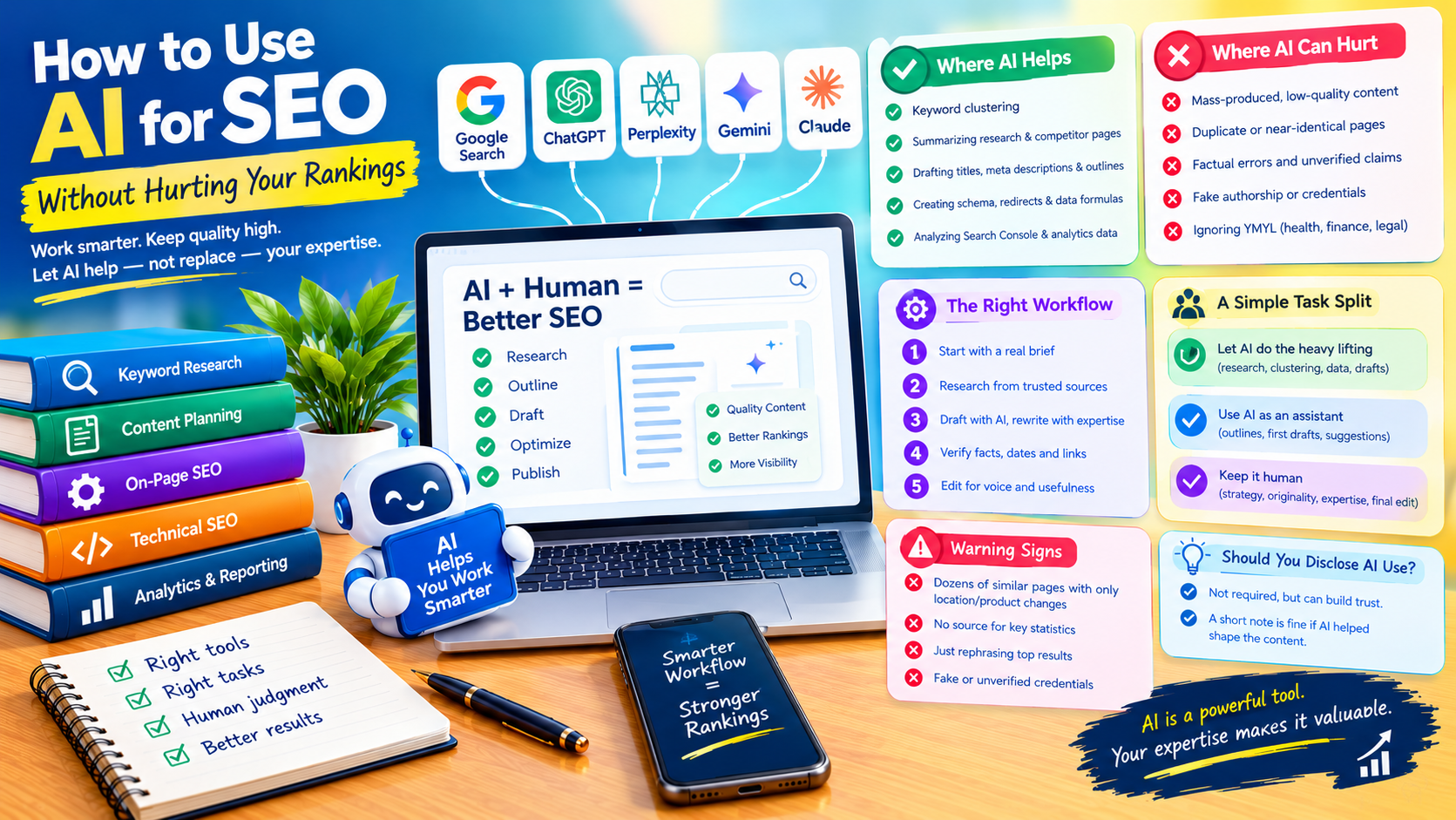
Most conversations about AI SEO focus on how to appear in AI answers. There is a second, equally practical question: how should you use AI tools to do SEO work faster without producing content that quietly drags your site down? The answer is not “never” and not “everywhere.” It is a matter of knowing which tasks suit a machine and which need a person. Sarkar SEO builds its workflows around exactly that division.
What Google Actually Says About AI-Generated Content
Google’s position is more nuanced than the internet’s rumors. According to its guidance on generative AI content, using AI is not against its guidelines in itself, and AI can help with researching a topic and structuring original content. The problem is using AI tools to mass-produce pages that add nothing for users, which can violate Google’s spam policy on scaled content abuse. Read Google’s guidance on generative AI content.
The same guidance makes a second point that is easy to overlook: language models predict likely sequences of words rather than retrieve verified facts, so they can produce errors. Google advises reviewing and fact-checking AI-generated content before publishing, including titles, meta descriptions, structured data and image alt text.
The line, in short, is not “AI versus human.” It is “useful versus mass-produced and unchecked.”
What the Ranking Data Suggests
Evidence on performance is mixed, and it helps to read it carefully. In a 2026 Semrush study of about 42,000 blog pages from the top ten Google results for 20,000 keywords, human-written pages held the number one position roughly 80% of the time, compared with around 9% to 10% for pages classified as purely AI-generated. The gap narrowed lower down the page.
Three caveats matter. The pages were classified with an AI detector, which can misjudge text. The data shows correlation, not proof that AI use causes lower rankings; human-written pages may also have stronger links and brand authority. And Semrush sells SEO tools, so weigh the source accordingly.
The survey half of the same study is revealing. Of 224 SEO professionals, 72% believed AI content performs as well as human content, yet 87% said their content was fully human-created or human-led. Seventy percent named speed as AI’s top benefit, while only 19% said it improves quality. Professionals, in other words, use AI for efficiency and rely on people for quality.
A Task-by-Task Framework
This framework is Sarkar SEO’s own working view, drawn from the sources above rather than a controlled test. It sorts tasks into three groups.
Let AI do the heavy lifting
- Clustering large keyword lists by theme or intent.
- Summarizing long documents, transcripts and competitor pages for your own research.
- Generating first-pass title and meta description options to choose from.
- Drafting schema, redirect maps or spreadsheet formulas that a specialist then validates.
- Spotting patterns in exports from Search Console or analytics.
Use AI as an assistant, with human control
- Outlining articles and suggesting questions readers might ask.
- Producing rough first drafts that a subject expert rewrites with real examples.
- Proposing internal link opportunities, which an editor approves.
- Translating or adapting content for other markets, reviewed by a native speaker.
Keep primarily human
- Choosing your angle, positioning and what you will not say.
- First-hand experience, case studies, interviews and original data.
- Fact-checking statistics, quotes and claims.
- Anything in medical, legal or financial territory.
- Final editorial judgment on every published page.
The reasoning is simple. The first group is mechanical, so mistakes are easy to catch. The third group is where trust and originality come from, which are the qualities competitors and AI tools cannot copy from the open web.
A Five-Step Human-Led Workflow
- Start with a real brief. Define the reader, their question, the evidence you will use and what you can add that others cannot. A vague prompt produces a vague page.
- Research from sources, not from the model. Gather primary sources, product documentation and your own data first. Use AI to summarize them, then confirm key points against the originals.
- Draft with AI if it helps, but rewrite with expertise. Replace generic statements with specifics: a number, a screenshot, a mistake you saw, a decision you would make. If a paragraph could appear on any competitor’s site, it needs work.
- Run a verification pass. Check every statistic, date, name and link. Remove claims you cannot support. This single step prevents most of the damage associated with careless AI content.
- Edit for voice and usefulness. Cut filler, repeated explanations and inflated adjectives. Ask whether a reader who never buys from you would still find the page worthwhile.
Warning Signs Your AI Use Has Gone Too Far
- You are publishing dozens of near-identical pages with only the city or product name changed.
- No one on your team can explain where a statistic came from.
- Pages restate the top search results in different words and add nothing new.
- Authors are listed with credentials they do not have.
Any of these is a reason to pause, audit and consolidate, rather than to publish more.
Should You Disclose AI Use?
Google suggests that giving readers context about how content was created, such as explaining how automation was used, can be helpful. Disclosure is not a ranking requirement, but a short, honest note is reasonable where AI materially shaped the content.
