



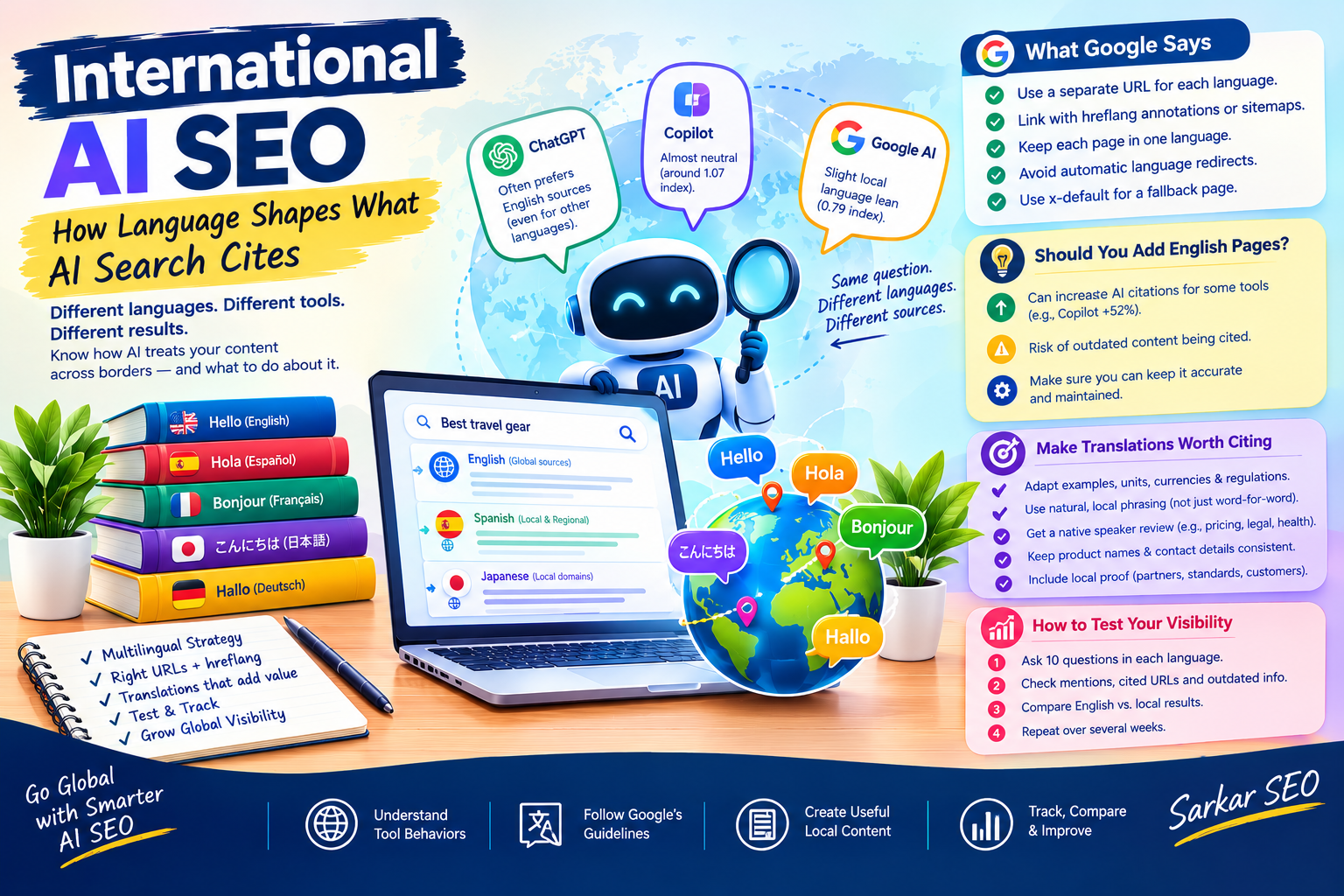
AI SEO across languages is not one problem. Different AI SEO tools treat language differently: some lean toward English sources even when the user asks in another language, while others follow the user’s language closely. Before you translate your whole site, or add an English version of it, you need to know which behavior affects your audience. That is the starting question Sarkar SEO recommends for any international site.
AI Tools Do Not Treat Language the Same Way
Three recent analyses point in the same general direction, though all have limits.
An OMcollective study, published on Search Engine Land, compared English’s share of AI citations with its share of search impressions on multilingual sites. It found a strong English tilt in ChatGPT (an index of about 2.6, where 1.0 is neutral), almost none in Copilot (1.07) and a slight local-language lean in Google AI (0.79). The sample was small, with 26 properties for the ChatGPT log analysis, and the author’s agency sells this kind of work.
Peec AI, an AI monitoring vendor, reported that about 43% of ChatGPT’s background searches for non-English prompts ran on the English web, drawn from over 10 million prompts. The collection window was not stated and the method is not reproducible from the post.
A Weglot study, from a translation software company, ran 400 questions in English and in local languages across five markets. Local-language questions shifted citations sharply toward local sources. For Japanese queries, about 26% of citations went to .jp domains versus about 1% in English. It reported single snapshots with no statistical tests.
All three sources have a commercial interest. Read them as consistent signals, not precise measurements: language changes which sources AI tools reach for, and the effect varies by tool.
What Google Expects From Multilingual Sites
Google’s documentation is steady and practical:
- Use a separate URL for each language version, not cookies or browser settings.
- Link versions with hreflang annotations or sitemaps. Every version must list itself and all others, and if two pages do not point to each other, the tags are ignored.
- Keep each page in one language, including navigation. Translating only menus while the main content stays in another language creates a poor experience.
- Avoid automatic redirects based on guessed language, and give users links to switch.
- Use x-default for a language-selector or fallback page.
Two details surprise people. Google does not use hreflang or the HTML lang attribute to detect a page’s language; it reads the visible content. And localized pages are treated as duplicates only if the main content remains untranslated, so a genuine translation is not a duplicate-content problem.
Should You Add English Pages?
OMcollective’s data suggests an English folder can raise AI citations for some tools. Copilot citations were about 52% higher on sites with one, and a Google panel showed a 28% aggregate lift that fell to a 9% median once outliers were removed. Those are agency figures from small panels.
The same study carries a warning. An outdated English page can be quoted as the current answer, as in its example of a bank whose old English rates document was cited. At Sarkar SEO, we frame the decision as a maintenance question first: can you keep the English version as accurate as the original?
Make Translations Worth Citing
A literal translation is rarely enough. Make each language version independently useful:
- Rewrite examples, units, currencies and regulations for the market.
- Check how local customers phrase questions, since direct translations of search terms often miss natural wording.
- Have a native speaker review the pages that carry business risk, such as pricing, legal and health content.
- Keep product names, prices and contact details consistent across versions.
- Mention local proof, such as local partners, standards and customer examples, where you truthfully have them.
The Weglot data also suggests local-language answers lean toward local domains and local-language pages, so a local presence matters beyond translation.
How to Test Your Visibility by Language
Write ten customer questions in each target language, then run them in the main AI tools. Record whether each answer mentions your brand, cites which version of your site, and states anything outdated. Compare the English and local-language results for the same question. Because AI answers change between runs, repeat the check over several weeks before drawing conclusions.
Common Mistakes
- Machine-translating every page and publishing without review.
- Redirecting visitors automatically by country or language.
- Leaving old language versions unmaintained after the main site changes.
- Assuming results from one AI tool apply to all of them.
- Judging success only by English-language prompts.
Do I need hreflang for AI search? Google’s documentation presents hreflang as a way to help it serve the right version in Search. We found no source showing other AI tools use it, so treat it as search hygiene.
Should every page be translated? No. Start with pages that drive leads or customer questions, and expand as you can maintain quality.
