



If your business sells beyond one country, AI search raises a question that classic AI SEO handled with a familiar toolkit: which version of your content does the answer use? Someone asks in Spanish, German or Japanese, and the tool may cite a page in a different language entirely. This article explains what recent research shows and gives you a practical way to decide how much to invest in each market.
What the Research Shows
The strongest data point comes from Weglot, which studies Spanish-language sites in Spain and Mexico. As reported by Search Engine Journal, 98 untranslated sites from Spain earned 17,094 AI Overview citations for Spanish queries but only 2,810 for the equivalent English searches. The same report concludes that translated sites closed this gap and saw up to 327% more visibility than untranslated ones. Weglot sells translation tools, and the study covered a narrow sample, so read the headline figure as a direction, not a forecast for your site.
Language is also unevenly represented in AI answers. Ahrefs found that English accounts for more than 50% of all AI Overviews worldwide. That leaves a real opening for businesses willing to serve other languages well.
Different Engines Handle Language Differently
This is where international AI SEO gets tricky. Glenn Gabe tested multilingual queries across Google, Bing, AI Overviews, AI Mode, ChatGPT, Perplexity, Claude, Copilot and Gemini. A summary of his results says Google and Bing generally show the correct language version when hreflang is in place, and AI Overviews and AI Mode often get it right, but not always. In the same summary, ChatGPT, Perplexity and Claude frequently replied in a different language but still linked to English sources. These were small hands-on tests, not large-scale studies. stanventuresstanventures
Search Engine Land’s analysis adds nuance: English over-indexing is clear in ChatGPT data but not in Copilot, AI Mode or AI Overviews. In plain terms, a non-English page may need to compete with English pages on some platforms and not on others.
Google’s own position is that these features are not separate from its language systems. It describes AI Overviews and AI Mode as Search features grounded in web information. Its AI Mode is also spreading fast: at Google I/O 2026, Google said Personal Intelligence in AI Mode was expanding to nearly 200 countries and territories across 98 languages. The gap between a change in Google’s interface and its effect on your international traffic may be getting shorter.
The Language Ladder
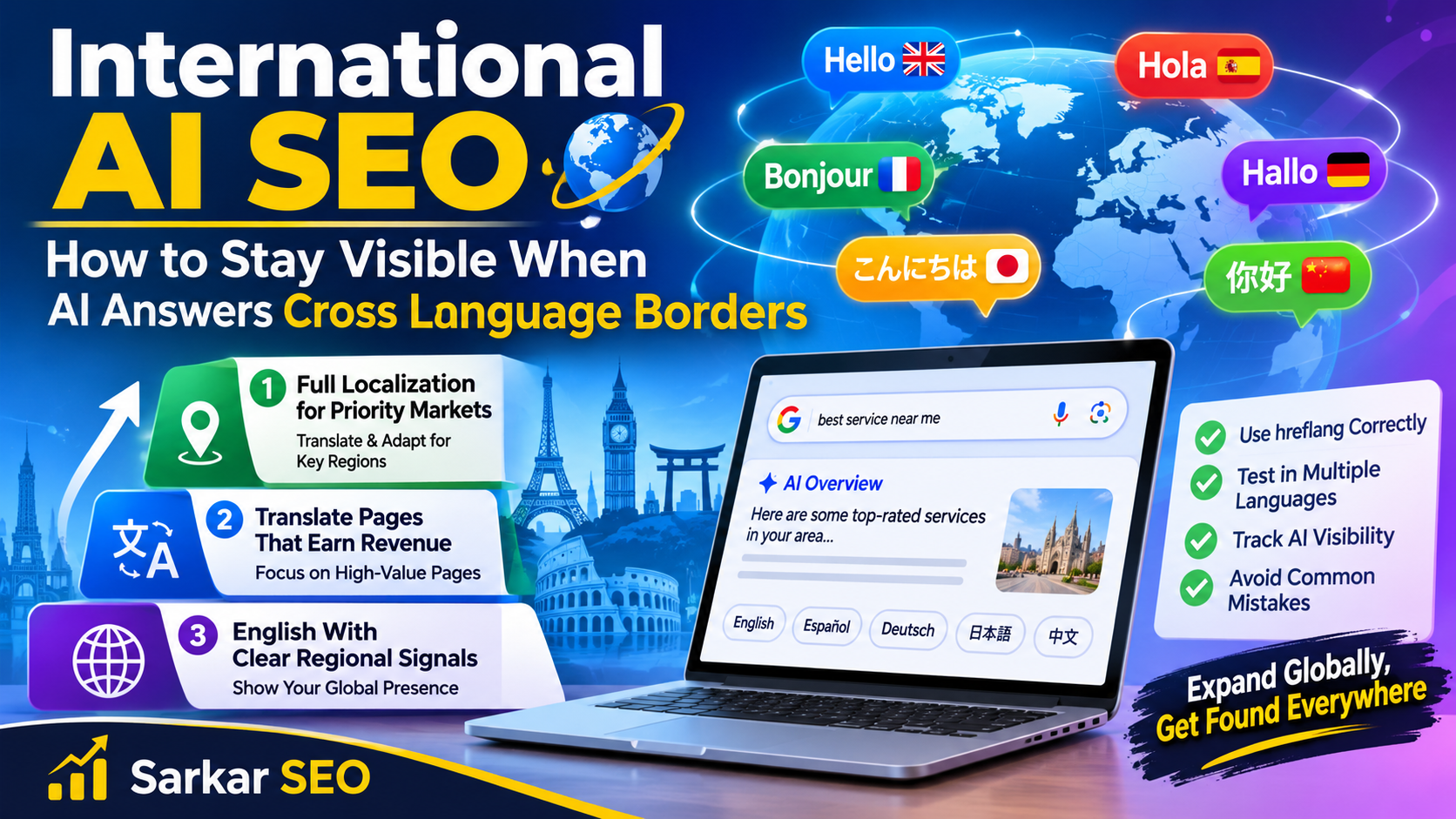
Rather than translating everything or nothing, sort your markets into three rungs. This is a working framework based on the evidence above, not an industry standard.
Rung 1: Full Localization for Priority Markets
Choose the markets that matter most for revenue. Here, translation is only the first step. Localization means adapting the content itself:
- Search language, not source language. Research how people in that market actually phrase the question. A literal translation of your English keyword is often not what locals type.
- Local specifics. Currency, units, laws, payment methods, delivery details and cultural examples.
- Native review. Have a fluent subject-matter expert check terminology, since a machine translation can read fluently and still use the wrong industry term.
- Local proof. Reviews, case studies and mentions from that market, not only from your home country.
One international SEO guide argues that in AI-driven search, hreflang is table stakes and content alignment is the differentiator. That is a vendor’s opinion, but it matches the logic that systems favor the clearest, most relevant answer. ranktracker
Rung 2: Translate the Pages That Earn Revenue
For secondary markets, don’t translate your whole blog. Start with the pages that drive conversions: product or service pages, pricing, shipping and returns, contact details and your most useful guides. A smaller set of accurate pages beats a large set of thin, machine-translated ones. Avoid mass-producing low-value translated pages. That risks the scaled content problems Google’s spam policies already address.
Rung 3: English With Clear Regional Signals
For small markets, a strong English page may be enough, provided it says where you operate. State the countries you serve, the currencies you accept and the support hours or languages available. This helps both people and AI tools understand relevance even when the page isn’t localized.
Technical Basics Still Apply
Because Google and Bing remain the backbone of many AI answers, keep your international fundamentals clean:
- Use hreflang correctly, with reciprocal annotations between language versions.
- Give each language its own crawlable URL, not content swapped by script or cookie.
- Make sure each version is indexable and has its own title, description and internal links.
- Keep business details consistent across languages: the company name, the address and the descriptions of your services.
Gabe’s tests suggest some AI tools may not follow hreflang the way classic search does. Don’t assume the tags alone will route every answer engine to the right version.
Test Before You Invest More
Build a simple matrix: five buyer questions per target language, each run in Google AI Mode, ChatGPT and Perplexity. Record which language appears in the answer, which pages are cited, and whether a competitor replaces you. Where you see English pages cited for local-language questions, you’ve found a gap worth filling. Re-run monthly, because results move. Sarkar SEO uses a matrix like this as the starting point for international audits, since it turns a vague worry into a ranked list of fixes.
Common Mistakes
- Translating everything through automation and never reviewing it.
- Forgetting that a good ranking in one country says nothing about another.
- Ignoring local review sites and directories that shape trust in each market.
- Reporting global traffic as one number, which hides where visibility is really changing.
