



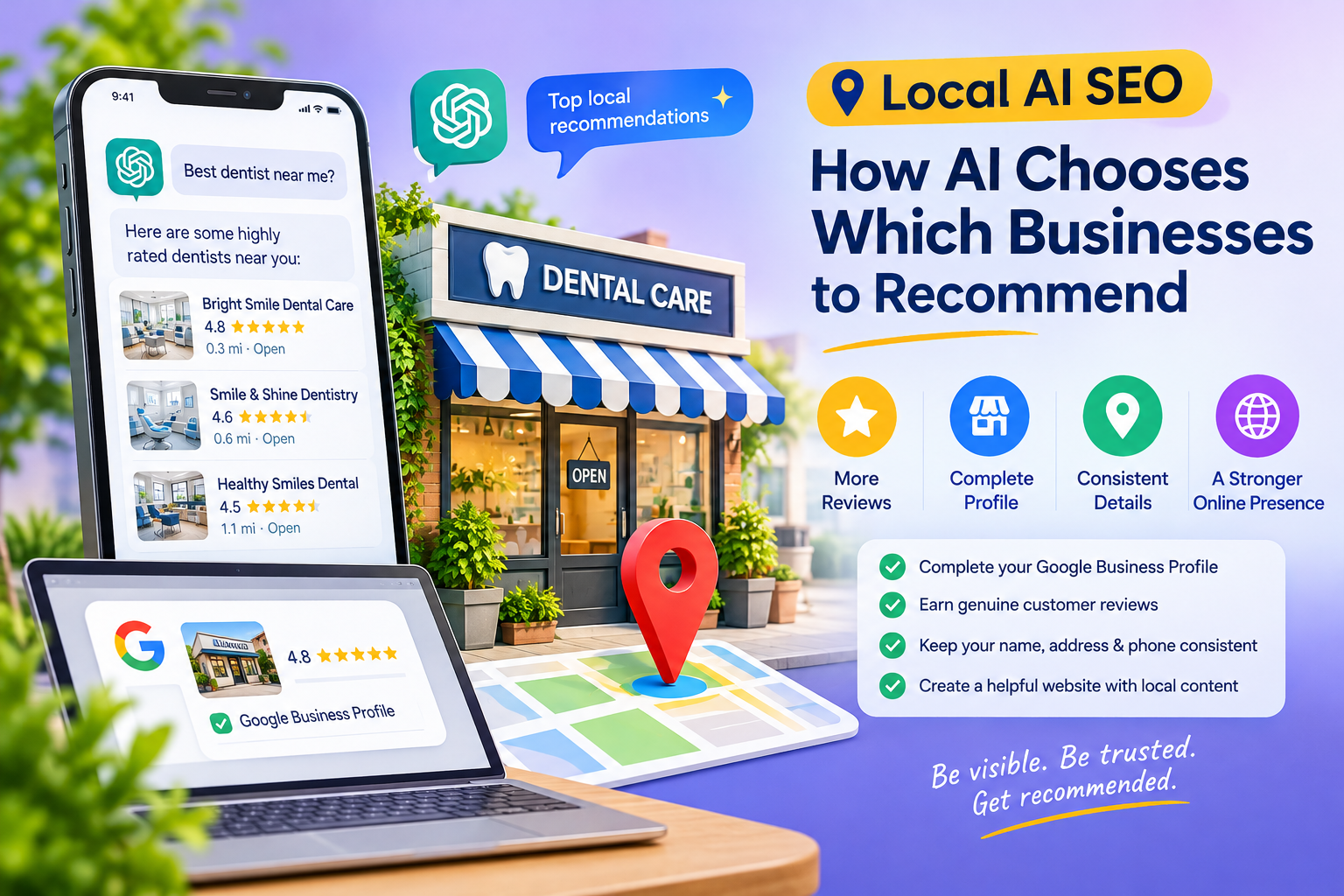
Ask a search engine for “dentist near me” and you used to get a list. Ask an AI assistant and you often get a short answer with one or two names. Being third on a list was fine. Being left out of a two-name answer is not. For local businesses, AI SEO is mostly about earning a place in that short list.
Local Search Is Not Ordinary Search
A useful starting point comes from Whitespark’s research, reported by Entrepreneur. It found AI Overviews on only 15% of traditional local-intent queries, while Local Packs appeared on 93%. When Google did show AI results for local needs, they relied heavily on Google Maps, reviews, ratings and Business Profile data, according to the same report.
In practical terms, local AI visibility sits on top of the local SEO foundation you may already have. It does not replace it. And Google’s own documentation says no extra requirements or special optimizations exist for appearing in AI Overviews or AI Mode.
What the Largest Local Study Found
Insites, a vendor of AI visibility audit tools, analyzed 10,000 US businesses across ChatGPT and Perplexity and published results in May 2026. Because the company sells related services and the study is correlational, treat it as indicative, not conclusive. Its main findings:
- Reviews showed the strongest link. Businesses found by both engines averaged 133 Google reviews, against 11 for businesses AI didn’t surface.
- Local Pack presence mattered. Businesses in the pack were recommended about 3.5 times more often.
- Awareness is not recommendation. Insites reported that 93% of businesses were known to at least one platform, yet 41% were never recommended by ChatGPT even when it knew they existed.
- The website remained central. The business’s own site was the most frequently cited source, appearing in 72% of AI answers.
- Technical perfection did not separate winners. Pass rates on the technical checks Insites ran were close between surfaced and invisible businesses.
That last point should be read carefully. It does not mean technical SEO is useless, since a site that can’t be crawled won’t be read. It suggests that polishing minor technical details is a poor use of time compared with reviews and profile quality.
Where Each Engine Looks
Sources differ by platform, and this changes how you spread your effort.
Google’s AI features draw on Google Search, Maps and Business Profile data. Keeping the profile complete and accurate is the foundation.
ChatGPT relies mostly on Bing’s index, according to eClincher’s review of sources. The same article reports that ChatGPT began using licensed Yelp reviews, ratings and photos in July 2026. I could not confirm that arrangement from a primary source, so verify it before relying on it. Google reviews may still reach ChatGPT indirectly through websites and articles that mention them.
Perplexity and others assemble answers from multiple sources. Search Engine Journal’s local guide says models lean on Google, Yelp, Reddit, Facebook and a business’s own site, then look for agreement across them. Consistent information across those places is what builds confidence.
If you operate outside the US, note that these studies are American. Review platforms and map products differ by country, so check which sources AI cites for your market rather than copying US priorities.
A Local Readiness Checklist
At Sarkar SEO, we group local AI preparation into four areas, from most to least influential in the research.
- Business Profile completeness. Fill every field: correct primary category, services, hours, attributes, description, photos and booking or contact links. Keep seasonal and holiday hours current. Use your real business name, with no added keywords.
- Review quantity, recency and quality. Ask every satisfied customer, at the moment of completion, with a direct link. Encourage specifics, such as the service performed and the outcome. Reply to all reviews, including negative ones, politely and factually. Google has tightened its review policies against bulk solicitation, incentivized reviews and coordinated campaigns, so never buy, trade or script reviews.
- Consistent name, address and phone details. Search your business name and number and compare what appears across directories, social pages and maps. Remove duplicates, correct old addresses and align descriptions. Contradictions lower the chance an engine can confidently describe you.
- A website that answers local questions plainly. Create dedicated pages for each core service and each location you genuinely serve, listing prices or ranges where possible, process steps, service areas, credentials and frequently asked questions in real prose. Avoid cloned city pages with only the place name swapped, which is the thin-content pattern Google’s spam policy targets.
Content That Helps Local Businesses Get Named
Local businesses have an advantage generic publishers lack: firsthand knowledge. Use it.
- Answer questions customers actually ask, such as what a repair costs, how long a job takes or what to prepare before a visit.
- Document real work. Photos, short case notes and before-and-after descriptions show an engine, and a reader, that the work exists.
- Show people. Staff pages with qualifications and licenses support trust, particularly for health, legal and trade services.
- Describe your niche precisely. “Emergency boiler repair for older homes” gives a system something specific to match, where “plumbing services” does not.
Mistakes to Avoid
- Chasing AI tricks before the basics. An incomplete profile with 12 reviews will not be rescued by special markup.
- Inflating service areas. Claiming towns you don’t serve invites enforcement and confuses engines.
- Letting information drift. Wrong hours or an old phone number is the most common local AI error, and customers notice it first.
- Treating one test as the truth. AI answers vary by phrasing, location and run, so test several questions over time.
