



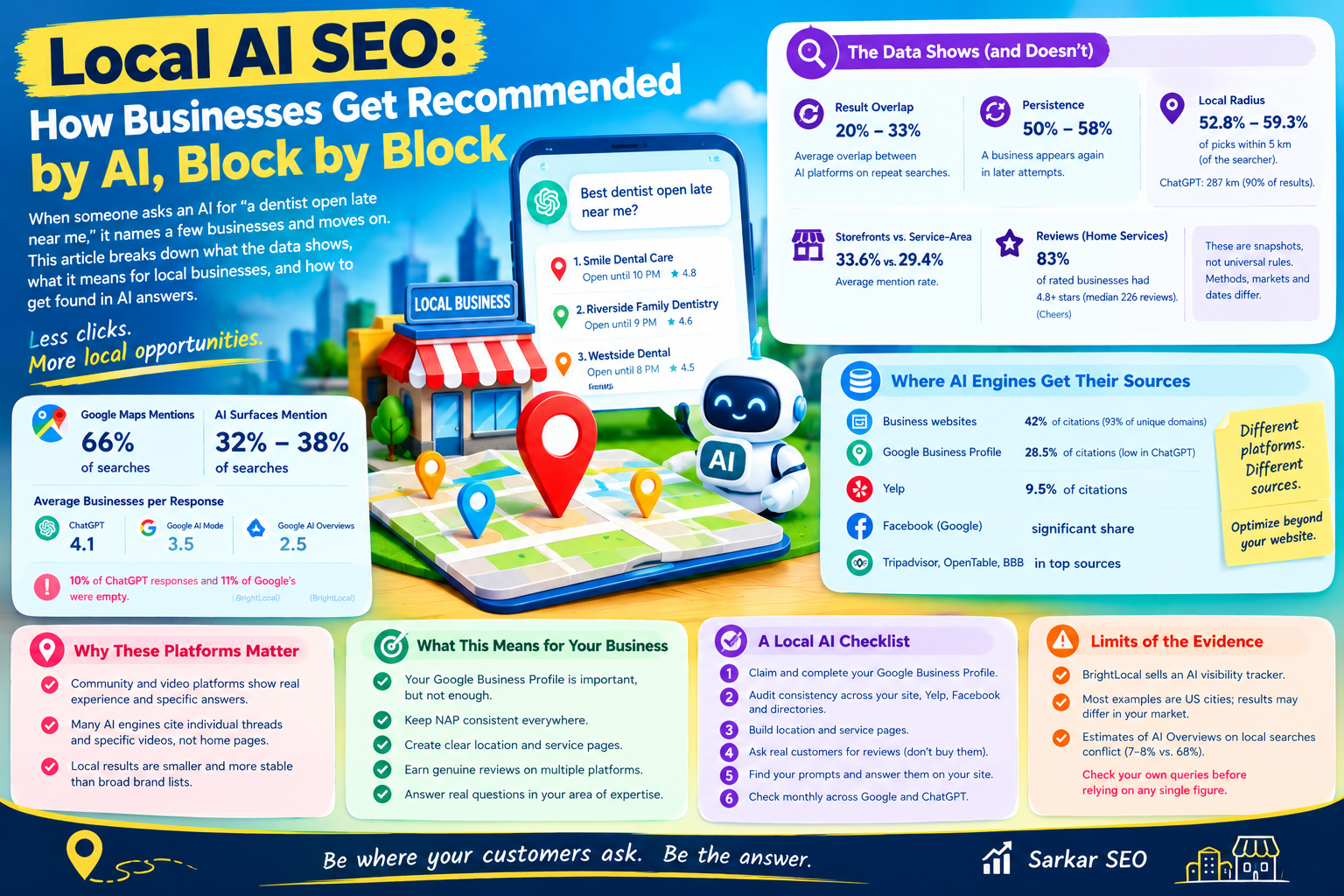
When someone asks an AI for “a dentist open late near me,” it names two to four businesses and moves on. There is no page of ten results to fall back on. For local businesses worldwide, that makes AI SEO a different game: the shortlist is small, it changes between runs, and the sources behind it are not the ones you might expect. Sarkar SEO reviewed the best recent local data, much of it from a September 2026 BrightLocal study, to show what is actually known and what is still guesswork.
Ranking on Maps does not guarantee an AI mention
BrightLocal reviewed roughly 200,000 localized searches across ChatGPT, Google AI Mode and AI Overviews, covering about 1,300 business locations. One finding stands out: Google Maps mentioned a tracked business in 66% of searches, versus 32% to 38% on the AI surfaces. A strong Maps position is useful, but it is not a ticket into AI answers.
The lists are also short. ChatGPT averaged 4.1 businesses per response, AI Mode 3.5 and AI Overviews 2.5. And 10% of ChatGPT responses and 11% of Google’s were empty. With so few slots, small differences in trust signals matter more. brightlocalbrightlocal
Expect rotation, and measure persistence
Run the same local prompt repeatedly and the names change. BrightLocal found only 20% to 33% average overlap between result sets on repeat searches. Yet the picture is not random. A business that appears once is seen again in about half of later attempts, 50% for ChatGPT and AI Mode and 58% for AI Overviews.
The study also notes that local pools are far smaller than general product categories, which likely explains why local results look steadier than broad brand-recommendation lists. That explanation is the authors’ reasoning, not a proven cause.
The practical lesson is to track how often you appear, not whether you appeared once. Showing up in half of runs is a different position from showing up in one in ten.
Each platform pulls from different places
The platforms disagree with each other. AI Mode and AI Overviews share only 29.3% of named businesses on average, and ChatGPT overlaps roughly 19% to 20% with either Google surface.
The sources explain part of the gap. Across 1.9 million citations, Google Business Profile made up 28.5% of all citations, but ChatGPT hardly used it. All three platforms relied on Yelp, and Google relied on Facebook significantly too. The study’s top-ten source table shows Yelp at about 9.5% of citations, with Facebook, Tripadvisor, OpenTable and the Better Business Bureau following.
That means one profile is not enough. A business optimized only for Google’s listing may be thin in the places ChatGPT looks.
Your own website still counts
Some owners assume AI has made websites irrelevant. The data says otherwise. Business sites made up 93% of all unique source domains and 42% of all citations. Third-party listings matter, but your site is where AI can confirm who you are, where you work and what you do.
BrightLocal’s advice is plain: keep your name, address and phone number consistent everywhere, give each location a clear page, and answer common customer questions directly. That is the study’s recommendation, and it matches ordinary local SEO practice.
Distance and address type still matter
“Near me” survives in AI answers. Between 52.8% and 59.3% of picks fell within 5 km of the searcher. ChatGPT is the exception: the radius covering 90% of its results stretched to 287 km, versus 38 to 64 km for the Google surfaces. A fixed address helps too. Storefronts had a 33.6% average mention rate against 29.4% for service-area businesses. The gap is modest, so service-area businesses are not shut out. Study: AI local search data – BrightLocal +2
Reviews: a pattern, not a proven lever
A separate Cheers study of 9,435 Google AI Mode answers about US and Canadian home services found 83% of rated businesses named had 4.8 stars or more, and the median showed 226 Google reviews. That is a vendor’s snapshot of one sector and region, and it shows correlation, not cause. Treat it as a reason to earn genuine reviews steadily, not to chase a number.
A local AI checklist
These steps are my own synthesis of the research:
- Claim and complete your Google Business Profile, with accurate categories and hours.
- Audit consistency: compare your name, address and phone across your site, Yelp, Facebook and the directories your industry uses.
- Build clear location and service pages that state your area, expertise and contact details.
- Ask real customers for reviews on more than one platform, and reply to them professionally.
- Find your prompts. BrightLocal suggests a Search Console regex filter, ^(?:\S+\s+){9,}\S+$, to surface queries of ten words or more, which often read like conversational prompts. Then answer those questions on your site.
- Check monthly across Google and ChatGPT from a few nearby locations, and log your presence rate.
If you would rather not run this alone, Sarkar SEO can set up the audit and the monthly check.
Limits of the evidence
Be cautious about three things. First, BrightLocal sells an AI visibility tracker, so the study comes from a vendor with an interest in the topic. Second, the study’s examples are largely US cities, and I could not confirm which countries its locations cover, so results may differ in your market. Third, estimates of how often AI Overviews appear on local searches conflict. Two secondary sources put it near 7% to 8%, while one vendor guide claims 68%. I would not rely on either figure until you check your own queries.
