



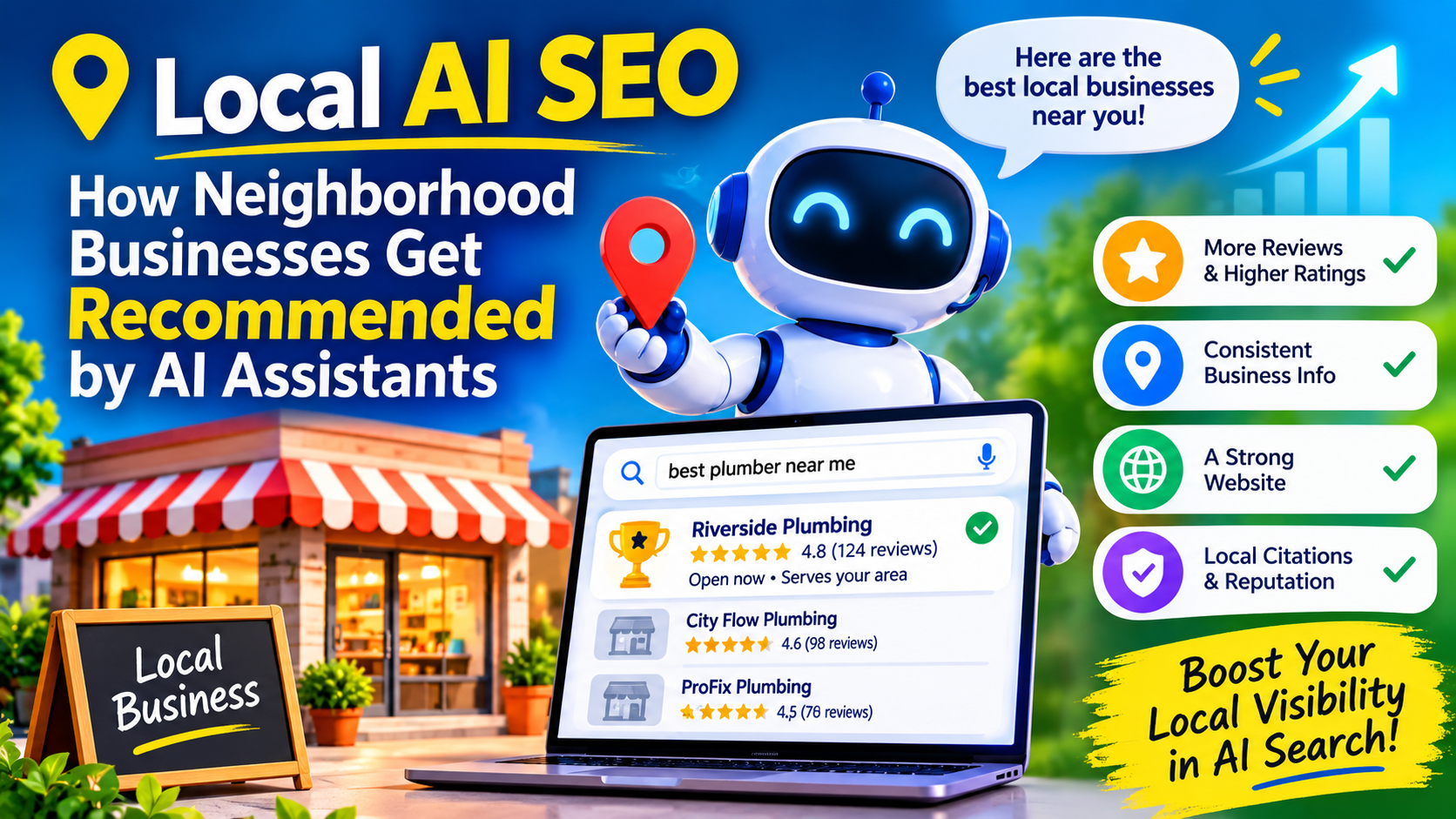
A customer used to search “dentist near me” and scan a map. Now they may ask an assistant for a family dentist who handles anxious patients and is open on Saturdays. The reply can name two or three businesses, and everyone else is invisible.
Local AI SEO is the work of earning those names. The evidence is early and mostly vendor-led, but it points in a consistent direction.
What the Data Suggests, and How Far to Trust It
The largest study I found is Insites’ 2026 AI Visibility Report, which compared signals across 10,000 local businesses in ChatGPT and Perplexity. Its headline: businesses found by both tools averaged 133 Google reviews, while those invisible to AI averaged just 11. The same report found businesses in the Local Pack were recommended 3.5 times more often than those that weren’t. insitesinsites
Another dataset, SOCi’s 2026 Local Visibility Index, paints a sobering picture. It found ChatGPT recommends just 1.2% of local businesses, and strong performance in Google’s local results doesn’t automatically translate into AI visibility.
Read these carefully. Both come from software vendors with a commercial interest. Insites measured correlation, not cause, since busy, popular businesses naturally collect more reviews. The data skews toward English-speaking markets and two assistants. Consumer-survey figures on how many people use AI for local recommendations vary widely between sources, so I’m not quoting a single number.
What holds up is the pattern: reviews, profile quality and consistent information appear again and again.
Google Still Anchors Local Discovery
Don’t abandon classic local SEO. A Whitespark analysis summarized by Entrepreneur found that when someone needs a business, Google still shows the Local 3-Pack, and so do AI Overviews when they appear, built from Google Business Profile data. The same piece cautions that this doesn’t mean a profile directly causes an AI recommendation, as the relationship is still developing. EntrepreneurEntrepreneur
Different assistants draw on different sources. One vendor guide reports that ChatGPT search relies mostly on Bing’s index and, since July 2026, on licensed Yelp reviews, ratings and photos, while Gemini and Google Maps are built on Google’s own place and review data. I couldn’t confirm that in a primary announcement, so verify it before acting. It does suggest a sensible rule: keep Google, Bing and a few major directories accurate, not just one.
The Consistency Problem Nobody Talks About
A quiet finding deserves attention. According to a summary of the SOCi data, only 68% of business contact details surfaced by ChatGPT and Perplexity matched the details on the corresponding Google Business Profile. If your phone number, opening hours or service list differ across sources, an assistant may hedge, mix them up or skip you.
At Sarkar SEO, we begin local audits with a plain spreadsheet that compares your listings side by side. Try it yourself:
- Record your exact business name, address, phone, website, hours and categories as they appear on your website.
- Compare them against Google Business Profile, Bing Places, Apple Business Connect, Yelp and your top two industry directories.
- Check for old addresses, tracking numbers, duplicate listings and holiday hours that were never reset.
- Fix mismatches at the source and keep one master record.
It’s unglamorous, and it removes a real obstacle.
Reviews: Quantity, Recency and Substance
Review volume showed the strongest correlation in the Insites data, but chasing numbers alone is shortsighted. Assistants summarize what reviewers say, so detail matters more than stars. A review mentioning “fixed our burst pipe at 2 a.m. and explained the quote clearly” teaches an assistant what you’re good at.
Healthy habits include:
- Ask every satisfied customer, at the moment of good service, with a simple direct link.
- Invite specifics, such as “What did we help you with?”, without scripting the answer.
- Respond to everyone, including critics, with calm and factual replies.
- Never buy reviews, fake them or filter requests only to happy customers. Platforms prohibit these practices, and fake feedback can destroy trust and invite penalties.
Make Your Website Do Local Work
In the Insites data, a business’s own website was cited in 72% of AI answers, while directory listings appeared in 35% to 39%. Your site is still the source you control most.
Useful local pages answer the questions customers actually ask:
- Which areas do you serve, and which do you not?
- What does a typical job cost, and what changes the price?
- How long does the service take?
- What licenses, insurance or certifications do you hold?
- Who will turn up, and what are their credentials?
Write from real experience. A page about “emergency plumber in [city]” with swapped place names adds nothing. A page describing recurring problems in the older housing in a particular district, with photos of actual jobs, does.
Add a few practical elements: staff profiles, project galleries with captions, and clear contact options. Local business structured data is worth implementing for rich results, though Google says no special markup is required for its AI features.
Check Your Local AI Visibility
Build a list of 15 questions customers might ask, in the language and wording they’d really use. Include “best,” “near,” “open now,” and problem-based questions. Run them monthly in the main assistants and in Google, noting:
- Whether you appear, and in what position
- What the assistant says about you and whether it’s accurate
- Which sources it cites
- Which competitors keep appearing, and why
Answers vary between runs and locations, so look for trends. Use Google Business Profile insights, call tracking and a “how did you hear about us?” question to connect visibility to actual enquiries.
Do I need a website if I have a strong Business Profile? Yes. The evidence suggests assistants use sites heavily, and sites carry detail a profile can’t.
Do reviews on one platform help everywhere? Not necessarily. Different assistants favor different sources, so spread your reputation sensibly.
Is this relevant outside the US and UK? The logic is, but platform popularity differs by country. Check which review and map platforms dominate your market.
