



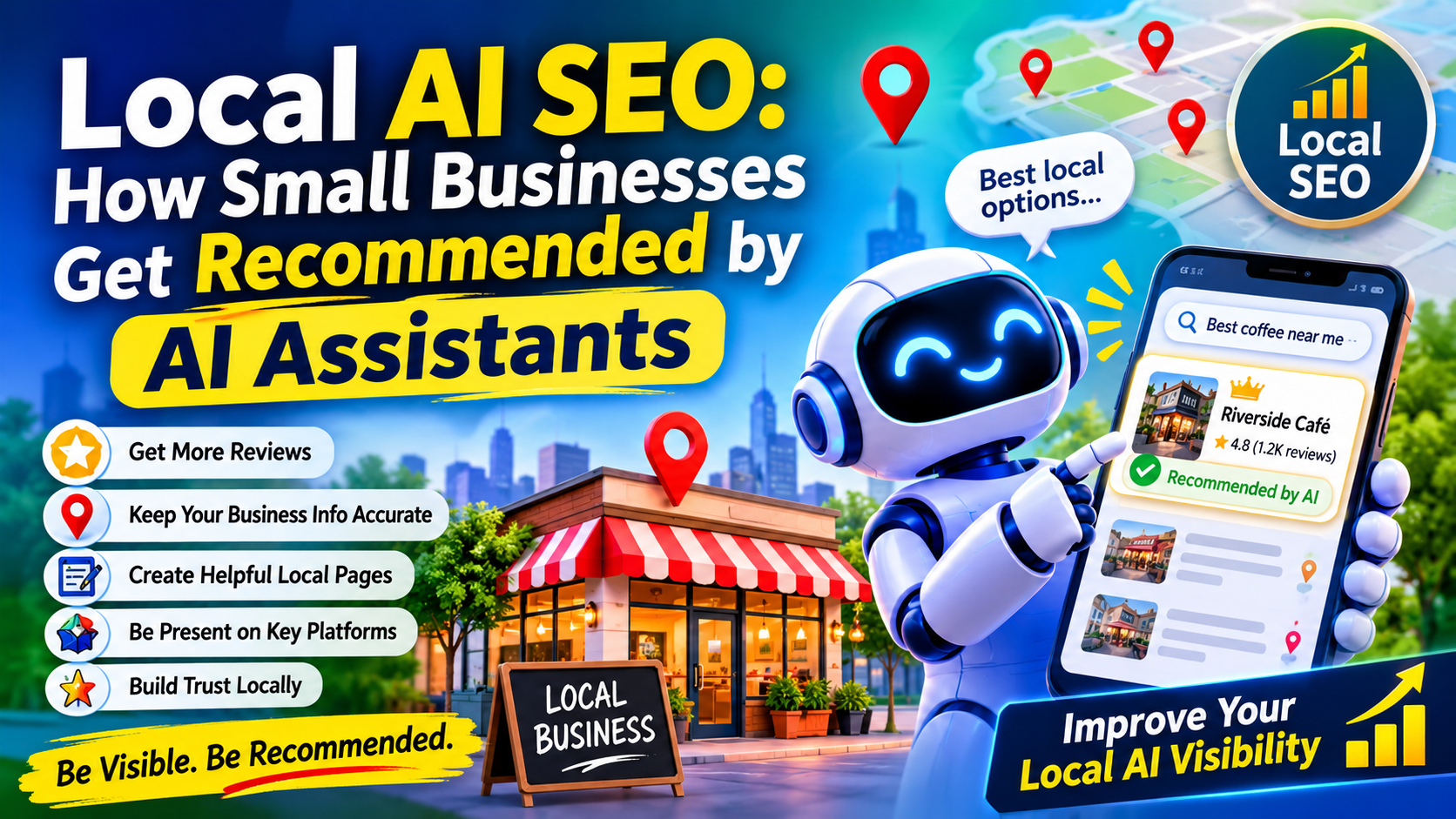
A growing number of people now ask an assistant where to eat, who to hire, or which clinic to trust. The answer is often one or two business names, not a page of listings. For local businesses, that changes the stakes. Being on the first page matters less than being named.
This guide explains how local AI SEO differs from classic local SEO, what the research shows so far, and a practical way to improve your odds.
Why local is a different game
Three findings, taken together, show how sharply the picture has shifted.
First, assistants are becoming a real source of local advice. BrightLocal’s 2026 consumer survey of 1,002 US adults found 45 percent had used an AI tool for local business recommendations in the past year, up from 6 percent in 2025. That is a US sample, so don’t assume the same figure applies elsewhere.
Second, they name very few businesses. SOCi’s 2026 Local Visibility Index analyzed over 350,000 business locations across 2,751 brands and found ChatGPT recommends just 1.2% of them. The same brands appeared in Google’s local 3-pack 35.9% of the time.
Third, doing well on Google doesn’t carry over. In the same research, fewer than half the retail brands performing well in traditional local search also appeared in AI recommendations. A separate analysis of 189,905 ChatGPT results by Local Falcon reported that 83% of restaurants were completely invisible in ChatGPT, compared with 14% in Google. localiqEntrepreneur
Both datasets come from companies in the local marketing industry, so use them for direction, not as precise benchmarks. The message is clear anyway: a strong local-pack position is not a guarantee of AI visibility.
What seems to matter
No assistant publishes its local ranking formula, so everything below comes from correlation studies and testing. Treat it as a well-supported hypothesis, not a rulebook.
Reviews. Insites studied 10,000 local businesses across ChatGPT and Perplexity. It found that Google review volume showed the strongest correlation with AI visibility, with visible businesses averaging 133 Google reviews against 11 for invisible ones. The same study listed review volume, Google Business Profile completeness and Local Pack presence as the strongest correlating signals. Correlation isn’t causation. Established businesses tend to have more reviews, a better profile and more mentions all at once.
Your Google Business Profile. For Google’s own AI surfaces this is the foundation. One local analysis describes Gemini and AI Overviews as relying on Google’s own index and your Google Business Profile, while Perplexity draws more on vertical directories, reviews and Reddit threads. Still, a cautionary note from an Entrepreneur report applies: that doesn’t mean a profile directly causes an AI recommendation; the relationship is still developing. ai visibility for local businesses +2
Different engines, different inputs. The same analysis cites Search Engine Land testing that found ChatGPT relies on Bing-indexed web results, not on your Google reviews directly. That is a secondary report, so verify it, but it hints at why a Google-only strategy leaves gaps. It’s worth confirming your site and listings are visible in Bing too.
Accurate facts. This one is easy to overlook. SOCi’s data found business profile accuracy on ChatGPT and Perplexity was only 68% for the brands studied, against 100% on Gemini, which is grounded in Google Maps. Wrong opening hours or an old address undermine trust, and may push an assistant to skip you.
A practical local AI SEO plan
Step 1: Clean up your facts
List your business name, address, phone number, opening hours and services exactly as they appear on your website. Then check every place they appear: your Google profile, Bing Places, Apple Maps, industry directories, social profiles and any chamber of commerce or association listings. Fix every mismatch. This is unglamorous, but inconsistent data is the cheapest problem to solve.
Step 2: Turn services into answerable pages
Assistants answer specific questions. A page titled “Services” doesn’t. Create a clear page for each core service and area, and open each with a direct statement of what you do, where, for whom, and what it costs or how pricing works. Add honest details: how long a job takes, what’s included, who it isn’t right for. Avoid copying one page across dozens of towns. Thin, near-identical location pages are the kind of pattern spam systems look for.
Step 3: Earn reviews the right way
Ask real customers at the natural moment, such as right after a job is completed. Make it easy by sharing a direct review link. Don’t offer rewards, don’t screen out unhappy customers and don’t buy reviews. Reporting on this area notes that Google has tightened its Business Profile review policies, cracking down on bulk solicitation, incentivised reviews and coordinated campaigns.
Two habits help more than raw volume. Reply to every review, including negative ones, in a calm and specific way. And encourage customers to describe what they hired you for in their own words, since that detail helps both people and machines understand what you do. Reviews also decide customers directly: BrightLocal found that 65% of consumers who rejected a local business did so for at least one review-related reason.
Step 4: Be present where your customers look
Find out which directories matter in your trade. For restaurants it may be review platforms, for tradespeople a vertical directory, for clinics a professional register. Claim those profiles and complete them. Local press, sponsorships and community organizations also create credible mentions.
Step 5: Test it as a customer would
Ask three or four assistants the questions your customers ask, such as “best [service] near [area]” and “who can [solve this problem] in [town].” Note who is named and why. Repeat monthly. Answers vary between runs, so look for patterns over time, not one-off results. This method is a suggestion of mine, not a validated measurement system.
Common mistakes
- Chasing five-star ratings through selective asking.
- Publishing dozens of near-duplicate suburb pages.
- Ignoring Bing and non-Google directories.
- Letting hours and holiday schedules go stale.
- Treating AI visibility as a one-off project.
Where Sarkar SEO fits
Sarkar SEO approaches local AI visibility as a trust problem first and a technical problem second. That means making sure your facts agree everywhere, your services are explained clearly, and your reviews reflect real customers. It is patient work, and it tends to improve ordinary local search along the way.
