



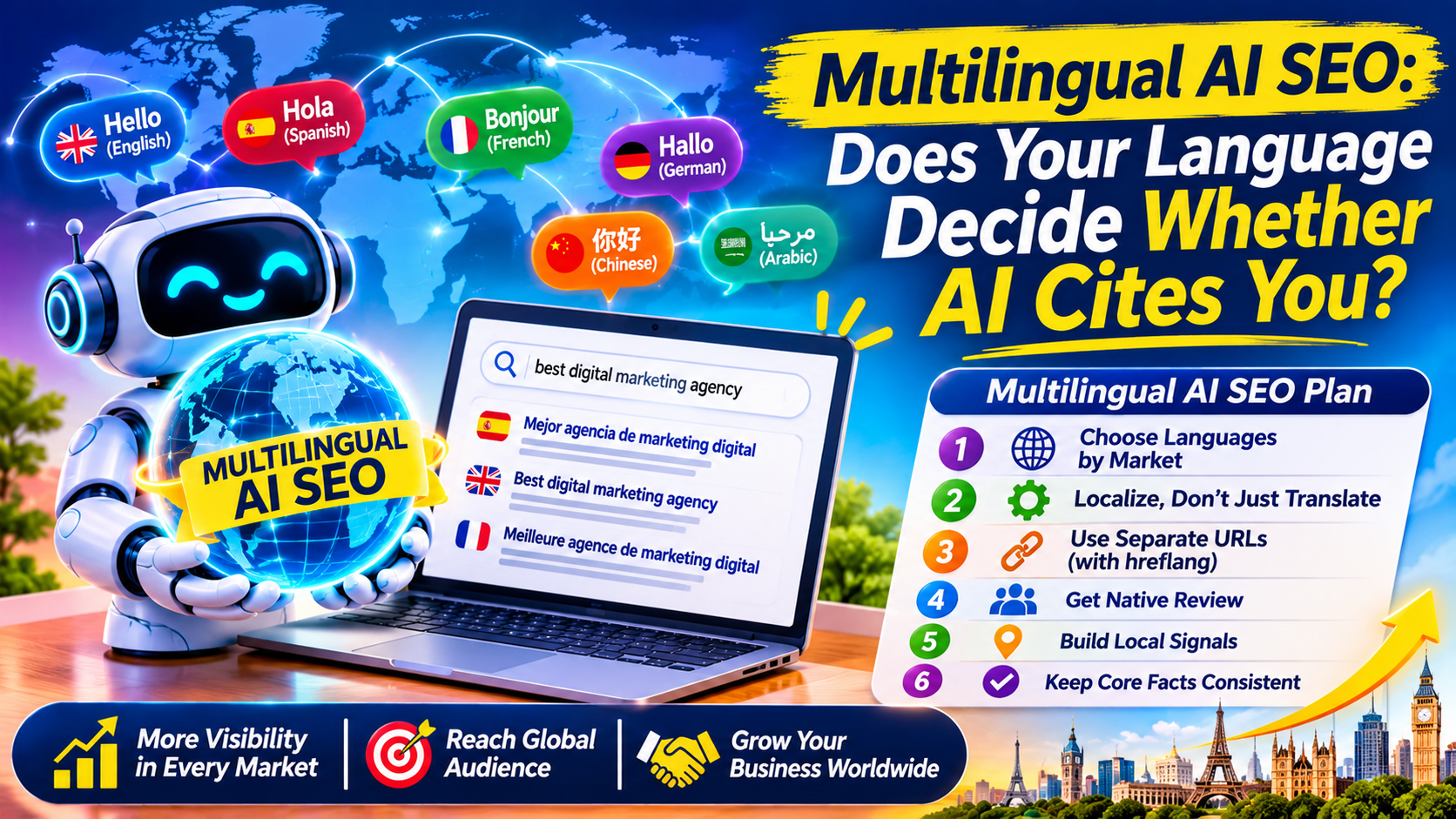
A business can rank well in one language and be almost invisible in another, and AI answers make that gap harder to see. When a customer in Madrid asks a question in Spanish and another in Toronto asks the same thing in English, they may be shown very different sources. For any brand selling beyond one language market, that is a core part of AI SEO.
Engines Handle Language Differently
A large study by Temso analyzed over 7 million AI-generated citations across four major models, six non-English languages, 12 countries and 47 industries. It measured how often models cited English pages when the prompt was not in English:
- Google AI Overviews: 8.7%
- Microsoft Copilot: 15.4%
- ChatGPT: 23.7%
- Grok: 39.6%, nearly two in five sources, four times Google’s rate.
So Google’s AI surfaces tend to match the user’s language, while others lean more heavily on the English-language web. This study comes from an AI visibility vendor and used a commercially oriented prompt set, so treat it as a strong indicator rather than a universal law.
An analysis in Search Engine Land of multilingual sites found a similar pattern from another angle: English over-indexing is clear in ChatGPT data, not in Copilot, AI Mode or AI Overviews. Its explanation is that the bias belongs to the retrieval path of the language model itself, not to search indexing in general.
Does Translating Your Site Raise AI Visibility?
Weglot, a website translation company, studied 1.3 million citations across Google AI Overviews and ChatGPT for Spanish-language sites in Spain and Mexico. Among untranslated Spanish sites from Spain, there were 17,094 citations for Spanish queries versus 2,810 for the equivalent English searches. Sites that also offered English closed the gap to only 22% in AI Overviews. The report concludes that translated sites achieved 327% more visibility than untranslated ones and earned 24% more total citations per query. www.searchenginejournal.com +2
Two cautions apply. The coverage was sponsored by Weglot, a company that sells translation, and the sample for untranslated Spanish sites was small, at 98 sites. The finding is plausible and consistent with other research, but it is not independent proof that translation causes the lift.
On the English question specifically, the Search Engine Land analysis reported that sites with an English folder saw a 122% uplift in AI visibility. That came from a panel of European multilingual sites, so it may not transfer to every market.
Your Query Language Changes the Sources
Language does not only affect whether you are cited. It changes the whole cast of cited sources. Research summarized by Ethan Lazuk, based on 1,920 AI Overview queries, found that using a country’s official language increased locally sourced citations by roughly 3.5x to 13.5x.
A small independent test makes the point vividly. Its author asked 40 equivalent questions about Lebanon in English and Arabic across four AI search tools, yielding 320 responses. In Gemini, Lebanese sources accounted for 34.8 percentage points more citations in Arabic than in English, and news and media sources made up 24% of Arabic citations but only 10% of English ones. The author is careful to note that the study does not establish what caused the differences or whether they affected factual accuracy. your language changes who ai search cites +2
For lesser-served languages, the problem can go further. Search Engine Land has documented cases where queries in Belarusian were often auto-corrected to Russian, with results, including AI Overviews, in Russian and citing Russian sources.
A Practical Multilingual AI SEO Plan
- Choose languages by market, not by habit. List where your customers actually are and which language they search in, then rank markets by revenue potential. English is not always the right second language. At Sarkar SEO, we start with this market-by-language map before touching any page.
- Localize instead of only translating. Adapt terminology, units, currency, regulations, examples and proof points. A Spanish page that cites only US case studies gives a Mexican reader, and an AI system judging relevance, little reason to trust it.
- Give each language its own crawlable URL. Serve translations as real pages in HTML at distinct addresses with proper language annotation, rather than relying on a script that swaps text in the browser. Use standard international SEO practice, such as hreflang tags, so engines connect the versions.
- Have native speakers review the output. Machine translation is a fast first draft, but an unreviewed page can contain awkward phrasing or wrong terminology. That is a quality judgment on my part rather than a research finding, yet it is hard to defend publishing something no fluent reader has checked.
- Build local off-site signals. Reviews, directories, press and community mentions in each market matter, because the citation mix shifts with language. A strong English reputation does not automatically carry over.
- Keep core facts identical across languages. Names, services, prices, contact details and claims should agree everywhere, so engines do not meet contradictory versions of your business.
Measure Each Language Separately
One of the most useful lessons from the Hamsterdam research is that a brand’s AI visibility score may look very different depending on the country, language and search engine being tested. A single blended figure hides this. Test the same intents in each target language, in each relevant country, across the assistants your audience actually uses, and compare results side by side. Where a market lags, check first whether the page exists in that language, and then whether it is as strong as the original. ethanlazuk
Mistakes to Avoid
- Assuming English content covers everyone. In some engines it may, and in others it clearly does not.
- Translating everything at once. Start with high-value pages and expand once quality is proven.
- Copying one market’s strategy into another. Platforms, review sites and competitors differ by country.
- Ignoring right-to-left and script differences. Layout, fonts and search behavior can vary, and poor rendering undermines trust.
- Treating vendor studies as settled. Several of the figures above come from companies with something to sell.
