



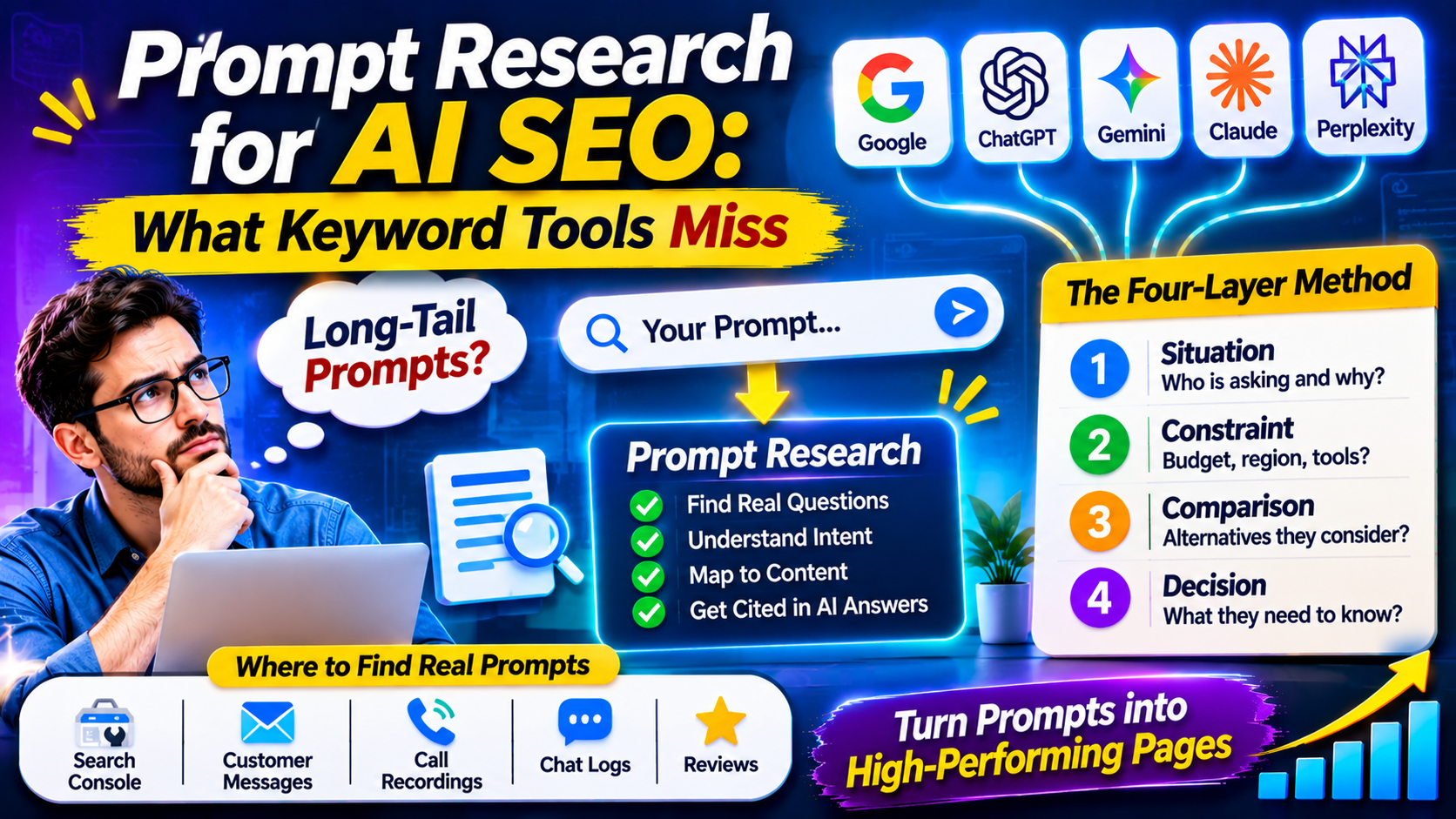
For two decades, keyword research started with a tool and a list of short phrases. AI search is breaking that habit. People now type full questions with context, constraints and a goal, and the queries engines send behind the scenes look different again. This article explains what that means for planning content, and gives a repeatable method for researching prompts. At Sarkar SEO, we treat this as the new first step of AI SEO.
People write differently to AI
The behavior gap is measurable, though the numbers depend on the study. An academic comparison found that participants using ChatGPT formulated significantly longer queries than those using Google, and needed fewer queries to finish the first task (1.55 versus 2.13).
Semrush’s clickstream study found the average AI Mode query ran 7.22 words, almost twice the 4.0 words of a traditional query, while ChatGPT prompts averaged around 23 words. The same source notes that when ChatGPT’s search feature is on, queries get shorter, around four words. Length depends on how people perceive the tool: a collaborator or a search box.
Beware inconsistent figures in circulation. One widely repeated Similarweb comparison, for example, quotes character counts that look more like word counts, so I have avoided it. Treat any single “X times longer” claim cautiously.
The queries you never see
There is a second layer. When ChatGPT decides to search the web, it writes its own queries. Nectiv analyzed more than 8,500 prompts and reported that ChatGPT searched in 31% of them, averaged 2.17 searches per prompt, and its queries ran 5.48 words, with 77% at five words or longer. searchengineland
It also searched more often for some intents. Searches were triggered in 59% of local-intent prompts and 41% of commerce prompts. The same study noted frequent use of words like “reviews,” “features” and “comparisons.” That is a clue about what retrieval looks for when a buyer is deciding.
Google describes something similar. Its documentation says AI Overviews and AI Mode may use “query fan-out,” issuing multiple related searches across subtopics and data sources to build a response. In practice, one prompt becomes several searches, and your page may be retrieved for a sub-question the user never typed.
Why keyword tools fall short
A secondary report of Semrush data claims that between 65% and 85% of ChatGPT prompts could not be matched to any traditional keyword in a database of over 27 billion keywords. I could not verify that figure at the original source, so treat it as a signal, not a fact. The direction is easy to believe: nobody has a monthly search volume for a 30-word question about a specific business situation.
Prompt research is therefore not a replacement for keyword research. It adds a layer: keyword research tracks short terms and ranking positions, while prompt research tracks full conversational questions and visibility in AI-generated answers.
A four-layer method
Here is a framework I use for turning one keyword into many prompts. It is my own working model, not an industry standard. Take a phrase like “accounting software” and add four layers:
- Situation. Who is asking and why? “I run a six-person design studio and invoice clients in three currencies.”
- Constraint. Budget, region, tools, deadline or skill level. “Under $50 a month, works in the UK.”
- Comparison. The alternatives they are weighing. “Is X better than Y for freelancers?”
- Decision. What they need to be convinced of. “What should I check before switching?”
Each layer becomes a heading, a table or a short section on your page. A single article built this way answers dozens of prompts without padding.
Where to find real prompts
You do not need a new tool to start. Use what you already own.
- Search Console. One guide advises filtering for long-tail queries of ten or more words, which already behave like AI prompts.
- Sales and support messages. The way a customer describes a problem in an email is usually closer to a prompt than anything in a keyword tool. Read twenty recent ones and copy the phrasing.
- Call recordings and chat logs. Note the objections, comparisons and “what if” questions.
- The engines themselves. Ask ChatGPT, Gemini or Perplexity a question in your category and look at the follow-up questions and sources they offer. Treat these as hypotheses, since answers vary.
- Reviews. Because retrieval seems to favor review-style content in buying contexts, your customers’ language in reviews is worth mining.
Turn research into pages
Once you have fifty real prompts, group them by theme, not by exact wording. Each group should map to one strong page, not fifty thin ones. This matters because Google’s spam policies still apply: scaled content abuse and other spam policies are formally in scope for AI Overviews and AI Mode citations, as one analysis puts it. Writing a page per prompt variation is the fast road to that problem.
For each page:
- Open with a direct answer to the core question.
- Add one section per layer: situation, constraint, comparison, decision.
- Include something original, such as pricing ranges you have actually seen, a short checklist or a worked example.
- Update it on a schedule. One vendor claims pages not refreshed quarterly are three times more likely to lose citations, but that is an unverified marketing figure, so use it only as a reminder to keep key pages current.
How to test whether it worked
Create a fixed list of 25 prompts from your research, each written the way a customer would write it. Run them monthly in Google, ChatGPT, Perplexity and Gemini, and log whether you are mentioned, cited or absent. Because answers change between runs, repeat each prompt a few times and look at trends over a quarter. Pair this with Search Console impressions, branded searches and lead counts.
