



Most teams respond to AI search by publishing more. The research suggests a quieter move may pay off sooner: improving what you already have. Several large studies now show that pages cited by AI assistants tend to be newer, or more recently updated, than the pages that rank in ordinary results. But the details matter, the platforms differ, and “update everything weekly” is bad advice. Here is what the data actually says and how to act on it sensibly.
What the Studies Found
Ahrefs analyzed about 17 million cited URLs across ChatGPT, Perplexity, Gemini, Copilot, AI SEO Overviews and organic Google results. It reports that Google’s AI Overviews and organic results are the most likely to cite older pages, while ChatGPT is most likely to cite newer ones. In the data it published, ChatGPT’s references were on average about 393 days newer by publication date than organic results, while AI Overviews’ top citations ran slightly older than organic ones.
A separate Seer Interactive study looked at 7,683 pages cited in 47,097 answers from ChatGPT, Gemini and Perplexity between March and June 2026. It found that about three in four cited pages had been updated within the last year, and that, in every vertical, freshness came from updates rather than new publishing. Perplexity was the most forgiving of the three, with around 65% of its cited pages updated in the past year. seerinteractive
The takeaway is directional: on assistants that retrieve live web results, recently maintained pages are over-represented among citations.
Read the Studies Carefully
Three cautions keep you from over-reading this.
Correlation is not a recipe. Ahrefs itself warns that freshness is one factor among many, and low-quality, irrelevant content updated daily will not have a magic positive effect. A commentary on the Seer study also notes the sample covered four brands in four industries and was drawn from non-branded queries. It isn’t proof for your niche.
Google’s AI features behave differently. Because AI Overviews draw on the same core ranking systems as organic results, freshness appears to act as one input among many, not a gate. Don’t assume what works for ChatGPT applies to Google.
Vendor claims vary wildly. Some blogs cite figures such as content updated within 30 days earning several times more citations. I couldn’t trace those to a primary study, so I haven’t relied on them. Treat any precise multiplier skeptically.
What Counts as a Real Update
Changing a date doesn’t change a page. A real refresh gives a reader and a machine a reason to trust the page more than before. In my judgment, these qualify:
- Replacing outdated statistics, prices, screenshots or legal and regulatory details.
- Correcting statements that are no longer true.
- Adding a section that answers a question people now ask.
- Adding fresh examples, data or first-hand evidence.
- Removing advice that no longer applies.
These do not qualify: swapping the year in a title, adding filler paragraphs, or bumping a “last updated” stamp. Beyond being unhelpful, they risk readers noticing and trusting you less. And remember Google’s guidance on AI-written revisions: if you use AI to speed up an update, a person should fact-check every change.
A Three-Bucket Refresh Triage
Here is a method I’d suggest, which is my own framework rather than an industry standard. List your pages, then sort each into one of three buckets.
Bucket one: quick verification (about 30 minutes). Evergreen pages whose facts rarely change. Check links, names, prices and claims. Add a visible “last reviewed” date only if you genuinely reviewed it.
Bucket two: substantive update (a few hours). Pages on moving topics, such as tools, regulations, comparisons or statistics. Rework the sections that have aged, add what’s new, and record what changed.
Bucket three: rebuild or retire. Pages that are thin, duplicated or beyond saving. Merge them into a stronger page and redirect, or remove them.
Prioritize within each bucket by three questions: Does the page matter to revenue? Does its topic change quickly? Has it lost traffic or stopped being cited? Sarkar SEO starts content audits with this triage, because it stops teams from spending equal effort on pages that don’t deserve it.
Which Pages to Refresh First
Not every page benefits equally. Seer’s data indicates commercial and comparison-style content leans particularly recent, and a separate report states that comparison queries account for roughly a third of AI citations, although I didn’t verify that number. Start with:
- Comparison and “best of” pages.
- Pricing, features and “how it works” pages.
- Statistics and benchmark roundups.
- Regulatory or compliance guides.
- Your highest-converting informational pages.
Leave timeless explainers for later.
Make Freshness Visible and Honest
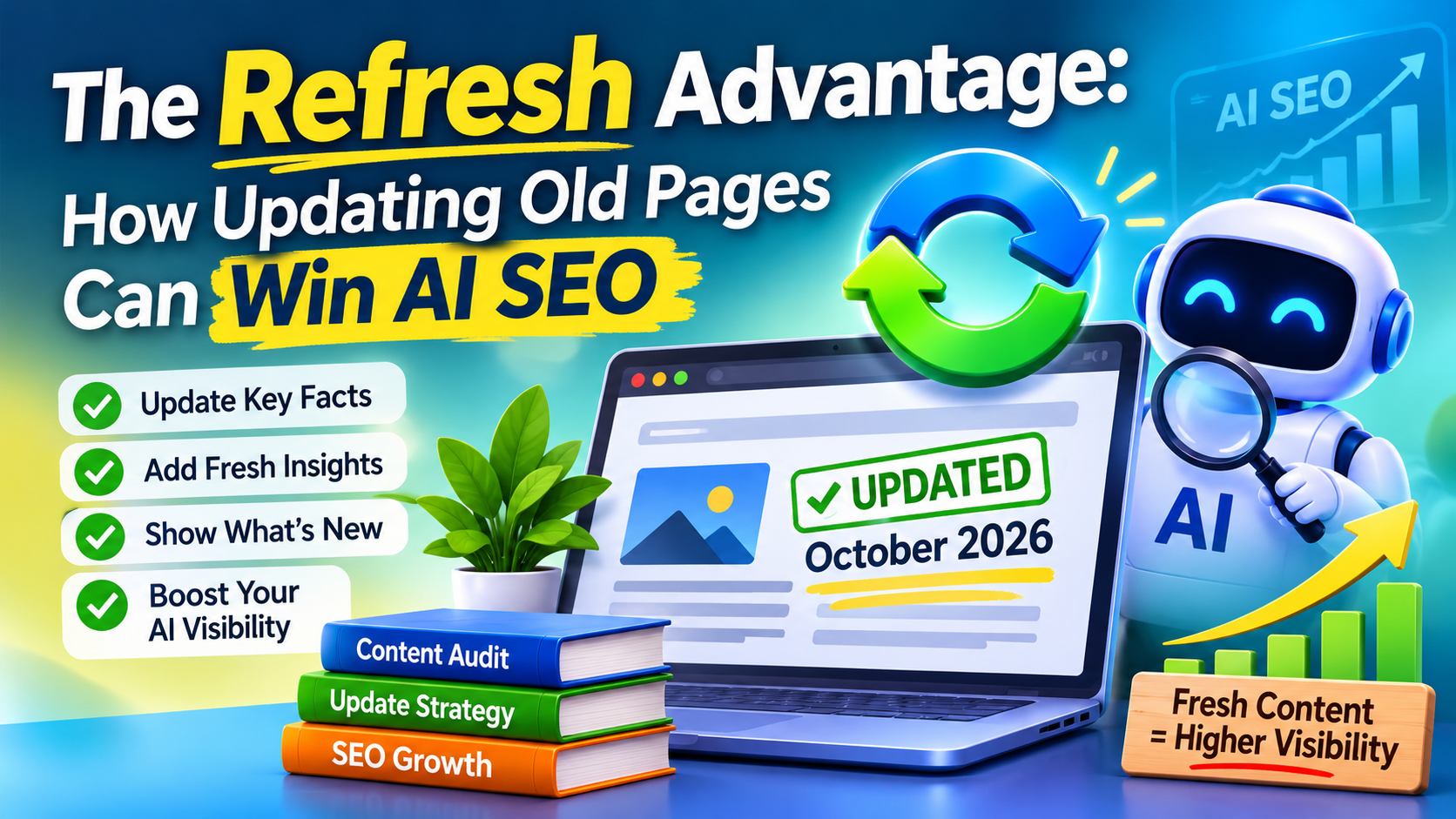
Show readers what changed. A short note such as “Updated October 2026: revised pricing and added new integration details” tells people, and likely machines, what is current. Keep a simple changelog per page. Make sure the date in your page markup and on screen matches the real revision. Keep a spreadsheet of review dates and owners, so pages don’t depend on someone’s memory.
Set a Realistic Rhythm
Resist rules like “refresh every page monthly,” which waste effort. Instead, match cadence to topic speed. Fast-moving pages, such as software comparisons or regulations, might warrant a quarterly check. Stable pages might need a yearly one. Sarkar SEO suggests reviewing your list each quarter and keeping the effort proportional to the traffic and revenue at stake.
Measure the Effect
For each refreshed page, record the date and change, then watch for movement over the following weeks:
- Search Console clicks and impressions for the page’s key queries.
- Whether assistants now cite or describe the page, using a fixed set of test questions.
- Conversions from that page.
Allow time, since assistants refresh at different speeds, and avoid claiming credit for every uptick.
