



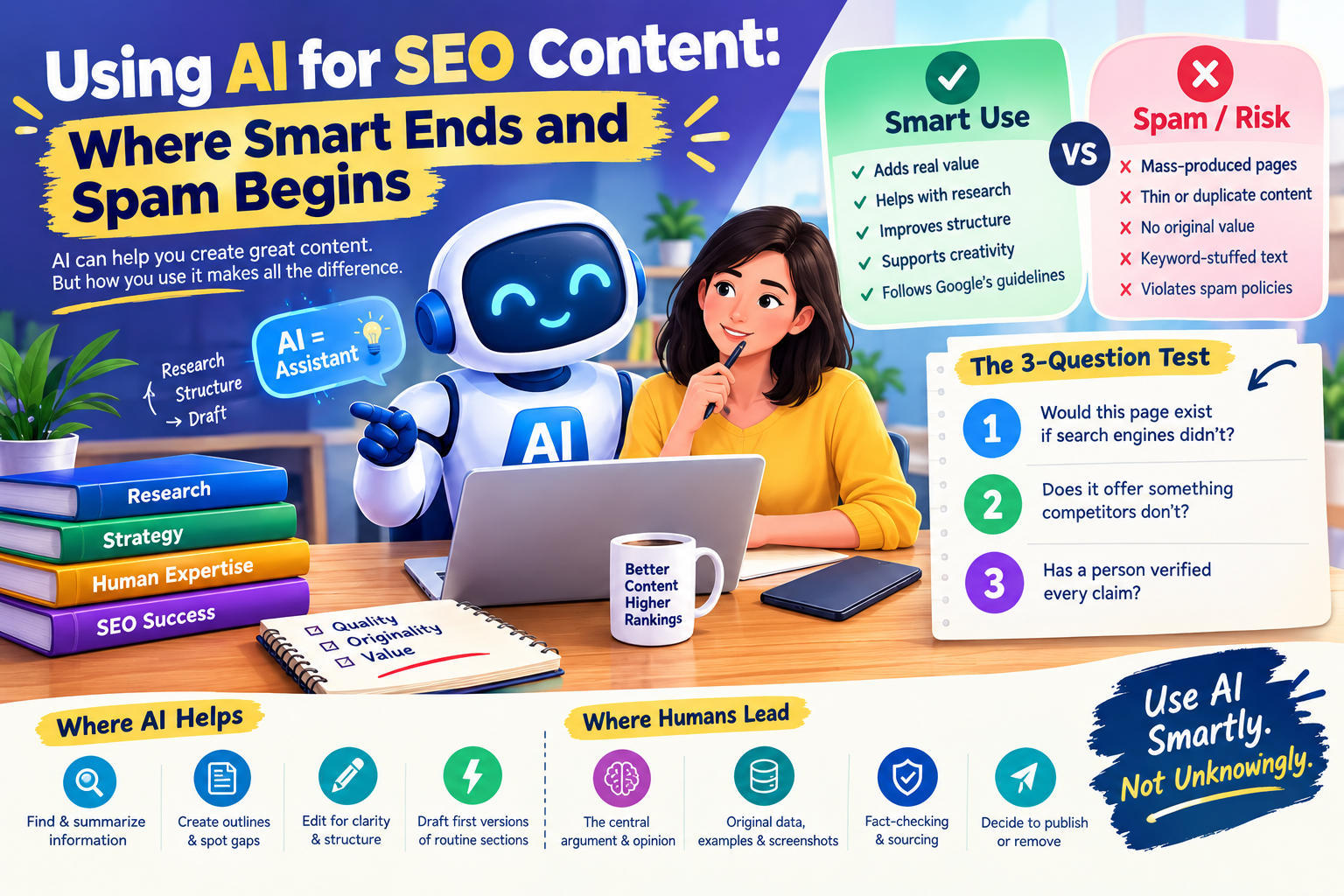
“AI SEO” now means two different things. One is getting your brand found inside AI answers. The other is using AI tools to produce the content that earns visibility in the first place. This article covers the second, because it’s where many sites get hurt. Sarkar SEO sees the same question from business owners everywhere: how much of my content can I hand to AI before Google objects?
What Google actually says
Google does not ban AI-written pages. Its guidance says generative AI SEO can be particularly useful for researching a topic and adding structure to original content. The warning is aimed at volume: using AI to generate many pages without adding value for users may violate the scaled content abuse spam policy. googlegoogle
So the question is rarely “Was this written by AI?” It is “Does this page deserve to exist?”
Why intent matters more than method
Google introduced the scaled content abuse policy on March 5, 2024. According to PPC Land’s summary, the policy applies whether automation, humans or a combination are involved. Freelancers working from a keyword spreadsheet can trip it just as easily as a language model can.
Two details matter in practice:
- No published threshold. Google has never disclosed a page count or publishing rate that triggers the policy, and volume alone is not described as a violation.
- Site-level judgment. Google’s rater guidelines tell human reviewers to look at several pages and, when a site is built on scaled, valueless content, rate it Lowest even when the production method is unclear. Those ratings evaluate Google’s systems and do not directly change rankings, but they show how Google defines low quality.
Enforcement continues. PPC Land reports that a spam update began on September 24, 2026 and lists scaled content abuse among the policies in scope.
A cautionary example
The best-known case is the 2023 “SEO heist.” A marketer reportedly used AI to publish about 1,800 articles on topics copied from a competitor’s sitemap and claimed 3.6 million visits. According to figures that The Decoder reported, the site’s traffic later fell from about 610,000 visits in early October to 190,000 by mid-December 2023. These are secondary reports of one case, so read them as an illustration, not proof of a penalty. Even so, the pattern is instructive: a spike built on borrowed topics and thin pages is fragile.
Treat the output as a draft, not a deliverable
Google’s guidance on this has grown stricter. PPC Land reports that on October 1, 2026, Google added language saying all AI-generated content should be manually fact-checked before publication, including titles, meta descriptions, structured data and alt text. I could not open Google’s own page for that wording, so confirm it there before quoting it to a client.
Google also suggests that sharing how a piece of content was created can give readers more context. For online stores the rules are firmer. Google says AI-generated images need IPTC DigitalSourceType metadata, and AI-generated product titles and descriptions must be separately labeled. googlegoogle
The three-question publishing test
Here is a simple test to run before any AI-assisted page goes live. It is my own framework, not a Google rule.
- Would this page exist if search engines didn’t? If the honest answer is “only because a keyword tool listed it,” stop.
- Does it contain something a competing page lacks? That could be your own data, a tested process, a named expert’s judgment or a real customer scenario. Rephrasing the top ten results does not count.
- Has a named person verified every claim? Statistics, dates, prices, quotes and links all need a human check against a primary source.
If a page fails any one of the three, fix it or don’t publish it.
Where AI helps and where humans must own the work
AI is useful for:
- Gathering and summarizing background material for you to verify
- Proposing outlines and spotting gaps in your coverage
- Editing for clarity, grammar and structure
- Drafting first versions of routine sections you will then rewrite with real knowledge
Humans should own:
- The central argument and the opinion
- Original data, examples and screenshots
- Fact-checking and sourcing
- The decision to publish or kill a page
Think of AI as a fast research assistant, not an author. Sarkar SEO’s recommendation to clients follows from that: let AI shorten the slow parts, and keep experience and judgment on the human side.
Fewer, stronger pages beat keyword variations
The riskiest habit is creating one page per keyword variation. A guide on AI-written content warns that publishing pages for every keyword variant can become scaled content abuse and recommends building fewer, stronger topic hubs. That is consistent with Google’s own framing: merge overlapping pages, expand the best one and retire the rest.
If you’ve already published too much
Start with an audit of the site, not the tool. Group pages by purpose, check which ones earn impressions or conversions, and flag thin or near-duplicate pages. For pages that cannot be rescued, Google’s policy page tells hosts to exclude such material from Search through a noindex directive or deletion.
Be careful about diagnosis. Algorithmic demotions arrive without notice, and spam updates often overlap with core updates. In one reported case of a large traffic collapse, neither Google nor the analyst involved attributed it to a scaled content action. Treat any “we were hit by AI penalty” conclusion as a hypothesis until the evidence supports it.
