



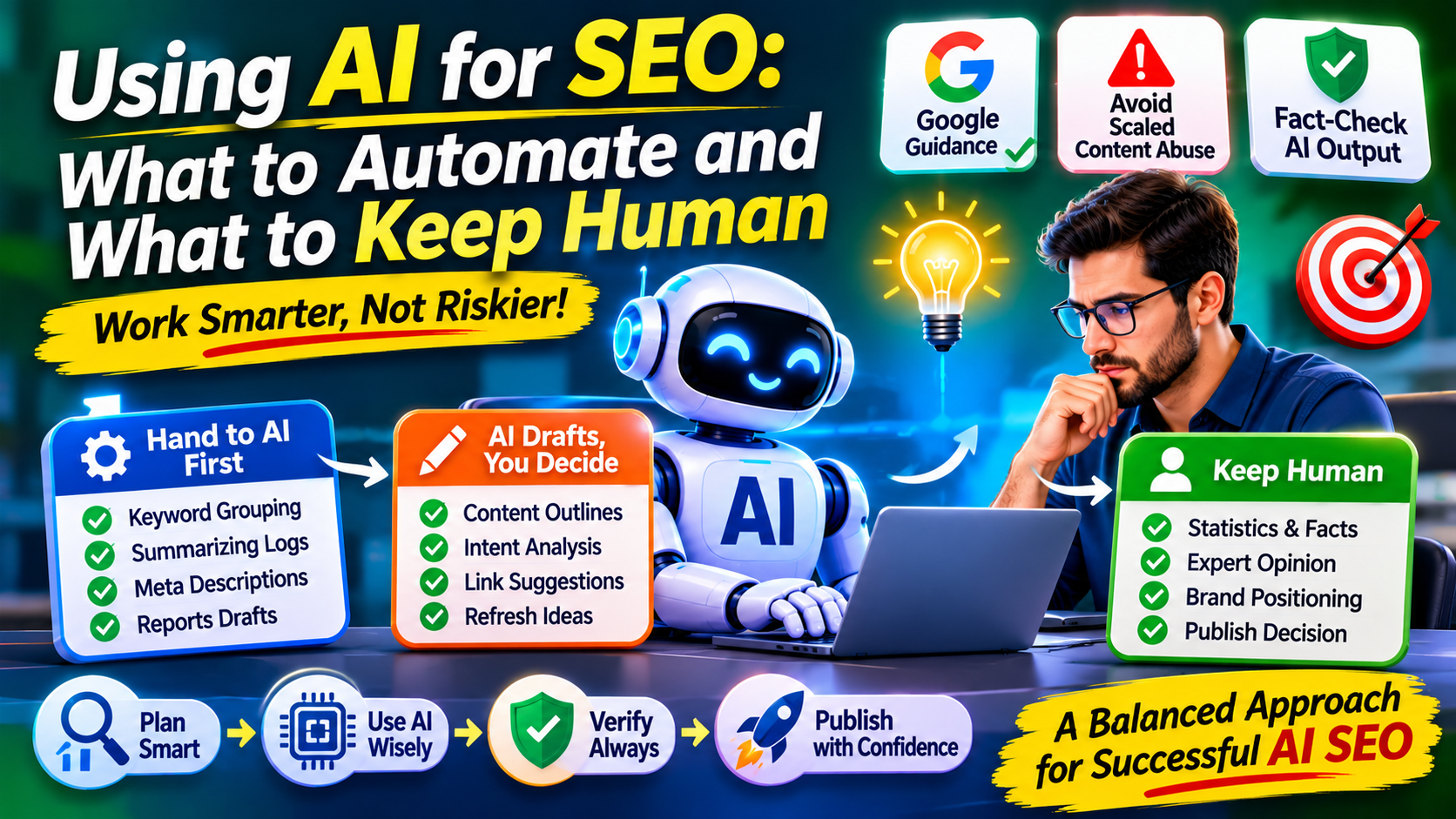
Most AI SEO teams already use AI. The harder question is where it belongs in the workflow. Hand it too little and you lose hours to repetitive work. Hand it too much and you risk publishing pages that are generic, wrong or both. This guide gives you a practical way to decide, task by task, and shows where Google draws its lines.
Everyone Uses It, Few Use It Deliberately
A 2026 Keyword.com survey of SEO teams found that 87% use AI regularly or more extensively, and only one respondent reported fully automated work. The same survey found the most common uses were content briefs and outlines (77%), keyword research and clustering (68%), drafting (66%) and reporting (60%). It is a small sample of fewer than 100 respondents, so read it as a signal, not a benchmark.
The more telling finding is that usage often depends on one person supplying the prompt, context and checks each time, with fewer teams having turned that into a shared workflow. Using AI is now the baseline. What separates good results from bad is the process around it.
What Google Actually Allows
Google does not ban AI-assisted content. Its guidance says generative AI can be useful for researching a topic and adding structure to original content. The risk sits elsewhere: using AI tools to generate many pages without adding value for users may violate the spam policy on scaled content abuse. That policy applies no matter how the content was made, so human-written spam and AI-generated spam face the same consequences. Google Search’s guidance on using generative AI content on your website +2
Two recent signals matter. On October 1, 2026, Google added a warning that AI output may contain errors, along with advice to fact-check it by hand before publishing. And a spam update that began on September 24, 2026 lists scaled content abuse among the policies in scope. The direction is clear: speed is fine, unreviewed volume is not.
A Delegation Map for AI SEO
Sarkar SEO’s working approach is to sort every SEO task into three buckets, based on what happens if the AI gets it wrong. This is a practical framework, not an official standard.
Hand to AI first (errors are cheap and easy to spot):
- Grouping large keyword lists by intent
- Summarizing crawl exports and log files into plain-language findings
- Producing title and meta description variants for you to choose from
- Drafting first versions of recurring reports
AI drafts, a person decides (errors are plausible-looking):
- Content outlines and briefs
- Intent classification for borderline queries
- Internal link suggestions
- Refresh recommendations for aging pages
Keep human (errors damage trust):
- Every statistic, date, price and quotation
- Experience, opinions and case results
- Positioning and what the page claims to offer
- The final decision to publish
The rule behind the buckets: the more a mistake would embarrass you in public, the less you delegate.
Build a Verification Habit
Unchecked output is the biggest practical risk. Language models can produce confident figures, invented citations and links that lead nowhere. Treat every AI draft as an unverified first pass and apply a simple loop:
- Mark every checkable claim. Highlight each number, name, date and “studies show” statement.
- Trace each to a source you opened. If you cannot find the original, cut the claim or rewrite it as a clearly labelled opinion.
- Check that every URL resolves and says what the draft says it does.
- Read as a skeptical customer. Would a real buyer or expert find anything naive?
This is slower than publishing the draft. That slowness is the point, and it is what Google’s updated guidance now asks of site owners.
Warning Signs Your Workflow Has Drifted
Review your process if you notice any of these:
- Pages that could be swapped between competitors. If you could paste a rival’s logo onto your article and nobody would notice, it has no distinctive value.
- A growing pile of near-duplicate pages, each targeting a slightly different phrasing of one query.
- Nobody can say who checked a page. Unowned content is where errors survive.
- Output rising while engagement falls. More pages with shorter visits, thinner links or weaker conversions suggests quantity is outrunning quality.
- Drafts that need only light edits. Real expertise rarely survives a skim. If editing feels effortless, you may be approving instead of improving.
Google’s quality rater guidance reinforces why this matters. Raters are told to use the lowest rating when they strongly suspect scaled content abuse after looking at several pages on a site, even if they are unsure how the pages were created. Patterns across a site get judged, not just single pages. userp
Give the Model What It Cannot Supply
A model can organize what is already known. It cannot supply what only you have: your data, your customers’ real questions, your failures, your judgment. A sound workflow feeds those in at the start rather than hoping to bolt them on at the end.
Before drafting, write down three things the page must contain that no competitor page does. It might be a number from your own records, a decision you made and why, or a mistake you would warn others about. Give these to the AI as source material, then have it help with structure and clarity. The final page should read as yours because the substance is yours.
Track the Right Numbers
AI changes your cost per page, so measure value per page. Useful checks include:
- Share of AI drafts rejected or heavily rewritten. A rate near zero is a warning, not a success.
- Fact corrections caught before publishing. Count them. If the number is never above zero, your checks may be too shallow.
- Performance of AI-assisted pages versus fully human ones over three to six months, using the same Search Console and conversion metrics.
If assisted pages consistently underperform, tighten the review stage before adding more volume.
