



Most AI SEO advice focuses on your own website. But when an answer engine builds a response, it often leans on pages you don’t control: forum threads, videos, review sites and encyclopedias. If your market’s questions are answered there, your best content may never be seen. This article looks at which sources AI engines cite, where the data disagrees, and how a business can earn a place in those conversations honestly. Sarkar SEO treats this as the part of AI SEO that most site-only strategies overlook.
The pattern: a few platforms keep appearing
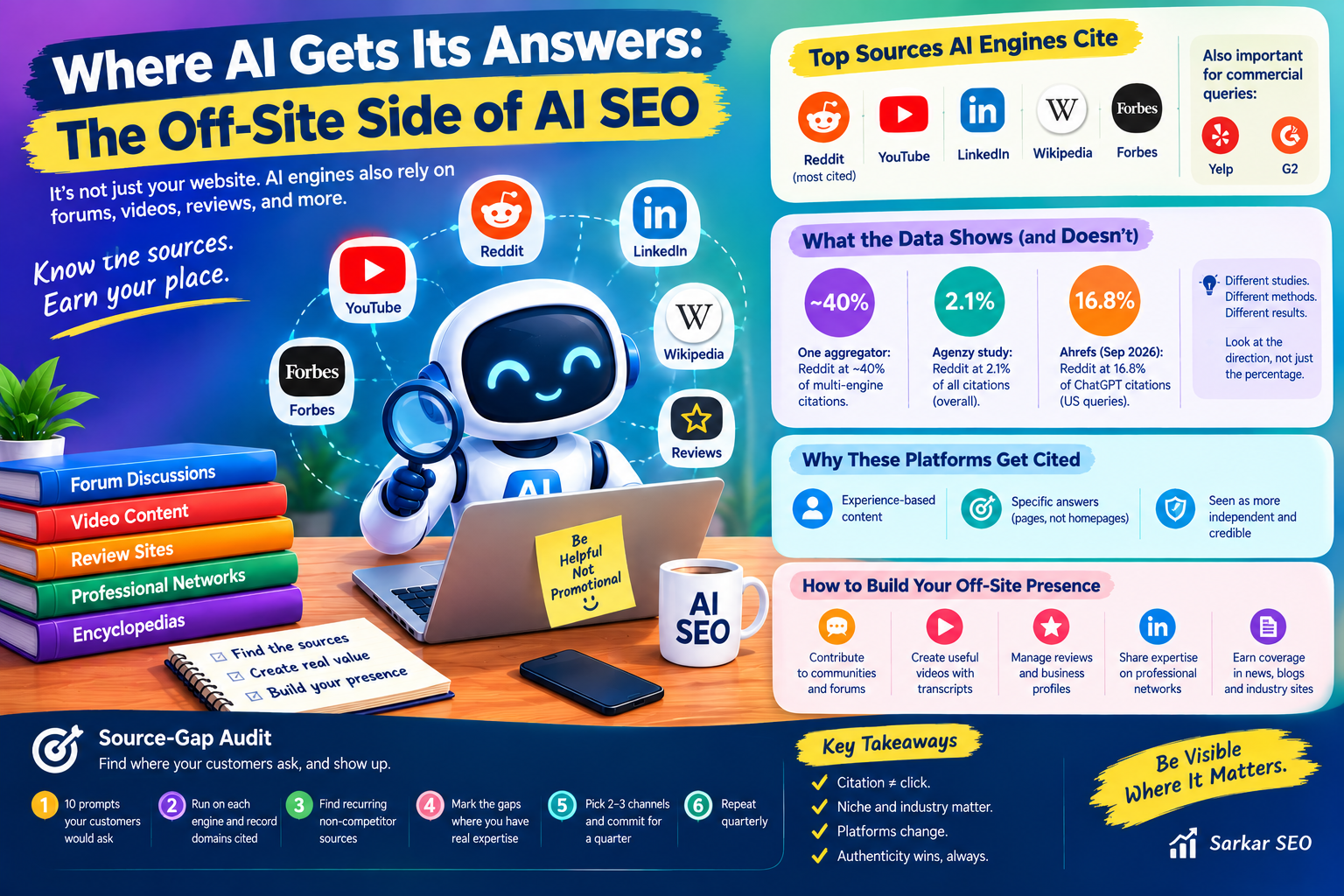
A Peec AI analysis of 30 million sources found that Reddit was the most-cited domain across ChatGPT, Google AI Mode, Gemini, Perplexity and AI Overviews, with YouTube, LinkedIn, Wikipedia and Forbes also in the top five. The same report notes that review platforms such as Yelp and G2 appeared often in recommendation queries. searchenginelandsearchengineland
The engines differ in taste. In that analysis, ChatGPT favored Wikipedia, Reddit and editorial sites like Forbes, while Perplexity emphasized Reddit, LinkedIn and G2 for B2B queries. A synthesis of several studies adds that the overlap between any two engines’ cited sources runs roughly 16% to 59%. That synthesis is a secondary source, so read the range as indicative. searchenginelandfrase
Why the numbers don’t agree
Be careful with any single percentage. Compare three published figures:
- One aggregator reports Reddit at roughly 40% of multi-engine aggregate citation frequency.
- Agenzy’s study of 2,283,923 citations found Reddit took 2.1% of all citations, with ChatGPT giving it 3.0%, Google AI Overviews 1.7% and Perplexity 0.6%.
- The same Agenzy article cites an Ahrefs September 2026 count that puts Reddit at 16.8% of ChatGPT citations, measured on US queries.
These figures can all be “true” because they measure different things: different query sets, different engines, different definitions of a citation. The sensible reading is directional. Community and video platforms are heavily represented, but the exact share depends on the topic and the method. Before you build a strategy on a statistic, check how it was measured.
Why these platforms get cited
Two reasons stand out, and both are partly interpretation rather than proven fact. First, engines appear to value experience-based content. Google’s own AI features can draw on articles, videos, reviews and forums. Second, specificity matters. One analysis reports that 99% of ChatGPT’s Reddit citations point to individual discussion threads and 85% of YouTube citations point to specific videos rather than channels. That is a secondary report of Profound’s data, but the logic holds: engines cite the page that answers the question, not the brand’s homepage.
What this means for a business
You cannot “optimize” a Reddit thread the way you optimize a landing page, and trying to is usually counterproductive. These platforms are valuable precisely because they feel unpromotional. That is my reasoning, not a published rule, but it should shape your approach. The goal is to be a genuine contributor where your customers already ask questions.
Communities and forums. Answer real questions in your area of expertise, disclose who you are, and follow each community’s rules. Value first; links only where they truly help.
Video. Because YouTube features so strongly in the data, a clear tutorial with an accurate transcript and a descriptive title is worth considering. One aggregator puts YouTube at about 19% of Google AI Overviews’ top-source share, though I’d treat that number as approximate.
Review platforms. For commercial queries, profiles on sites like G2 or Yelp matter. Keep your listings accurate and respond professionally to reviews. Never write or buy fake ones.
Professional networks. One study cited by Contently found LinkedIn appeared in 14.3% of ChatGPT Search responses and 13.5% of Google AI Mode responses. Original posts by named experts can build the visible authorship that your site’s articles also need.
Encyclopedias. Wikipedia is influential, but it is not a marketing channel. Companies shouldn’t write their own entries, and a page generally requires independent coverage. Earn that coverage through real work.
A source-gap audit you can run
This is my own method, offered as a practical way to apply the research.
- Choose 10 prompts your customers would really ask, for example “best way to choose X” or “alternatives to Y.”
- Run them on each engine you care about and record the domains cited, not just whether you appear.
- Find the recurring domains that are not competitors. These are the sources shaping answers in your niche.
- Mark the gaps: where do you have genuine expertise and no presence?
- Pick two or three channels and commit to useful, regular contributions for a quarter.
- Repeat quarterly, because the cited sources shift.
Sarkar SEO uses this logic as a planning framework: the audit tells you where answers are formed, and your resources decide where you can credibly show up.
Limits and cautions
- Citation is not the same as a click. Appearing in a source list does not guarantee visits.
- Niche matters. Studies mix industries. A local trade or a regulated field may show very different source patterns from consumer technology.
- Platforms change. The data above comes from 2025 and 2026 snapshots, and citation habits move as engines update their retrieval.
- Authenticity is the constraint. Tactics that depend on pretending to be a customer or inflating mentions carry both reputational and policy risk.
