



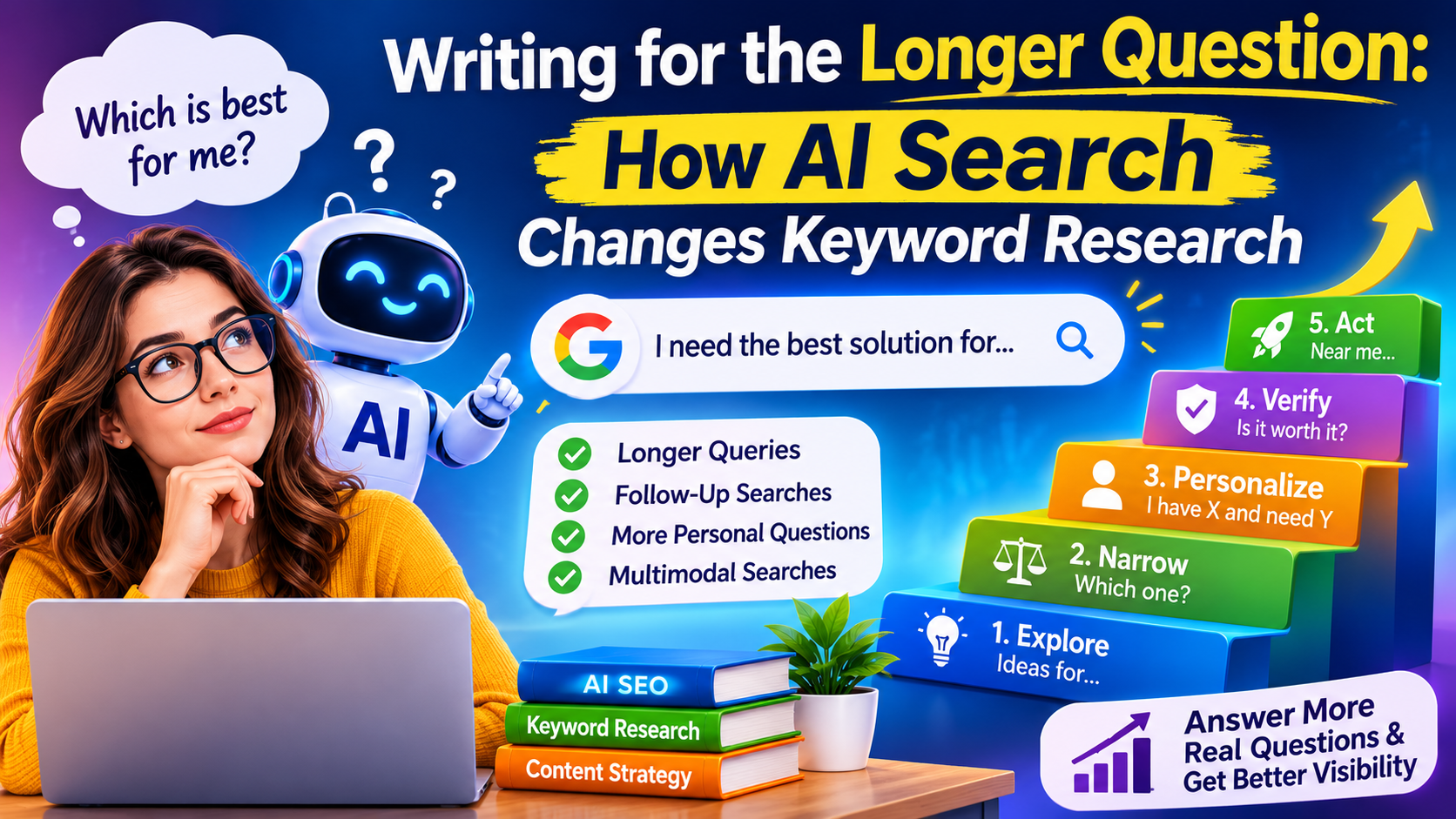
Traditional keyword research assumes that people type a few words and scan a list of links. AI search is breaking that habit. People now describe their situation in full sentences, ask follow-ups and sometimes upload a photo. If you still plan content around two-word phrases, you may be answering questions nobody asks the way you expect. Here is what Google’s own usage data shows, how far to trust it, and a practical way to adapt your research and writing.
What Google Has Disclosed
One year after launch, Google published its first usage report on AI Mode in the U.S. According to Search Engine Journal, the average AI SEO Mode search is three times longer than a traditional search, with both short and long queries increasing. The same coverage notes that common opening words include “what,” “how,” “I,” “is” and “can,” and that the word “I” is notable because it may suggest people treat AI Mode more like a conversation than a traditional search. searchenginejournalsearchenginejournal
Other reported figures from the same release:
- Follow-up queries rose by more than 40% per month in the U.S.
- More than one in six AI Mode searches were multimodal, meaning voice, images or video.
- Planning-related queries grew 80% faster over six months, and decision questions starting with “which” increased 40%.
- Brainstorming queries grew 30% faster than overall usage.
Limits Worth Knowing
These numbers are useful but narrow. The keyword data covers May 2025 to April 2026 from a random sample of U.S. searches, and the Trends figures measure search interest as a share of AI Mode searches, not total query volume. In a separate Search Engine Journal report on a Google podcast, the writer cautions that the three-times-longer figure lacks a stated baseline and measurement window. It also doesn’t show whether users differ or whether longer questions convert better. That report adds that Google has not supplied conversion benchmarks for these behaviors.
So the safe reading is this: query style is shifting toward longer, more conversational and more personal, at least for people who use AI Mode in the U.S. It does not prove that those searchers buy more, and the pattern may differ in your country or industry.
Keyword Lists Alone Won’t Capture It
Conventional tools show you terms and monthly volumes. They are weaker at revealing the unique sentence someone types about their own circumstances: “I run a two-person bakery and want to start selling online, which platform costs less?” That query will never have a clean volume figure, but it contains a topic, a constraint and a decision.
This is why your own data matters more than ever. Sources that reveal natural language include:
- Sales call notes and recorded demos.
- Support tickets and chat transcripts.
- On-site search logs.
- Open-text survey answers and review comments.
- Long queries in Search Console, which you can filter by character count or by words such as “which,” “should I” and “for my.”
The Question Ladder
Here is a framework I’d suggest, which is my own rather than an industry standard. Google’s data points to people moving through stages in a single conversation, so map each important topic across five rungs:
- Explore: “ideas for,” “where should I,” “what are my options.”
- Narrow: “which one,” “which of these,” comparisons.
- Personalize: “I have X and need Y,” where the person adds their constraints.
- Verify: “is it worth it,” “what’s the downside,” safety, cost, reliability.
- Act: availability, “near me,” pricing, financing, how to start.
For each rung, write the questions a real customer asks, in their words. Then ask whether your content answers them. Most sites cover rungs one and five well and skip the middle, which is where decisions are made.
Sarkar SEO uses this ladder when planning content, because it turns a single keyword into a conversation map and quickly shows which stage your pages ignore.
One Strong Page, Not Twenty Thin Ones
Longer, more varied questions tempt teams to create a separate page for each variation. Resist that. Earlier in this series we covered Google’s scaled content abuse policy, and Google’s AI search guidance has also called making a page for every fan-out variation an ineffective long-term strategy, as one commentator summarized it. A better approach is a comprehensive page organized around the ladder, with clear sections that answer each question, plus separate pages only where the topic or intent truly differs.
How to Write for the Personal Question
Practical habits help:
- Answer first, then qualify. Give the direct answer in the opening lines, then explain when it changes.
- Write “if you…” sections. Cover scenarios such as budget, team size, location, experience level or risk tolerance, so a reader can find their situation.
- Use decision aids. A small comparison table or a short “choose this if” list serves “which one” questions.
- State trade-offs plainly. The verify rung rewards honesty about drawbacks.
- Include real numbers with sources and dates, not vague ranges.
- Anticipate the next question. End sections with the follow-up a reader would likely ask, and answer it.
Avoid padding to hit a length target. Longer queries need complete answers, not longer articles.
Don’t Ignore Images and Voice
With more than one in six AI Mode searches using voice, images or video, your visual assets matter. Use original photos that show what you describe, give them honest, descriptive alt text, and make sure product and location images are current. Spoken queries tend to be natural sentences, so reading a key paragraph aloud is a simple test: if it sounds stiff, a reader will find it stiff too.
Measure What Changes
Track more than rankings. Review long Search Console queries monthly, note which questions you now appear for, and keep a set of ten conversational test prompts per topic to run across several assistants each quarter. Compare what they cite and how they describe you. Sarkar SEO suggests adding customers’ own phrasing, gathered from calls and forms, to that prompt set, because it keeps the research tied to real behavior and not to a keyword tool’s guesses.
