



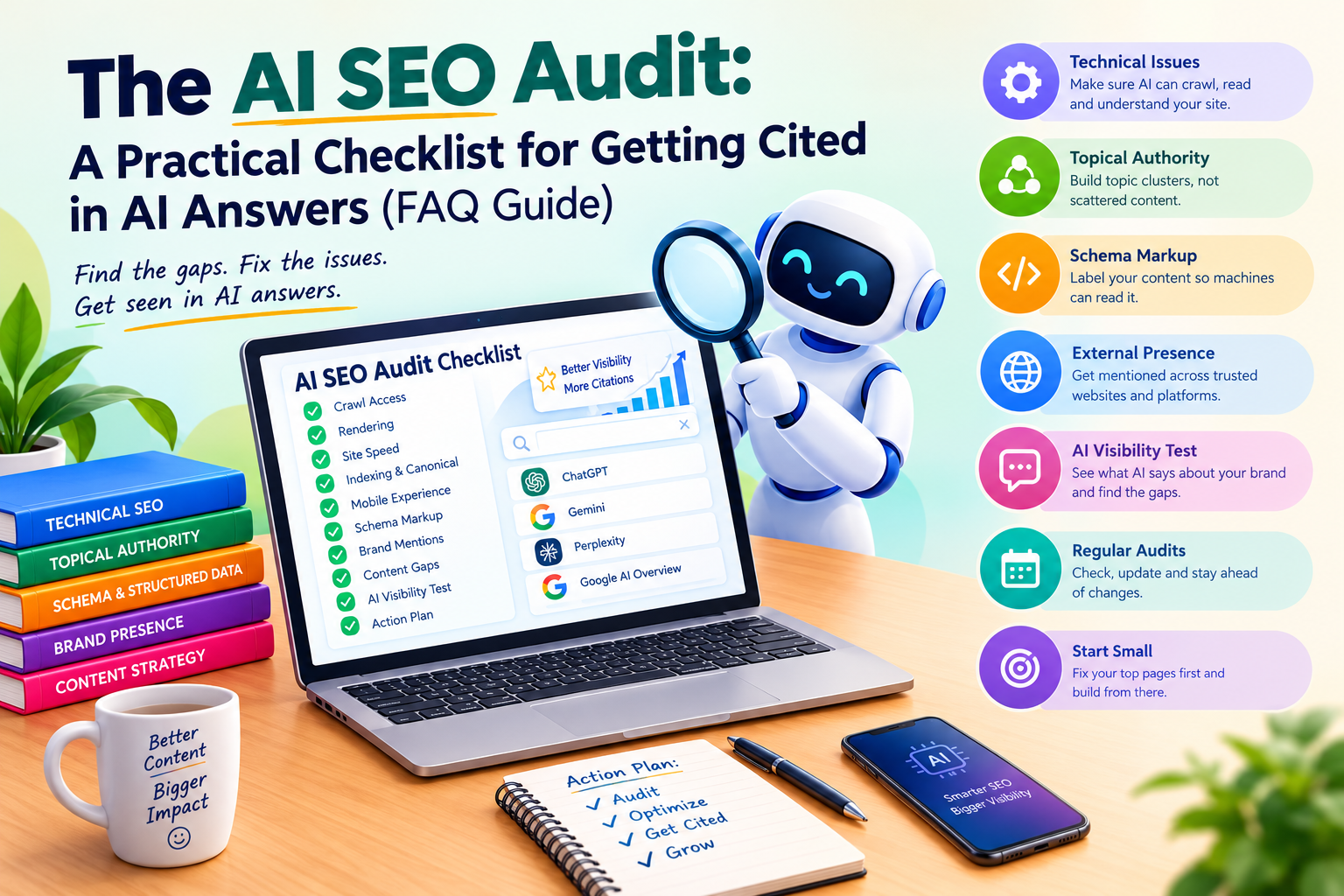
Most website owners ask the wrong first question about AI SEO. They ask, “What should I write?” A better one is, “Can AI systems actually reach, read and trust what I’ve already published?”
An audit answers that. Below are the questions we hear most often when businesses start looking at their AI visibility, with straight answers.
Why run an AI SEO audit at all?
Because many sites have invisible problems. A page can look perfect to a visitor and still be hard for a crawler to read. Another page may have great information buried in a way no system can extract. An audit finds these gaps before you spend money on new content.
Think of it as a health check. You wouldn’t buy more fuel for a car with a blocked exhaust.
What technical issues hurt AI visibility most?
Start with the unglamorous basics:
- Crawl access. Check that your robots.txt and security settings are not accidentally blocking bots you actually want.
- Rendering. If key content only appears after heavy JavaScript runs, some crawlers may never see it. Important text should be present in the page’s HTML.
- Speed and stability. Slow, broken or timing-out pages get skipped.
- Clean indexing. Fix duplicate pages, wrong canonical tags and stray noindex tags.
- Mobile experience. Most real visitors arrive on phones, so test there first.
At Sarkar SEO, this technical pass usually comes first, because the best article in the world cannot be cited if the page cannot be fetched.
How should I structure my site for topical authority?
AI systems tend to favor sources that clearly know a subject in depth, not websites that touch ten topics lightly. The practical answer is a topic cluster.
Pick one core subject, say AI SEO. Build one thorough main page, then surround it with focused supporting pages: one on GEO, one on AEO, one on schema, one on measurement, and so on. Link them to each other with descriptive anchor text. This shows how your ideas connect and gives AI a map of your expertise.
What role does schema play in an audit?
Schema is how you label your content for machines. During an audit, confirm that each page type uses the right markup: Article for blog posts, FAQ for question sections, Organization for your brand, LocalBusiness for physical locations, and Product or Service where relevant.
Then validate it. Broken or mismatched schema is worse than none, because it sends confusing signals. Also make sure the markup matches what is visible on the page, since hidden or exaggerated details can erode trust.
Does it matter where else my brand appears online?
Yes, and this is the part many audits skip. AI answers draw on more than your own domain. Video platforms, discussion forums, review sites, industry directories and news publications all contribute to how your brand is understood.
Check each one honestly. Is your description consistent? Are there outdated profiles saying something you no longer offer? Do real customers have a place to leave feedback? Cleaning up these scattered signals often improves clarity faster than publishing another blog post.
How do I check what AI says about my brand today?
Run a simple test. Write down fifteen to twenty prompts a customer might genuinely type, including comparison questions, “best for” questions and problem-based questions. Ask them across ChatGPT, Gemini, Perplexity and Google AI Overviews, then note:
- Whether your brand is mentioned at all.
- How accurately it is described.
- Which competitors appear beside you.
- Which sources the AI seems to rely on.
Repeat monthly, using the same prompts, so changes are easy to compare. The results become your to-do list.
What content gaps should I look for?
Look for questions your customers ask that your site never answers. Check your sales emails, support chats and WhatsApp messages. Real objections and doubts make excellent page topics: pricing questions, delivery timelines, comparisons, what happens after purchase, and who a service is not right for.
Pages that address these honestly tend to be more useful to readers and easier for AI to quote, because they contain specific answers rather than slogans.
How often should an audit happen?
A full audit once or twice a year is reasonable, with a lighter check every month. AI platforms evolve quickly, and what works today can shift. A short monthly review of your prompt results, top pages and technical health is usually enough to catch problems early.
Sarkar SEO recommends keeping a simple log: what you changed, when, and what happened next. After a few months, you will see which actions genuinely move the needle and which were just activity.
What is a realistic first step for a small team?
Do not try to fix everything at once. Choose your five most valuable pages. Confirm they are crawlable, fast and mobile friendly. Add or repair schema. Strengthen internal links between them. Then test a handful of prompts and record the baseline. That single afternoon of work gives you a clear starting point.
