



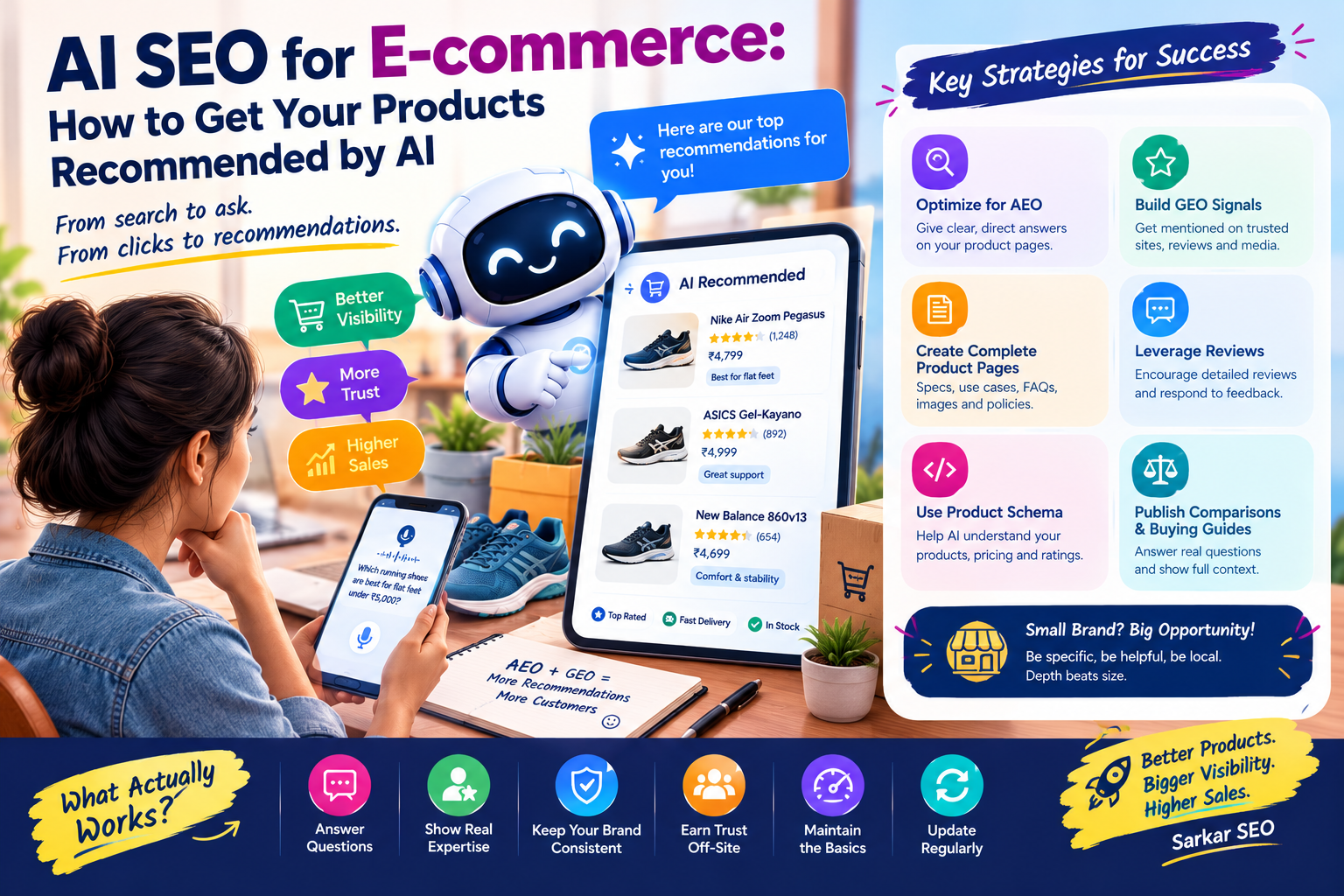
Not long ago, a shopper looking for running shoes would open Google, scroll through ten blue links and compare tabs for an hour. Today, many simply ask an AI tool: “Which running shoes are best for flat feet under ₹5,000?” and get a short, confident shortlist in seconds.
If your product is on that list, you may win the sale before the customer ever visits a store page. If it is not, you were never considered. This is why AI SEO has become a serious topic for online sellers. At Sarkar SEO, we hear the same question from store owners again and again: “How do I get my products into those AI answers?” Here is a practical walkthrough, question by question.
How is AI changing the way people shop online?
Shoppers are moving from searching to asking. Instead of typing “running shoes,” they describe a need, a budget and a problem, then ask the AI to narrow down the options. They also ask for comparisons, pros and cons, and “is it worth it?” opinions.
AI tools and Google’s AI features pull together product details, reviews and expert opinions to build these answers. That means your product page is no longer the only thing shaping the decision. Reviews, comparison articles, forum discussions and your brand’s overall reputation all feed into what AI says about you.
What do AEO and GEO mean for an online store?
AEO (Answer Engine Optimization) is about making your product information easy to extract. When someone asks, “Is this laptop good for video editing?” your page should answer clearly, in plain words, without making the AI dig for it.
GEO (Generative Engine Optimization) is about earning a place in generated recommendations. It depends on whether AI has seen your brand mentioned positively and consistently across trusted sources, not just on your own site.
For stores, AEO makes your pages usable and GEO makes your brand recommendable.
What should a product page include to be AI-friendly?
Most product pages are thin: a title, a few bullet points and a price. AI needs more context to feel confident.
- A clear, honest summary of what the product is and who it suits
- Full specifications in a clean, scannable format
- Use-case answers, such as “Best for beginners” or “Not ideal for heavy outdoor use”
- A product-specific FAQ with real customer questions
- Original photos and short videos instead of only supplier images
- Visible policies for shipping, returns, warranty and support
Honesty helps. A page that admits a limitation often looks more trustworthy than one claiming to be perfect for everyone.
How important are reviews for AI product recommendations?
Very important, and the wording inside reviews matters as much as the rating. A review that says “battery lasts two full days and the strap is comfortable” gives AI specific, usable detail. Short reviews like “good product” give it almost nothing.
Encourage customers to describe how they used the product and what they liked or disliked. Respond to criticism politely and fix recurring issues. Never post fake reviews. Platforms and communities are getting better at spotting them, and a damaged reputation is difficult to repair. Our team at Sarkar SEO advises store owners to treat reviews as a content asset, not just social proof.
Does product schema markup help?
Yes. Product, Offer, Review, AggregateRating and FAQ schema give machines a clear, labeled picture of your product: name, price, availability, ratings and common questions. This helps search engines and AI systems read your information correctly and reduces the risk of errors, such as showing outdated prices.
Keep your structured data accurate and in sync with what is visible on the page. Mismatched details can hurt trust rather than help it.
Why do comparison and “best of” pages matter?
Because shoppers, and AI, love comparisons. Questions like “Brand A vs Brand B” or “best budget blender” are extremely common. If you only talk about your own products, you miss these moments.
Create fair, helpful comparison content that explains differences, trade-offs and who each option suits, even when a competitor wins in some areas. This kind of honesty makes your content more likely to be quoted and your brand more likely to be trusted.
How can a small store compete with big marketplaces?
By being more specific and more helpful. Large marketplaces list everything. You can become the expert in a narrow category.
- Focus on a niche, such as “handmade leather wallets” or “organic baby skincare.”
- Publish buying guides that answer real questions in that niche.
- Share the story behind your products: materials, makers, testing.
- Show real customers using your products.
- Keep your Google Merchant Center and business profiles complete and accurate.
AI tools value sources that clearly understand their subject. Depth and clarity can outweigh sheer size.
What mistakes should e-commerce brands avoid?
- Copying manufacturer descriptions word for word, since duplicate text adds no value
- Leaving prices, stock and policies outdated
- Ignoring mobile speed, which affects both users and crawlers
- Buying fake reviews or mass low-quality links
- Publishing hundreds of thin, AI-generated pages with no human review
- Promising “guaranteed AI rankings,” which nobody can honestly offer
How do I measure AI SEO results for my store?
Look beyond classic traffic.
- Test product-related questions in several AI tools each month and note which brands are named
- Track branded search growth over time
- Watch impressions for question-style and comparison queries in Search Console
- Check referral traffic from AI platforms in your analytics
- Add “How did you hear about us?” to checkout and note answers like “ChatGPT” or “AI recommendation”
Where should I start this month?
Pick your five best-selling products. Rewrite each page with a clear summary, honest use cases, detailed specifications and a short FAQ. Add proper product schema. Then ask recent buyers for detailed reviews and publish one helpful comparison or buying guide. Review your results after thirty days and repeat with the next five products.
