



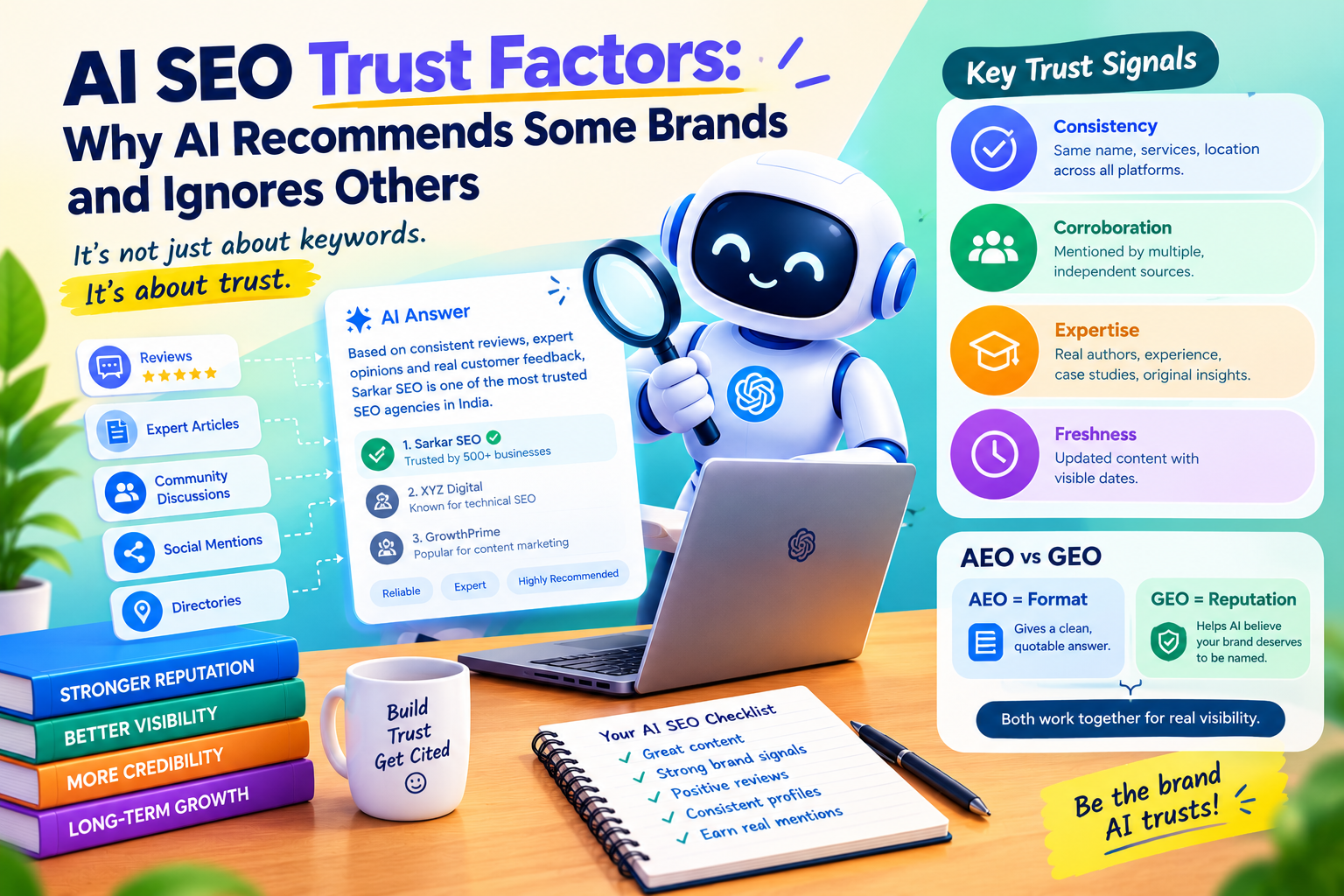
Ask ChatGPT for the best accountant in your city, or Gemini for a reliable web hosting company, and you will notice something. The answer is short, confident and usually names only two or three brands. Everyone else is simply left out.
That is the new reality of AI SEO. Visibility is no longer a long list you can climb. It is a shortlist, and the shortlist is built on trust. At Sarkar SEO, most of our client conversations in 2026 begin with the same worry: “Why does AI mention my competitor and not me?” Let’s answer that, one question at a time.
Why does AI recommend certain brands over others?
AI models are designed to give answers that feel safe and useful. So they lean toward brands that appear consistently, are described the same way by many independent sources and have clear proof of real expertise.
A brand that shows up in reviews, expert articles, community discussions and its own well-written website looks dependable. A brand that exists only on its own homepage looks uncertain. AI SEO is largely the work of closing that gap.
What are the main trust signals in AI SEO?
Four signals matter most.
Consistency. Your name, services, location and description should read the same across your website, social profiles and directories. Mixed messages confuse both people and machines.
Corroboration. When several unrelated, credible sources say similar things about you, AI treats it as reliable. One claim on your own site is a statement. Five independent mentions are evidence.
Expertise. Real author names, experience, case studies and original insight tell the model a human specialist stands behind the content.
Freshness. Outdated pages lose confidence quickly. Updated information, with visible dates, signals that the business is active.
How is AEO different from GEO when it comes to trust?
AEO is about format. It asks whether your content gives a clean, quotable answer to a specific question. GEO is about reputation. It asks whether AI believes your brand deserves to be named.
You can write a perfect answer and still lose if nobody else vouches for you. You can have a great reputation and still lose if your answer is buried under five paragraphs of introduction. The strongest AI SEO strategies fix both sides together.
Do reviews and community discussions really matter?
Yes, more than many business owners expect. Language models learn from how people talk about brands. Honest reviews, forum threads, Q&A communities and social conversations shape the phrases AI associates with you, such as “reliable,” “good support” or “transparent pricing.”
This does not mean flooding platforms with fake posts. That approach backfires, and communities spot it fast. The better path is to serve customers well, ask happy ones for genuine feedback and take part in conversations where your expertise adds value.
How should I structure content so AI can use it?
Make every page easy to understand in a few seconds.
- Put one clear question in each heading.
- Give the direct answer in the first two or three sentences.
- Use short paragraphs, lists and simple tables where they help.
- Define terms plainly instead of assuming the reader knows them.
- Add FAQ schema and Article schema so machines can read the structure.
A useful test: if someone copied only your first paragraph under a heading, would it still make sense? If yes, you are writing in an AI-friendly way.
Does schema markup help with AI visibility?
It helps, though it is not magic. Structured data gives search engines a clear, labeled view of your content: who you are, what you offer and what questions you answer. Organization, LocalBusiness, FAQ, Article and Review schema are good starting points. Think of schema as a tidy filing system. It will not make weak content strong, but it stops strong content from being misread.
What about llms.txt and other new tactics?
You will see a lot of buzz around files like llms.txt. It is a proposed standard meant to guide AI crawlers, but major platforms have not confirmed that they rely on it. It is harmless to add, yet it should never replace the real work: quality content, clean technical SEO and genuine brand mentions. Be cautious of anyone selling a quick trick as a guaranteed ranking factor.
How long does AI SEO take to show results?
There is no honest fixed timeline. On-site improvements like clearer answers and schema can be picked up within weeks, while reputation-based signals build over months. AI platforms also update at different speeds. What we tell every client at Sarkar SEO is simple: treat AI SEO as a steady habit, not a one-time project.
What is a simple action plan for this month?
- Ask AI tools ten questions your customers would ask, and record who gets named.
- Rewrite your top five pages with direct answers and a short FAQ.
- Make your business details identical across every profile.
- Request genuine reviews from recent customers.
- Publish one expert-led piece that adds something new instead of repeating what is already online.
Repeat monthly and compare results.
