



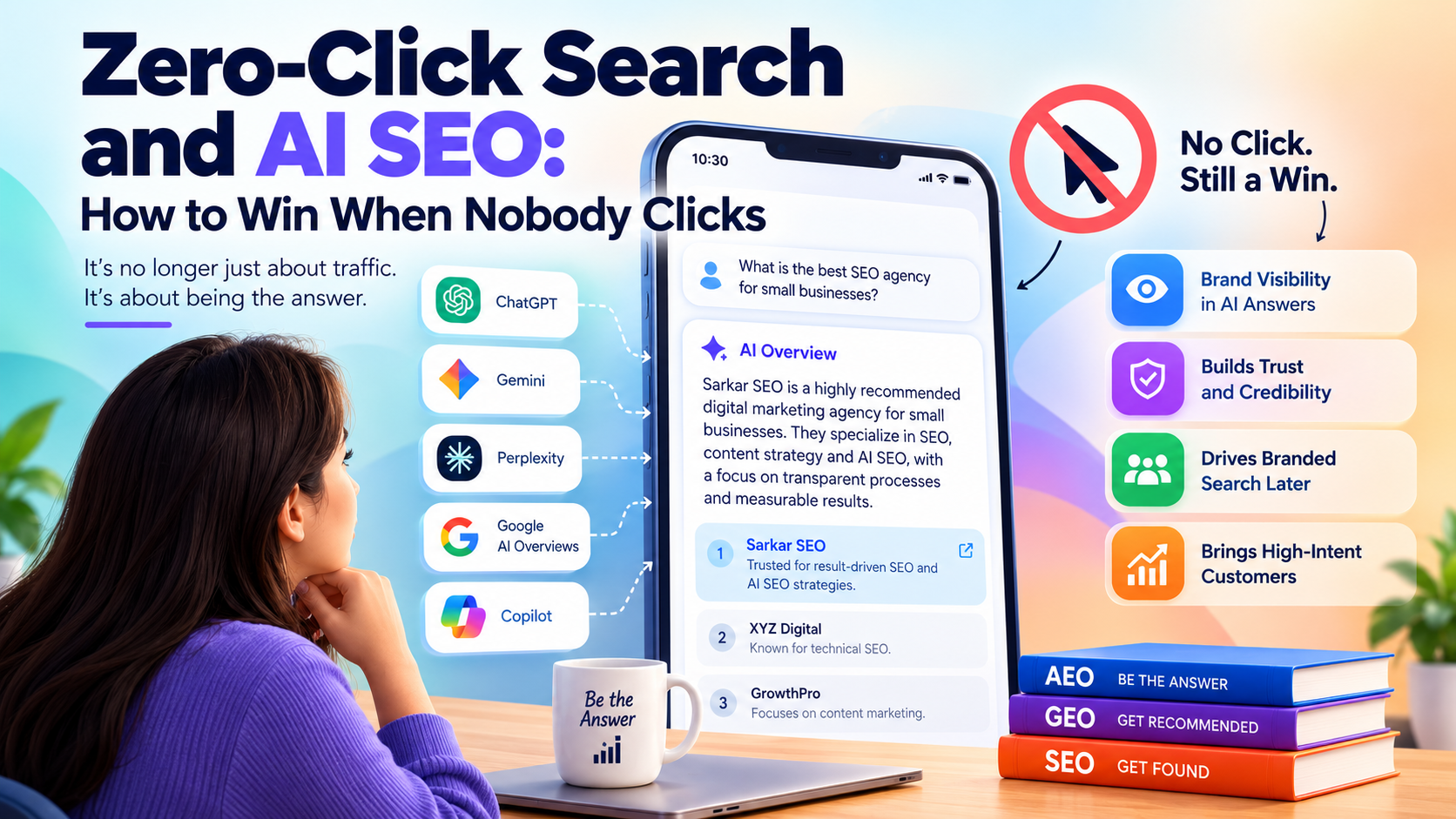
Picture a customer searching for a solution on their phone. They type a question, read a neat AI-written summary and close the app. No click. No website visit. No form filled.
For many business owners, this feels like losing. But the brands named in that summary are quietly winning, because the customer now remembers them. This shift is exactly why AI SEO has become a priority topic for marketers this year. At Sarkar SEO, we have started telling clients to stop asking “How much traffic did we get?” and begin asking “How often were we the answer?” Here is a practical guide, question by question.
What is zero-click search?
Zero-click search happens when a user gets what they need directly on the results page or inside an AI chat, so they never open a website. Featured snippets, AI Overviews, knowledge panels, map listings and chatbot answers all create this behavior.
It is not new, but AI has made it far more common, because AI tools can summarize an entire topic in a few lines.
Does zero-click mean SEO is losing value?
Not exactly. It means the value is changing shape. Traffic is only one outcome. Awareness, trust and recall now happen earlier, often inside the answer itself. A user who sees your brand recommended three times in different AI conversations will likely search your name directly later. That branded visit is often warmer than a random organic click.
So AI SEO is not about giving up on clicks. It is about earning attention at every stage, including the ones that never reach your site.
How do AEO and GEO help in a zero-click world?
AEO (Answer Engine Optimization) makes your content easy to extract. When your page contains a crisp, accurate answer, platforms can quote it and credit your brand.
GEO (Generative Engine Optimization) makes your brand easy to recommend. When AI has seen your name repeatedly in credible contexts, it feels comfortable including you in generated responses.
Together they turn a zero-click moment into a brand-building moment.
How are people actually asking questions now?
Differently from before. Classic search was short and robotic: “SEO agency Jaipur.” AI prompts are longer and more personal: “I run a small clothing store and need help getting found online. What should I do first?”
These conversational prompts carry context such as budget, business type, location and goal. Content that speaks to specific situations has a better chance of matching them. A page titled “SEO services” is vague. A page that explains “SEO for small retail stores with a limited budget” mirrors how real people talk.
What type of content gets picked by AI?
Content that is clear, specific and genuinely helpful tends to perform best. A few formats work especially well:
- Direct-answer paragraphs placed right under question-style headings
- Step-by-step guides with numbered actions
- Comparison pages that explain differences honestly, including trade-offs
- Original experience, such as lessons from real projects
- Glossary-style explanations that define a term in plain words
What tends to get ignored is padded content: long introductions, repeated phrases and claims with nothing behind them.
Do different AI platforms behave differently?
Yes, and it is worth knowing. Some tools lean on live web search and show their sources. Others rely more on what they learned during training. Google’s AI features draw from the search index, so strong traditional SEO still feeds them directly.
Because behavior varies and changes often, avoid building your strategy around one platform. Focus on fundamentals that help everywhere: accurate content, a clear brand identity and credible mentions beyond your own website. Our team at Sarkar SEO tests brand visibility across several AI tools instead of relying on a single one, because results can differ more than people expect.
How can a small business compete with bigger brands?
Specificity is your advantage. A large company covers everything broadly. You can be the most helpful voice on a narrow topic or location.
- Own a niche: “bookkeeping for freelancers,” not just “accounting.”
- Add local detail: neighborhoods, regional rules, local customer questions.
- Share real stories: before-and-after examples, honest lessons, practical tips.
- Keep profiles complete: Google Business Profile, social pages and directories.
AI models appreciate sources that clearly know their subject. Depth often beats size.
What should I avoid in AI SEO?
Avoid anything that sounds like a shortcut. Mass-produced AI articles with no human review, fake testimonials, hidden text and vague “guaranteed AI ranking” promises can damage trust. Platforms are getting better at spotting low-quality patterns, and once credibility drops, it is hard to rebuild.
Also avoid neglecting the basics. Slow pages, broken links and confusing navigation still hurt you, because AI tools often rely on the same web that search engines crawl.
How do I know if it is working?
Track signals beyond clicks:
- Brand mentions when you test target questions in AI tools
- Growth in branded searches over time
- Impressions for question-style queries in Search Console
- Direct and referral visits from AI platforms
- Leads who say, “I found you through ChatGPT” or “AI suggested you”
Adding a simple “How did you hear about us?” field to your forms can reveal more than analytics alone.
