



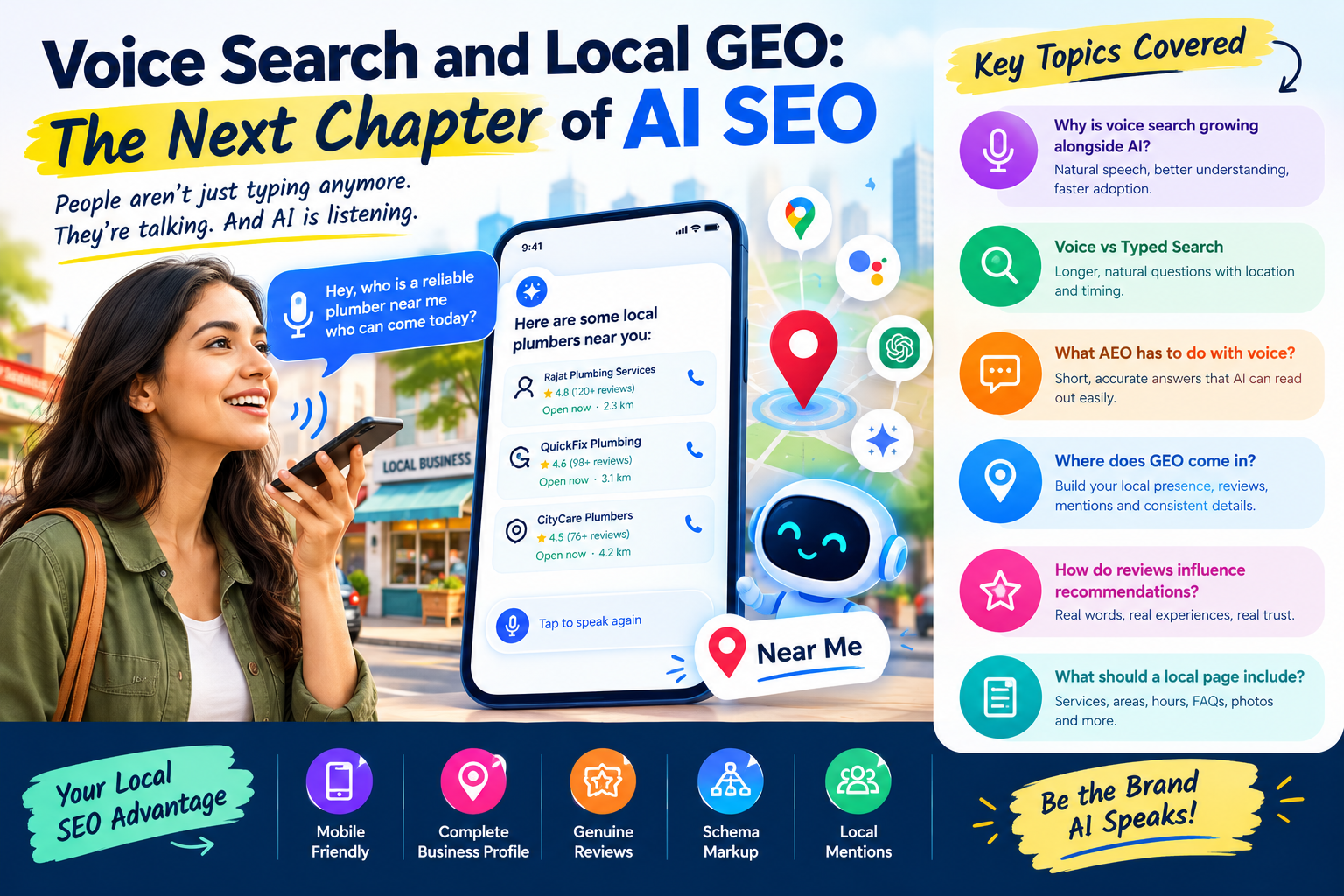
Think about how you ask questions when your hands are busy. In the car, in the kitchen, or while walking. You do not type “plumber Jaipur.” You say, “Hey, who is a reliable plumber near me who can come today?”
That one spoken sentence is changing local marketing. Voice assistants and AI tools give one or two answers, not ten links. At Sarkar SEO, we are seeing local businesses realize that being “somewhere on page one” is no longer enough. They need to be the name that gets spoken. Here is how AI SEO fits into that, one question at a time.
Why is voice search growing alongside AI?
Because the technology finally understands people. Earlier voice assistants needed exact phrases. Modern AI handles natural speech, follow-up questions and context. Users can say, “What about one that is open on Sunday?” and the assistant remembers the earlier question.
This makes asking by voice feel easy, and easy habits spread fast. For businesses, it means customers increasingly arrive with a clear, conversational request and a high intent to act.
How does voice search differ from typed search?
Voice queries are longer, more natural and often shaped as complete questions. They also lean heavily on place and timing: “near me,” “open now,” “today,” “this weekend.”
Typed: “dentist Jaipur”
Spoken: “Which dentist near me is good with kids and open on Saturday?”
Your content needs to answer the second version. A page that mentions child-friendly care, Saturday hours and the neighborhood you serve is far more likely to match than one that simply lists “dental services.”
What does AEO have to do with voice?
Almost everything. Voice assistants usually read out a single answer, so the answer must be short, accurate and easy to extract. That is the heart of Answer Engine Optimization (AEO).
Place a direct answer of roughly two to three sentences right under each question heading. Then add detail below it. If a voice assistant reads only your first paragraph, it should still be useful and complete.
Where does GEO come in for local businesses?
Generative Engine Optimization (GEO) is about whether AI tools feel confident naming your business in a generated response. For local companies, that confidence comes from a few places:
- A complete, accurate Google Business Profile
- Consistent name, address and phone details everywhere
- Genuine reviews that mention specific services and experiences
- Local mentions in news, community pages and directories
- Clear service-area information on your own website
When these pieces agree with one another, AI treats your business as a real, dependable local option.
How do reviews influence AI recommendations?
Strongly, and not only through star ratings. The words inside reviews matter. A review saying “fast delivery and honest pricing” gives AI a ready-made description of your strengths. Over time, those repeated phrases shape how your business is summarized.
Encourage satisfied customers to share details about what they bought and how it went. Reply to reviews politely, including the critical ones. Never buy fake reviews. Platforms and communities are increasingly good at spotting them, and the damage to trust can last.
What should a local service page include?
Strong local pages feel useful, not stuffed. Include:
- A plain-language summary of the service and who it is for
- The areas you serve, written the way locals describe them
- Clear pricing guidance or what affects the price
- Opening hours and how to book
- Five to eight real FAQs customers actually ask
- Photos, team details and proof of experience
Our team at Sarkar SEO often finds that adding honest FAQs alone makes a local page noticeably clearer, both for customers and for AI systems reading it.
Is schema markup important for local AI SEO?
It is a helpful extra layer. LocalBusiness, FAQ, Review and Organization schema label your details in a format machines read easily: name, address, hours, services and common questions. Schema will not rescue weak content, but it reduces the chance of your information being misunderstood. Treat it as good housekeeping.
Can small and new businesses really compete?
Yes, and local search is one of the fairest places to do it. You may not have a huge brand, but you can be the most helpful, most specific and best-reviewed option in your area. AI tools reward clarity and relevance, and a neighborhood specialist can outshine a faceless national brand for local questions.
Pick a clear niche, show real people and real work, and keep every online profile polished.
What mistakes should I avoid?
- Using different business names or phone numbers across platforms
- Writing pages around keywords instead of customer questions
- Ignoring mobile speed, since most voice and local queries happen on phones
- Leaving old information online, such as outdated hours
- Promising “guaranteed AI rankings.” Nobody can truthfully promise that
How do I get started this week?
Ask three AI tools the questions a local customer would speak aloud, and note who is named. Then update your Business Profile, fix any inconsistent details, add a short FAQ to your main service page and ask three recent customers for detailed reviews. Repeat every month and watch how the answers change.
