



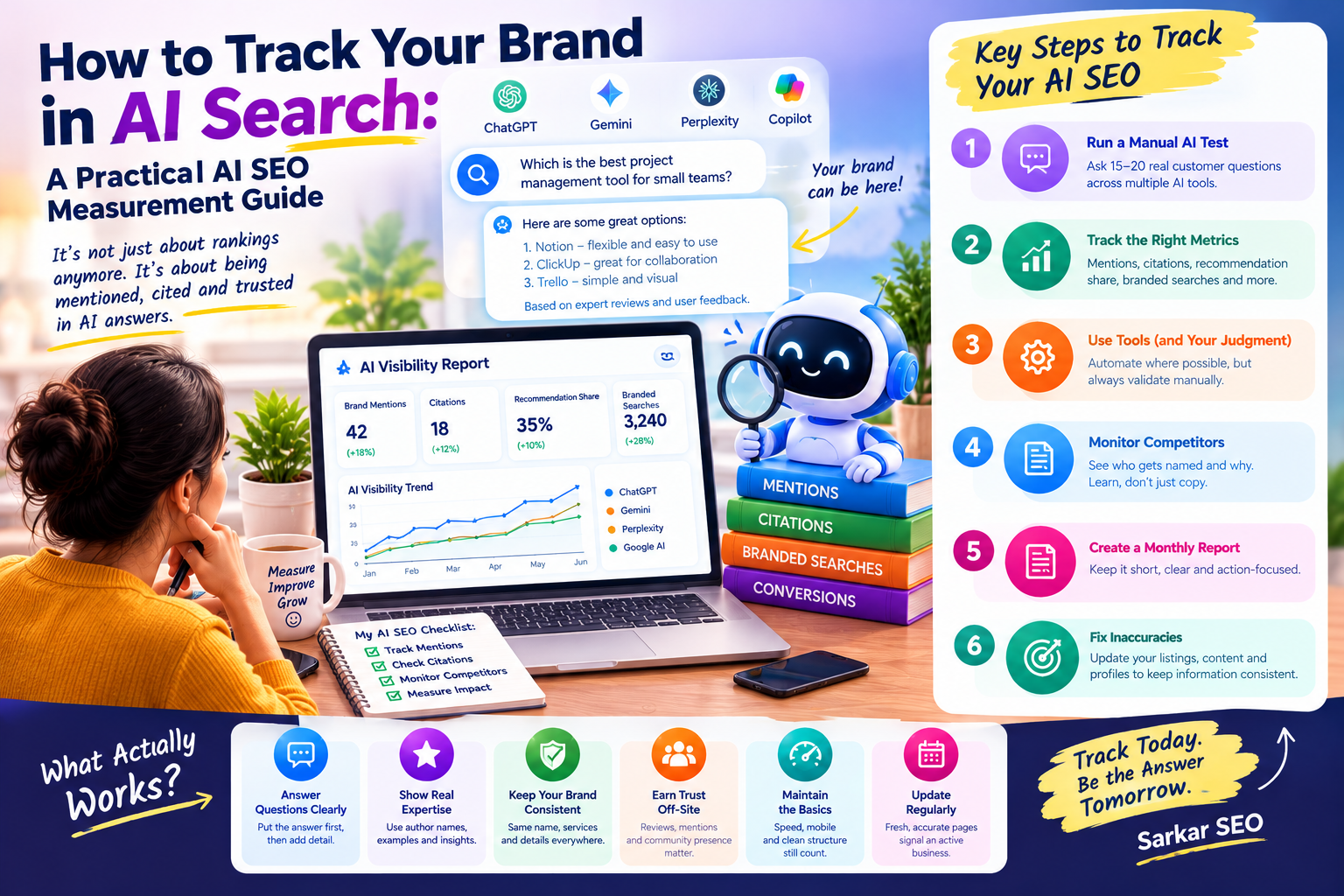
Here is an uncomfortable situation many business owners find themselves in. They invest in content, improve their website and hear that AI tools are sending them attention, yet when the monthly report arrives, the dashboard looks the same as before. Rankings are steady, traffic is flat, and nobody can say whether AI SEO is mentioning the brand at all.
The problem is not the strategy. It is the measurement. Old reports were built for a world of ten blue links, and AI answers do not fit into them. At Sarkar SEO, building a clearer way to measure AI visibility has become one of our most requested tasks. Let’s walk through it, question by question.
Why is AI visibility harder to measure than rankings?
Because AI answers are not fixed. A search ranking is fairly stable: you are position four today and probably position four tomorrow. An AI response can change from one moment to the next, vary by wording, differ between platforms and even differ between two users asking the same question.
There is also no official “AI Search Console” that shows exactly how often a chatbot named you. That means measurement relies on a mix of manual testing, existing analytics and careful pattern spotting. It is less tidy, but it is very workable.
What should I actually track?
Think in four layers.
- Mentions. When you ask AI tools your target questions, is your brand named at all?
- Position and context. Are you the first recommendation or the fourth? Is the description positive, neutral or inaccurate?
- Citations. Does the AI link to your website or quote your content as a source?
- Business impact. Are branded searches, enquiries and sales moving in the right direction?
Together, these show whether your AI SEO efforts are creating visibility and whether that visibility is turning into results.
How do I run a simple manual AI visibility test?
You do not need expensive software to begin. Try this routine.
- Write 15 to 20 questions your real customers would ask. Mix broad ones (“best accounting software for freelancers”) with specific ones (“which accounting tool works well for GST billing?”).
- Ask each question in several platforms, such as ChatGPT, Gemini, Perplexity, Copilot and Google’s AI Overviews.
- Record the date, the exact wording, which brands were named and whether your site was cited.
- Repeat the same questions every month, using the same wording.
Because answers fluctuate, treat any single result with caution. Look for trends across weeks, not one-off wins or losses.
What is “recommendation share”?
Recommendation share is a simple idea: out of all the answers you tested, how often did your brand appear compared with competitors? If you tested 20 questions and your brand was named in 6, your visibility is 30 percent for that set. If a competitor appeared in 12, they hold 60 percent.
This number is not perfect, and it is not an official metric. But it gives you a consistent benchmark to improve against, which is far better than guessing.
Are there tools that automate this?
Yes. A growing number of platforms now offer AI visibility tracking, and several well-known SEO suites have added similar features. They typically run your chosen prompts on a schedule and report mentions, competitors and cited sources.
These tools can save time, but they are still new, and their methods vary. Before paying, check how they collect data, how often they refresh and whether results match what you see manually. A tool should support your judgment, not replace it. Our team at Sarkar SEO usually combines light automation with regular manual checks so that nothing important slips through.
Which analytics signals show AI is helping me?
Several existing tools can reveal indirect impact.
- Google Search Console: Watch impressions for question-style and long, conversational queries. Growth here often reflects AEO progress.
- Google Analytics: Check referral traffic from AI platforms. Some tools pass a referrer, though not all do, so treat this as a partial picture.
- Branded search growth: If more people search your brand name directly, AI mentions may be planting the idea.
- Direct traffic: A rise in people typing your address may signal growing recall.
- Sales and lead forms: Add a “How did you hear about us?” field with options like “AI assistant,” and read the free-text answers.
Customers often tell you more than the dashboard does.
How do I check whether AI describes my brand accurately?
Accuracy matters as much as visibility. When you test questions, note what the AI says about you: services, location, pricing, strengths. If it states something wrong, find the likely source. Outdated directory listings, old press coverage and inconsistent profiles are common culprits.
Fix errors at the source. Update your website, correct business listings and publish a clear, current page that states the facts plainly. Over time, consistent information across the web helps AI repeat the right details. This is a core part of GEO.
Why should I track competitors too?
Because AI answers are comparative. Seeing who gets named beside you, or instead of you, shows where the gaps are. Look at which sources the AI cites when it recommends a competitor. Is it a review site, a comparison article or a community thread? That tells you where to focus your own outreach and content.
Do this to learn, not to copy. The goal is to understand what makes a brand trustworthy in your category and to offer something more useful.
What should a monthly AI SEO report include?
Keep it short and readable.
- Recommendation share across your tested questions
- New or lost mentions compared with last month
- Citations earned and which pages were used
- Any inaccurate descriptions found and corrected
- Branded search and impression trends
- Leads or sales linked to AI discovery
- Two or three actions for next month
A one-page summary that a busy owner can read in five minutes is worth more than a thirty-page export no one opens.
What mistakes should I avoid when measuring?
- Judging results from a single test or a single platform
- Changing your question wording every month, which breaks comparisons
- Ignoring accuracy and focusing only on mentions
- Expecting instant results, since reputation signals build slowly
- Trusting any tool or agency that promises guaranteed AI rankings
