



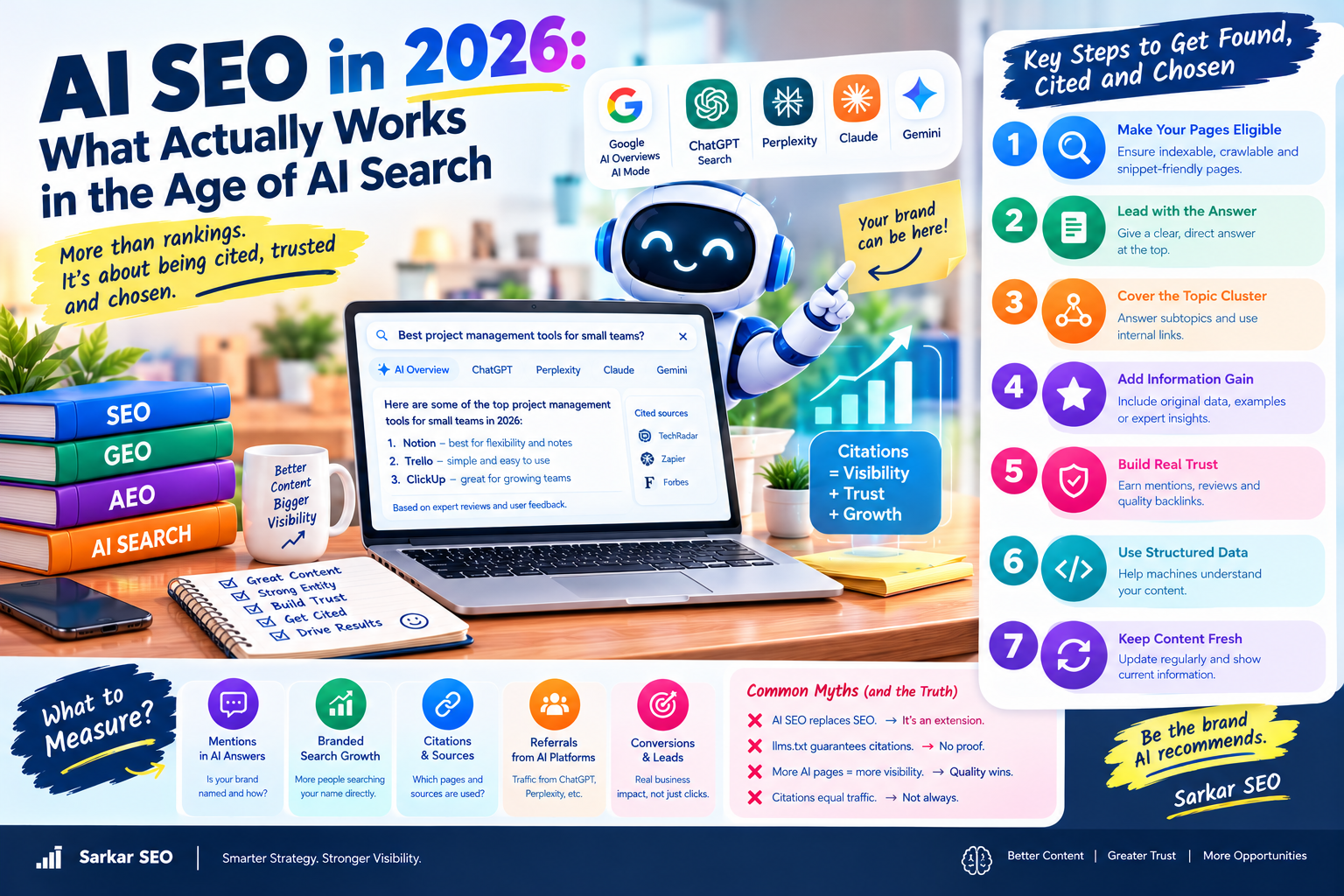
Search no longer ends with ten blue links. Google summarizes answers at the top of the page, ChatGPT cites sources, and Perplexity builds its answers around them. So the question for site owners has changed. It is no longer only “how do I rank?” but “how do I get chosen, cited and clicked?”
That is the promise of AI SEO. It is also surrounded by hype. Here is what the evidence supports.
What Is AI SEO?
AI SEO is the practice of making your content discoverable, understandable and citable by AI-driven search experiences, as well as by traditional results. These include Google’s AI Overviews and AI Mode, ChatGPT search, Perplexity, Claude and Gemini. You will also see it called GEO (generative engine optimization) or AEO (answer engine optimization). The labels differ, but the goal is the same: be the source an answer engine trusts.
What Google Says About AI SEO
In May 2026, Google published its first dedicated guide to optimizing for generative AI features in Search. It covers unique, non-commodity content, local, shopping, image and video content, mythbusting around “AEO/GEO,” and early guidance on AI agents. google
Its position is blunt. From Google’s perspective, optimizing for generative AI search is optimizing for the search experience, and so it is still SEO. The mechanics explain why. Google’s AI features use retrieval-augmented generation to pull from the existing Search index. There is no separate AI index to game. A page must be indexed and eligible to show with a snippet to appear in these features. google says ai optimization is just seo +2
Google also names what you can skip. Chunking content into short paragraphs, writing in an “AI-friendly” way, and chasing inauthentic mentions are not required, and fake mentions may look like spam. Google also confirms that no special schema markup is required for AI features. practicalecommerceinterodigital
One caveat matters. The guidance applies to AI Overviews and AI Mode, not necessarily to Gemini the standalone app, or to ChatGPT and Claude. Sarkar SEO treats Google’s guide as the foundation, not the whole picture. practicalecommerce
Beyond Google: ChatGPT, Perplexity and Claude
Other answer engines run on their own crawlers, and this is where many sites quietly lose visibility. Several vendors separate their crawlers by purpose. OpenAI treats GPTBot as the training control and OAI-SearchBot as the control for ChatGPT search. Blocking search-and-citation crawlers such as OAI-SearchBot, PerplexityBot and Claude-SearchBot excludes your site from those AI answers entirely, while training crawlers can be blocked or allowed based on your content strategy. therankmastersgrowthmk
Also note that if a crawler is blocked at the edge by a firewall or CDN, your robots.txt settings do not matter. Check both layers. aokmarketing
A Practical AI SEO Playbook
- Fix crawlability and indexation first.
Confirm that important pages return 200 status codes, carry no accidental noindex tag, and are not blocked in robots.txt. Generative answers draw on the same index as normal web search. A page that is not indexed cannot be cited. trustedshops - Publish non-commodity content.
If your content could have been written by anyone with a search engine, AI models have little reason to prefer your version. Add what a summarizer cannot invent: original data, first-hand case studies, tested workflows, screenshots, expert commentary. Every article should leave the reader knowing something they could not get from the top three results. previsible - Answer the question early, then go deeper.
You do not need to contort your writing for machines. Still, a clear answer near the top, followed by depth, serves skimming humans and extraction systems alike. Use descriptive headings and semantic HTML, the same structure for people and AI agents. - Cover the fan-out.
AI Mode, and to a lesser degree AI Overviews, uses “query fan-out” to break one question into several sub-queries. Think about the follow-up questions behind a topic: definitions, comparisons, costs, risks, next steps. A page, or a well-linked cluster of pages, that covers these has more chances to be retrieved. llmpulse - Build a real reputation.
Google confirms its AI features surface what is being said about brands across third-party sources. Earn mentions through original research, expert contributions, helpful community participation and genuine customer reviews. Never buy or fabricate them. previsible - Strengthen entities and details.
For local and e-commerce businesses, keep business profiles, product data and structured data accurate and consistent with what is visible on the page. Product data in AI Mode is informed in part by the Shopping Graph, which is powered by brand-provided feeds. botify - Maintain images and video.
Google’s AI search can surface relevant images and video, and following image and video SEO best practices already counts as optimizing for it. google
Myths Worth Retiring
- “AI SEO replaces SEO.” Google’s own documentation says otherwise.
- “Add llms.txt and you’ll be cited.” I found no evidence in Google’s guidance that this is needed for its AI features. Treat it as optional housekeeping, not a ranking lever.
- “More AI-generated pages means more visibility.” Scaled, undifferentiated content is exactly the commodity content Google’s guide cautions against.
- “Citations equal traffic.” Not necessarily. One analysis claims roughly 93% of AI Mode sessions end without a visit to an external website. That figure comes from a vendor blog, so treat it as directional. Even so, being cited builds brand presence even when no click follows, so measure more than clicks. nogood
How to Measure AI SEO
Track outcomes that connect to business results:
- Search Console performance for the queries and pages that trigger AI features. Google has also added a Search Console toggle that controls AI Overviews, AI Mode and Discover AI. digitalapplied
- Referral traffic from ChatGPT, Perplexity and similar sources in your analytics.
- Branded search growth, which often rises when AI answers mention you.
- Manual prompt audits: ask each major engine your customers’ questions monthly, and record whether you are cited, how you are described, and whether it is accurate.
- Conversions, not just sessions. AI-referred visitors may be fewer but more informed.
