



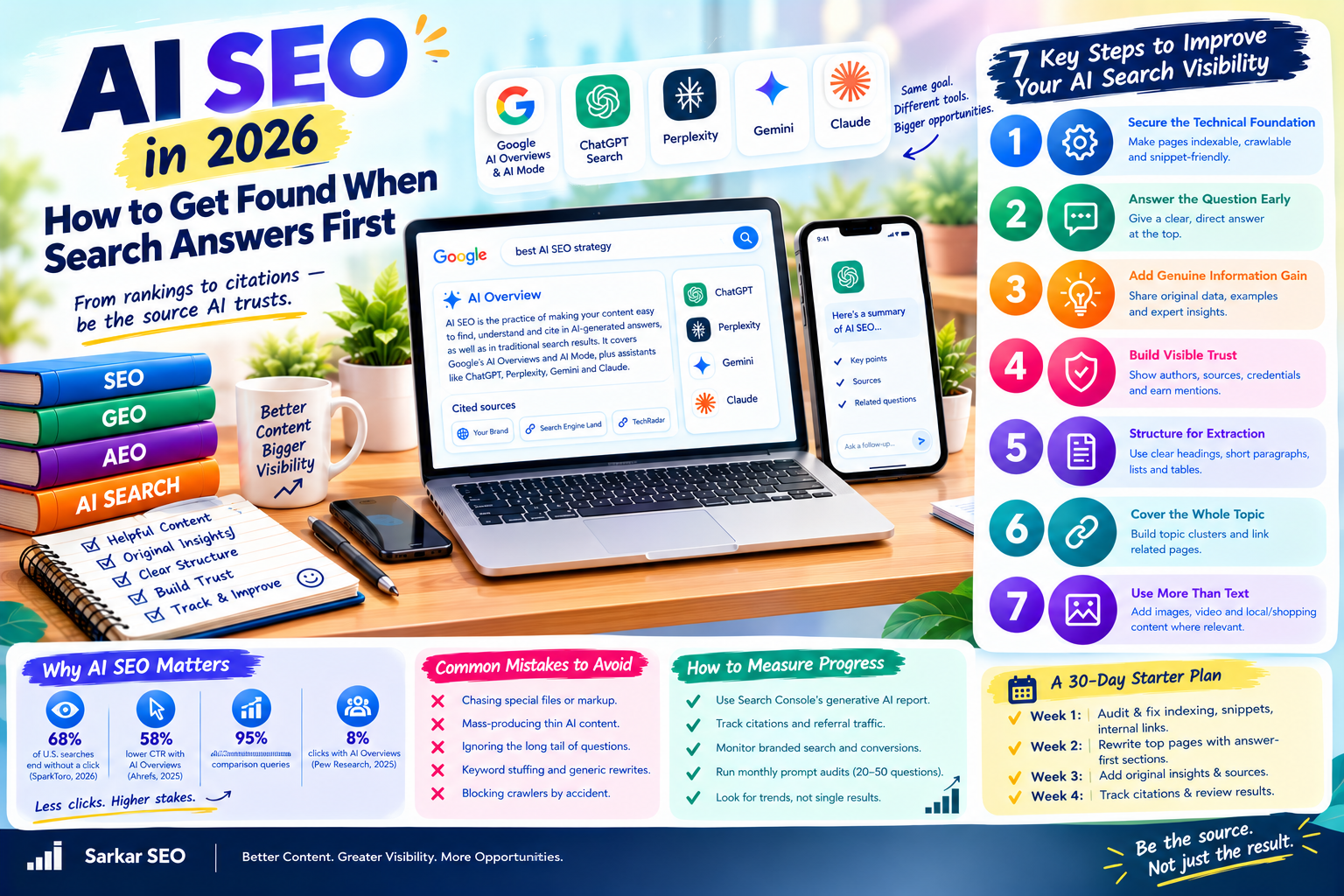
Ranking first used to mean winning the click. That is no longer guaranteed. Google, ChatGPT, Perplexity, Gemini and Claude now often answer a question before anyone visits a website. AI SEO is the practice of making your content easy for these systems to find, trust and cite, while still earning classic rankings. Here is what has changed, what the evidence shows, and what to do about it.
What Is AI SEO?
AI SEO means optimizing content so it appears inside AI-generated answers as well as in traditional results. You will also see it called generative engine optimization (GEO) or answer engine optimization (AEO). The GEO label traces back to a 2023 academic paper, and the practice has since grown into an industry of its own.
At Sarkar SEO, we frame it simply: AI SEO is not a replacement for SEO, it is SEO with a wider definition of “visible.” Google’s own guidance agrees. It states that no additional requirements or special optimizations are needed to appear in AI Overviews or AI Mode. A page must be indexed and eligible to show with a snippet. That’s it.
Why AI SEO Matters Now
Three data points show the scale of the shift:
- Clicks are falling where AI Overviews appear. Ahrefs analyzed 300,000 keywords and found that top-ranking pages had a 58% lower click-through rate when an AI Overview was present, compared with December 2023. Eight months earlier, the same study had measured 34.5%.
- Zero-click behavior is rising. SparkToro’s 2026 research reports that AI Overviews appear on more than 20% of Google searches, and that about 68% of US searches ended without a click in early 2026.
- Being cited helps, but does not fully compensate. Seer Interactive found roughly 3.3% CTR with no AI Overview, about 2.1% when your page is cited in one, and about 0.9% when it is not.
The exposure is uneven. Seer’s data shows AI Overviews on roughly 95% of comparison queries and 86% of question queries, but only about 5% of transactional ones. Informational content takes the hit first. High-intent and branded searches hold up better.
Rankings and Citations Are Not the Same Thing
Here is where AI SEO diverges from classic SEO. An eMarketer report found that fewer than 10% of sources cited by ChatGPT, Gemini and Copilot rank in Google’s top 10 for the same query. Ranking well helps you get crawled and considered, but it does not guarantee a mention.
Why? Research from the University of Toronto, which studied 158,099 AI answers and 468,037 citations, points to a mix of what content says, how it is retrieved, and what the model already “believes” about brands. Popular tactics such as FAQ blocks, structured data and summary boxes are widely recommended, yet Google says no special markup is required. Treat any claimed “citation formula” with caution. The research is still maturing, and results differ by engine.
A Practical AI SEO Playbook
- Secure the foundation. Confirm your key pages are crawlable, indexable and not blocked by noindex or nosnippet directives. Google notes that robots.txt controls for Googlebot also govern Search access, and that AI feature traffic is reported inside your normal Search Console totals.
- Answer first, then go deep. Open each section with a direct one- or two-sentence answer, then add context, evidence and nuance. Readers get what they need fast, and answer engines have a clean passage to lift. This is sound editorial practice rather than a proven ranking factor.
- Cover the whole question space. AI Mode and AI Overviews can use query fan-out, breaking a question into related subtopics. Build topic clusters that answer the follow-up questions a real buyer asks: costs, comparisons, risks, alternatives, next steps.
- Add information gain. If your page repeats what ten others say, an AI system has no reason to prefer yours. Publish original data, firsthand experience, clear methodology, and named authors with real credentials. Sarkar SEO recommends at least one genuinely new element per article: a dataset, a worked example, or a documented test.
- Build presence beyond your own site. Because model familiarity with a brand appears to influence what gets surfaced, consistent mentions in reputable publications, reviews, directories and communities likely matter. This is our inference from the research, not a guarantee.
- Measure visibility, not just traffic. Track branded search growth, impressions, assisted conversions, and how often your brand is cited across a fixed set of prompts in each AI engine. Seer noted that clicks sometimes stayed flat while impressions grew, a sign that appearing in more answers can be hidden by CTR alone. Sarkar SEO suggests reviewing a prompt set monthly and logging citations, sentiment and accuracy.
Mistakes to Avoid
- Chasing special files. Google says you do not need new machine-readable files, AI text files or markup to appear in its AI features.
- Mass-producing thin AI content. Quantity without original value gives answer engines nothing worth citing.
- Abandoning classic SEO. Foundations still determine eligibility.
- Ignoring intent. Defend informational traffic with depth and brand, and put conversion effort into queries where people still click.
Quick Answers
Is AI SEO different from SEO? It builds on SEO. The fundamentals decide eligibility, while clarity, originality and brand authority influence whether you are cited.
Do I need schema to appear in AI Overviews? Google says no special markup is required. Structured data can still help search engines understand a page.
How do I know if it works? Monitor citations across a stable prompt set, branded demand and conversions, not rankings alone.
