



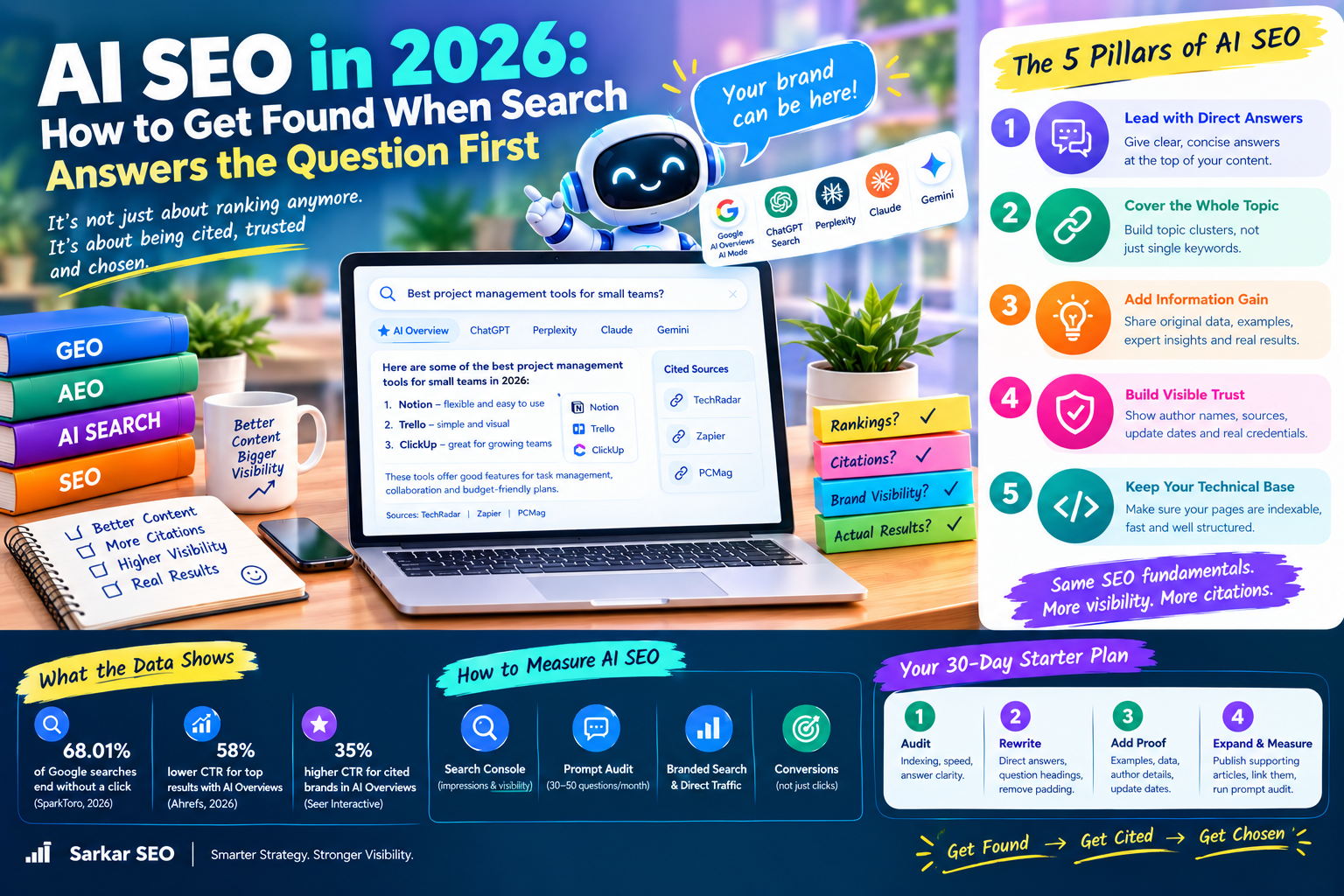
Search has changed shape. People still type queries, but many now get an AI-written answer before they see a single blue link. AI SEO is the practice of making your content easy to find, understand, trust, and cite across Google’s AI features and standalone answer engines such as ChatGPT, Perplexity, Gemini, and Claude.
It doesn’t replace traditional SEO. It extends it. Here is what the evidence says and how to act on it.
Why AI SEO Matters Now
The click is under pressure. SparkToro’s analysis of U.S. Google searches from January to April 2026 found that 68.01% ended without a click. The study doesn’t isolate how much AI Overviews contribute, but it points to them as a likely factor. searchengineland
Ahrefs measured the effect on rankings directly. In a study of 300,000 keywords, it found that AI Overviews correlate with a 58% lower clickthrough rate for the top-ranking page. Treat the exact figure with caution, because studies disagree. One comparison of research notes that First Page Sage’s meta-analysis is an outlier, arguing AI Overviews have minimal impact on organic CTR. Methodology, query mix, and device all shift the numbers. itouterboxdesign
The direction is consistent, though. Ranking first no longer guarantees traffic, so visibility now has two goals: being ranked and being referenced.
The upside is real. Seer Interactive reported that brands cited in AI Overviews saw 35% higher organic click-through rates. That is one vendor’s dataset, so use it as a signal rather than a promise. It still suggests that being the source an AI quotes is worth pursuing. seerinteractive
What Google Actually Says
Much AI SEO advice online is speculation, so start with Google’s own documentation. Its guide for site owners says that specific optimization isn’t required for AI Overviews and AI Mode, and that existing SEO fundamentals remain worthwhile. It also states there is no special schema.org structured data you need to add. googlegoogle
Google also explains that both features may use “query fan-out,” issuing multiple related searches across subtopics and data sources to build a response. That has a practical consequence. Your page can be pulled in for a question you never targeted directly, if it answers a related subtopic well. google
Beware anyone selling a secret trick. For Google, AI SEO is mostly excellent SEO.
The Five Pillars of AI SEO
- Lead with direct answers
AI systems extract passages, not whole articles. One industry guide notes that AI Overviews pull specific passages and favor content that gets to the point. Open each section with a one-to-two sentence answer, then add nuance, evidence, and examples beneath it. A heading phrased as a question, followed by a crisp answer, is easy for both readers and machines to use. fast
- Cover the whole topic, not one keyword
Because of fan-out, a single page rarely wins on its own. Build topic clusters: a pillar page on the core subject, supported by focused pages on definitions, comparisons, costs, mistakes, and how-tos. Link them together clearly. Google itself lists making content easily findable through internal links among the fundamentals that still apply. google
- Add information gain
Generic summaries are the easiest content for an AI to replace. What earns citations is something the model can’t generate from the average of the web: original data, first-hand case studies, expert commentary, screenshots, process walkthroughs, and clear opinions backed by evidence. If your article only restates the top ten results, give the reader and the AI no reason to choose you.
- Build visible trust
Name your authors, show their credentials, cite primary sources, and date your updates. Keep facts current, since AI Overviews lean heavily on recently updated pages. Sarkar SEO treats this as the foundation of AI search work: an answer engine can only cite what it can verify and trust. fast
- Protect your technical base
None of the above matters if pages can’t be crawled and indexed. Keep your site fast, indexable, and well structured, with accurate titles, descriptions, and alt text on images. Structured data is still useful for clarifying page content to search systems. Just don’t expect it to unlock AI citations by itself.
Don’t Treat All AI Search as One Channel
Google runs more than one AI surface, and they behave differently. Google said at I/O 2026 that AI Mode had passed 1 billion monthly users. One analysis reports that only 13.7% of citations overlap between AI Mode and AI Overviews. That figure comes from a secondary source, so verify it against your own tracking. The implication is still sensible: visibility in one surface doesn’t guarantee visibility in another. searchenginelandfast
The same applies beyond Google. ChatGPT, Perplexity, Claude, Gemini, and Grok each retrieve and cite sources differently, and their behavior changes often. Rather than chase each one, build content that is clear, well sourced, and consistent about who you are and what you do. Those qualities transfer across all of them.
How to Measure AI SEO
Traditional dashboards will understate your impact. Google notes that sites appearing in AI features are included in overall Search Console traffic, within the Web search type. There is no separate AI Overviews report, so you will need a broader approach: google
- Track impressions and visibility alongside clicks. Falling CTR with steady impressions may mean you are being seen but not clicked.
- Run a prompt audit. Maintain a list of 30 to 50 questions your customers ask. Test them monthly across Google, ChatGPT, Perplexity, and Gemini. Record whether you are cited, mentioned, or absent.
- Monitor branded search and direct traffic. Brand awareness from AI answers often shows up here.
- Measure conversions, not just sessions. Fewer visits can still mean better leads.
As Seer’s research suggests, the more realistic goal is to maintain your share and visibility, rather than simply driving traffic. seerinteractive
A Practical 30-Day Starter Plan
Week 1: Audit. Identify your ten highest-value pages. Check indexing, page speed, and whether each page answers its main question in the first few lines.
Week 2: Rewrite for clarity. Add direct answers, question-style subheadings, and a short summary at the top of each priority page. Remove padding.
Week 3: Add proof. Insert original examples, data, author details, and cited sources. Update outdated statistics and show the revision date.
Week 4: Expand and measure. Publish two supporting articles that cover related subtopics, link them to your pillar page, and run your first prompt audit as a baseline.
