



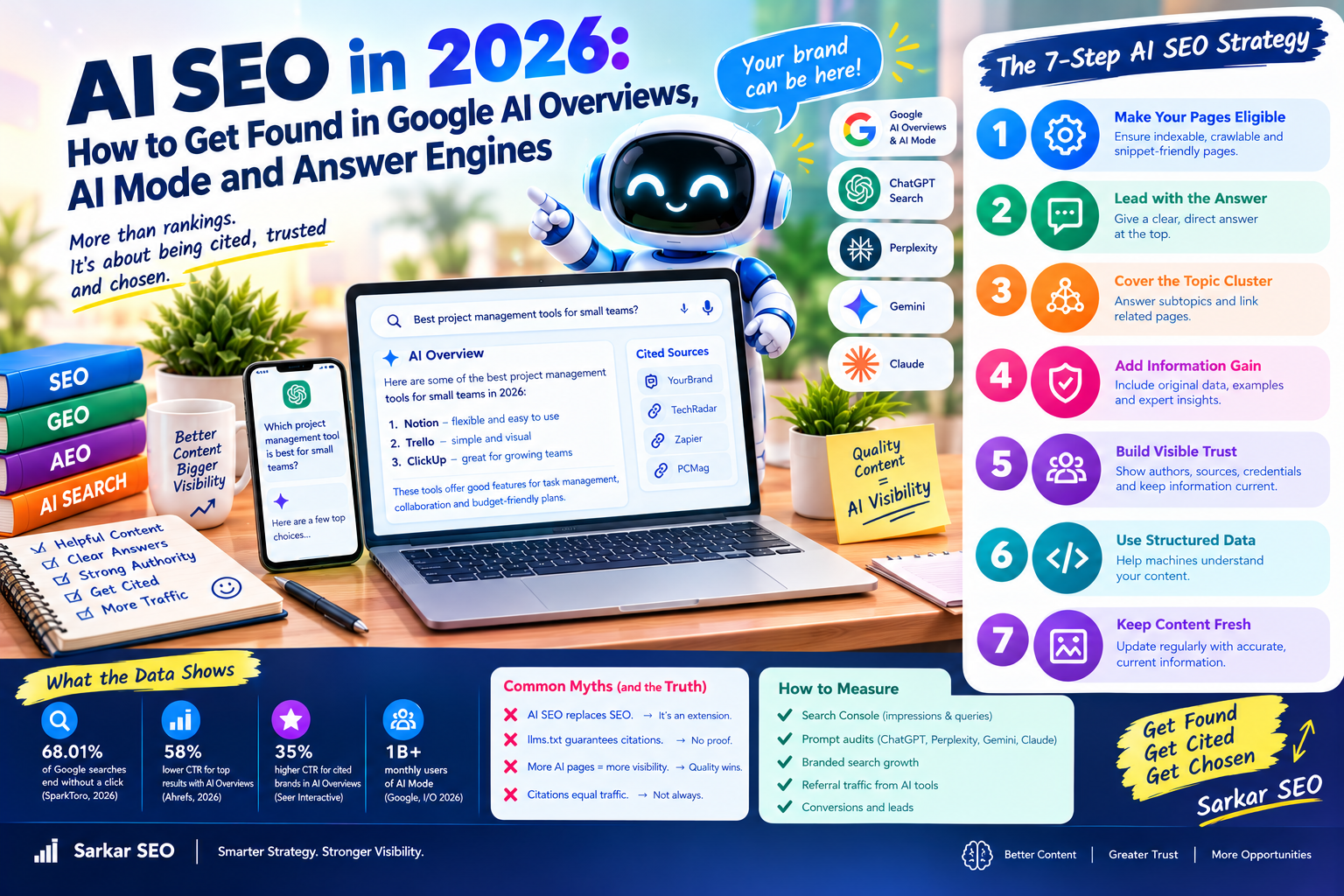
Search used to follow a simple path: publish, rank, get the click. AI-generated answers have changed that path, but they have not made SEO obsolete. AI SEO is the practice of making your content easy for search engines and AI assistants to find, trust, extract and cite. Here is what it involves in 2026, what has changed, and what to do about it.
What AI SEO actually means
AI SEO covers optimizing for Google AI Overviews, Google AI Mode, and assistants such as ChatGPT, Perplexity, Gemini, Grok and Claude. You will also see the terms GEO (generative engine optimization) and AEO (answer engine optimization). They describe the same goal: becoming a source that AI systems quote.
The scale explains the interest. Google says AI Overviews reach more than 2.5 billion monthly users, and AI Mode passed 1 billion monthly users as of May 2026. Your audience is increasingly reading a synthesized answer before they see any list of links. llmpulse
The key point: AI SEO is built on classic SEO
Many agencies sell AI search as a separate discipline. Google’s own guidance disagrees. Google’s developer documentation says that optimizing for AI Overviews and AI Mode remains part of SEO rather than a separate discipline. There is no separate “AI index”: generative answers draw on the same index as normal web search, so a page must first be crawlable and indexable. letsdatasciencetrustedshops
Basic hygiene therefore comes first. A stray noindex tag, a robots.txt block or a server error will keep a page out of AI answers just as it keeps it out of rankings. This guidance covers Google’s products only, so how other assistants choose sources can differ, and you should test them separately.
How Google picks sources: query fan-out
AI Mode, and to a lesser degree AI Overviews, uses a technique Google calls query fan-out, breaking a question into several sub-queries. A single question like “best CRM for a small agency” can trigger separate lookups on pricing, integrations, reviews and ease of use. llmpulse
This has a practical consequence. A page that answers only the headline query is less useful than one that covers the related sub-questions with clear, self-contained passages. Depth of coverage now matters as much as ranking for one phrase.
The AI SEO playbook
- Write answer-first passages. Put a direct answer in the first one or two sentences under each heading, then add the nuance. One sentence that makes sense on its own is easy to lift into an AI response.
- Cover the sub-questions. List the follow-ups a reader would ask after the main question and give each its own heading. This matches how fan-out retrieval works.
- Show real expertise. Name the author, explain their credentials, and publish original material: your own data, screenshots, test results or case notes. Summaries of what everyone else has said give a model no reason to cite you. Guides on this topic also point to building real E-E-A-T and third-party mentions as part of earning citations. llmpulse
- Keep content fresh and crawlable. Update key pages when facts change and show the date. Make sure important text is in the HTML rather than hidden behind scripts that crawlers may not run.
- Use structured data honestly. Schema markup helps machines understand your pages, particularly for products, organizations and articles. It must match the visible content. Google has also said it applies only to indexed pages eligible to appear in Search with a snippet, so snippet restrictions can quietly limit your visibility. llmpulse
- Feed product data where relevant. For ecommerce, AI Mode product answers are informed in part by Google’s Shopping Graph, which draws on brand-provided product feeds. Accurate, complete feeds are part of AI visibility for retailers. botify
- Build a brand, not just pages. Assistants lean on what the wider web says about you. Consistent mentions, reviews, expert quotes and citations from credible sites strengthen the case for including you.
The zero-click reality
Be honest with stakeholders about the trade-off. One industry analysis claims roughly 93% of AI Mode sessions end without a visit to any external website. Treat that figure as a vendor-reported estimate, not a Google statistic, but the direction is plausible: more answers are consumed on the results page. nogood
That changes how you should judge success. A citation in an AI answer builds recognition even when no click follows, and the clicks that do arrive often come from readers who are further along in their decision. Aim for visibility and qualified traffic, not raw sessions alone.
Measuring AI search performance
Measurement is still maturing. Industry coverage notes that Google has added AI Mode tracking to Search Console, letting site owners measure traffic from AI-driven surfaces. Use it as your baseline, then add manual checks: digitalapplied
- Run your 20 to 30 most important queries monthly in Google, ChatGPT, Perplexity, Gemini and Claude.
- Record whether you are cited, how you are described, and which competitors appear.
- Compare branded search volume and direct traffic over time, since AI exposure often shows up there.
- Track conversions from organic visits, not only clicks.
At Sarkar SEO, we treat this kind of repeatable prompt tracking as essential, because a one-off screenshot proves very little in a system whose answers vary between runs.
What to avoid
- Mass-produced AI content. Thin pages written to catch every long-tail query add nothing a model cannot already generate.
- Fake separation. Don’t buy “GEO packages” that ignore crawlability, content quality and links. Google’s own position is that these rest on the same systems.
- Keyword stuffing. It hurts readability and gives extraction systems nothing useful.
- Guaranteed citations. No one controls what an AI system chooses to quote. Be skeptical of anyone who promises it.
A practical 30-day starting plan
Week 1: Audit crawlability, indexation, snippet settings and page speed on your top 50 pages.
Week 2: Rewrite the top 10 pages with answer-first openings, clear headings and named authors.
Week 3: Add original evidence to each: a data point, a worked example, a comparison table.
Week 4: Start prompt tracking and set up Search Console reporting. Work with a team such as Sarkar SEO if you need help building the process.
