



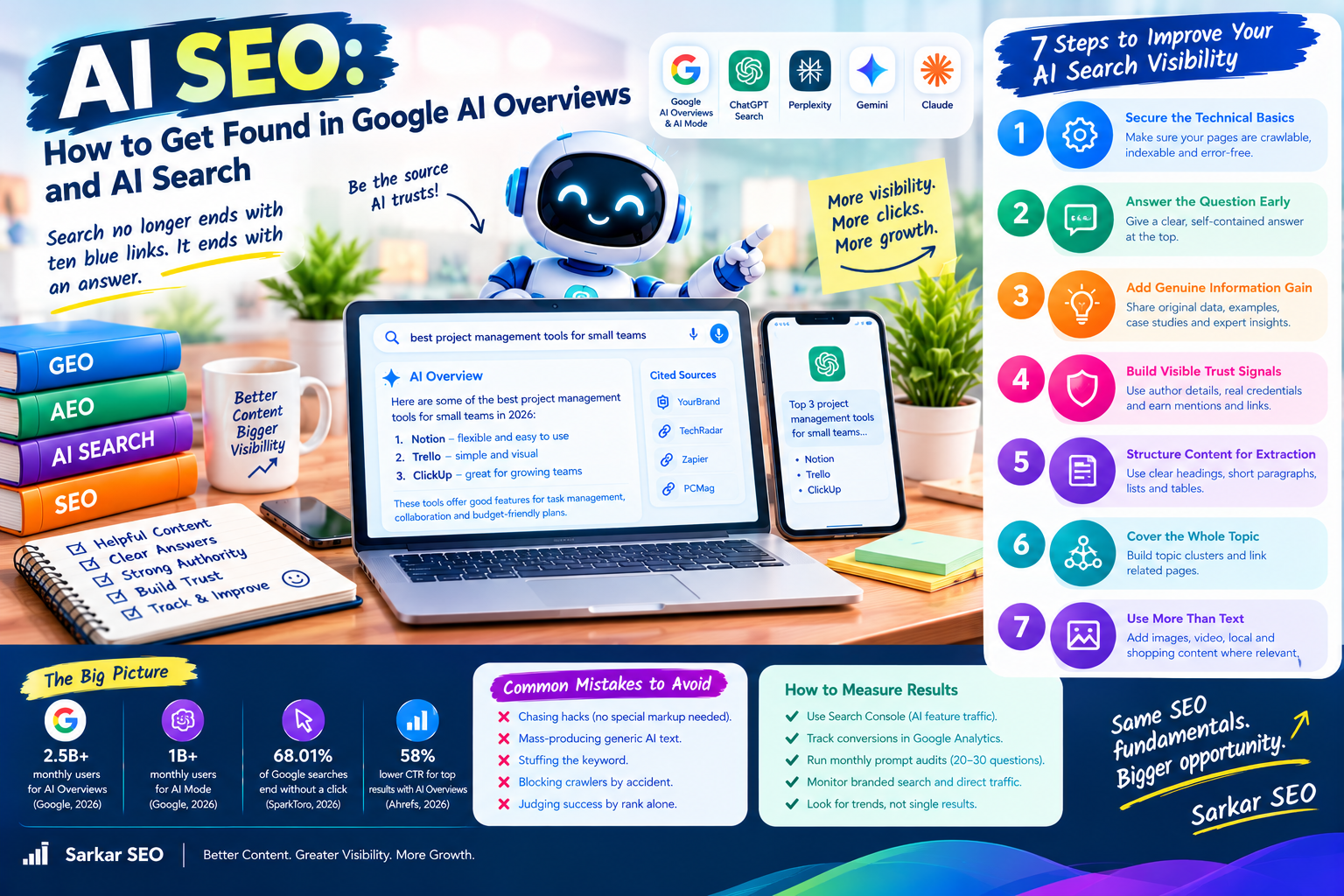
Search no longer ends with ten blue links. People now get synthesized answers from Google AI Overviews, AI Mode, ChatGPT, Perplexity and Gemini, often before they click anything. AI SEO is the practice of making your content easy for AI-powered search systems to find, understand, trust and cite, while still earning traditional rankings. Here is what the evidence says works, and what is mostly noise.
What Is AI SEO?
AI SEO means optimizing content so it can be retrieved, summarized and cited by generative search experiences as well as ranked in classic results. You will also see it called GEO (generative engine optimization) or AEO (answer engine optimization). The labels differ, but the goal is the same: become a source an AI system is comfortable quoting.
At Sarkar SEO, we treat it as an extension of strong SEO, not a replacement for it.
The Honest Answer: AI SEO Is Mostly SEO
Google’s own documentation says you can apply the same foundational SEO practices to AI features as to Search overall: meet the technical requirements, follow Search policies, and create helpful, reliable, people-first content. It also states that no special schema.org markup is required to appear in AI Overviews or AI Mode.
In May 2026, Google published a dedicated guide for generative AI features. It stresses valuable, unique, non-commodity content, covers local, shopping, image and video content, and tackles common “AEO/GEO” myths.
The practical takeaway: if a page cannot be crawled and indexed, nothing else matters. Fix that first.
Why AI SEO Matters Now
AI answers are spreading. BrightEdge tracking, as reported by RankAI, found AI Overviews growing from roughly 30% to 48% of tracked queries over a year. Treat that as directional, since prevalence varies by industry and query type. Industry analysts also report lower click-through on informational searches when a summary appears.
Google is responding with measurement and control. Traffic from AI features already counts inside the Web performance report in Search Console. In June 2026, Google announced dedicated generative AI performance reports and new opt-out controls, reportedly starting with a limited group of UK site owners before wider rollout.
The lesson: visibility is no longer only about position one. It is about being the source an answer is built from.
Seven Steps to Improve Your AI Search Visibility
- Secure the technical basics
Make sure Googlebot can reach your pages: no accidental noindex tags, no robots.txt blocks, no server errors. Keep important pages findable through internal links, and ensure structured data matches the visible text. If you want inclusion in ChatGPT search, RankAI notes that OAI-SearchBot should be allowed. Check each platform’s current crawler documentation before editing robots.txt.
- Answer the question early
AI Overviews tend to draw on content that states its answer clearly near the top rather than burying it deep in a long post. Open each section with a direct, self-contained answer of one to three sentences, then add depth. This is an editorial best practice, not a Google rule.
- Add genuine information gain
Google’s helpful content guidance asks whether content offers original information, reporting, research or analysis, and whether it shows first-hand expertise. If your article only restates what ten other pages say, an AI can generate that itself and has no reason to cite you. Bring original data, real case studies, screenshots, tested comparisons and a clear point of view.
- Build visible trust signals
AI Overviews tend to pull from pages Google already trusts. Use named authors with real credentials, a transparent About page, consistent brand naming, and earn mentions and links from reputable sites. Trust is built over time, not added with a plugin.
- Structure content for extraction
Use descriptive headings, ideally phrased the way people ask questions. Keep paragraphs short, use tables for comparisons and numbered lists for processes. Clean structure helps both readers and machines pull the right passage.
- Cover the whole topic
AI Mode researches answers across multiple steps, so thin, single-keyword pages lose out. Build topic clusters that answer related questions, and connect them with sensible internal links so each page supports the others.
- Use more than text
Google’s guidance highlights images, video, local and shopping content. Add original images with descriptive alt text, useful video where it helps, and keep business profiles and product data accurate.
How to Measure AI SEO Results
Start with Search Console’s performance report, which includes AI feature traffic within Web results, and use the new generative AI reports where available to you. Pair that with conversion tracking in Google Analytics, because fewer clicks can still mean better-qualified visitors.
Then add a simple manual process. Pick 20 to 30 priority questions, test them monthly in Google, ChatGPT, Perplexity and Gemini, and log whether your brand is cited. Be realistic: AI answers vary between runs, so look for trends rather than single results. Sarkar SEO uses this kind of recurring check to separate real gains from noise.
Common AI SEO Mistakes
- Chasing hacks. Google says no special markup or separate “AI SEO system” is needed.
- Mass-producing generic AI text. Commodity content is the easiest to replace.
- Stuffing the keyword. Clear, natural writing performs better for readers and machines.
- Blocking crawlers by accident. Audit robots.txt and meta directives regularly.
- Judging success by rank alone. Track citations, conversions and brand searches too.
