



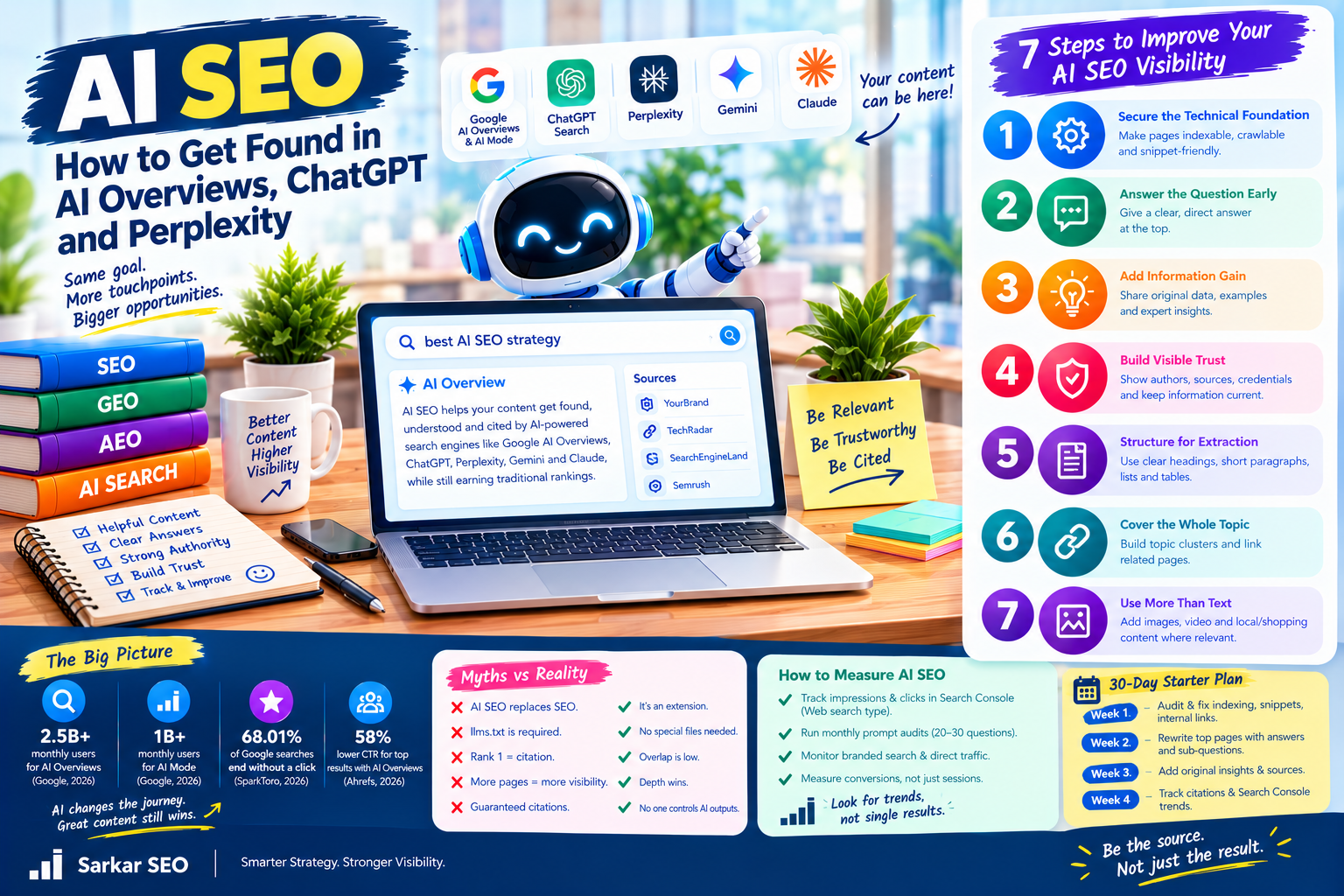
Search no longer ends with ten blue links. Google, ChatGPT, Perplexity, Gemini and Claude now summarize answers before anyone visits a website. That makes AI SEO a practical question: how do you make your content the source these systems trust and cite?
At Sarkar SEO, we treat AI SEO as a sharper version of good SEO, not a replacement for it. Here is what the evidence says and how to act on it.
What Is AI SEO?
AI SEO is the practice of optimizing content so it ranks in traditional search results and is also retrieved, summarized and cited by AI-powered answer systems. These include Google’s AI Overviews and AI Mode, and conversational tools like ChatGPT and Perplexity.
You will also see the terms GEO (generative engine optimization) and AEO (answer engine optimization). They describe largely the same goal.
Why It Matters: Clicks Are Shrinking
The risk is real. In a Pew Research Center study of 900 US adults, users clicked a traditional result link 8% of the time when an AI Overview appeared, versus 15% when none did. Only 1% of searches led to a click on a link inside the summary itself. That study covered March 2025 and US users only, and about 18% of searches produced an AI summary. Today’s numbers will differ, but the direction is clear. New on Yahoo +2
The takeaway is not that SEO is dead. Fewer clicks are available, so being cited and being chosen matter more than ever.
What Google Actually Says
Much online advice about AI visibility is speculation. Google’s own documentation is the best primary source.
Google’s guidance says the same foundational SEO practices apply to AI features as to Search overall. That means meeting technical requirements, following Search policies and creating helpful, reliable, people-first content. To appear as a supporting link, a page must be indexed and eligible to be shown in Search with a snippet. Google also states that no special schema.org structured data is needed. AI features and your website +2
A May 2026 Google resource reinforces this. Coverage of it notes that Google’s generative features rest on its core ranking and quality systems, and that unique, helpful content will matter more than any other tip in the guide. gigazine
One caveat: this guidance applies to Google’s products. ChatGPT, Perplexity and others use their own retrieval systems, and none of them publishes a ranking formula. Anyone promising guaranteed citations is overselling.
Seven Practical AI SEO Tactics
- Fix the foundation first. Make sure important pages are crawlable, indexable and not blocked by snippet controls like nosnippet or noindex. Google’s guidance notes that preview controls can limit what appears from your pages. If you block them by accident, no content strategy will save you. google
- Answer the question early. Open each section with a direct, self-contained answer of one or two sentences, then add depth. This helps readers, and it gives AI systems a clean passage to extract. One practitioner reports that opening a section with a single defining sentence gets quoted into AI Overviews remarkably often. That is anecdotal, but it matches what makes content scannable anyway. braindetox
- Add information gain. Summaries compress what many sources already say. To be cited, say something others don’t: original data, a tested process, a real case, a clear opinion. Generic rewrites of top-ranking pages give an AI system no reason to choose you.
- Use specifics. Some practitioner analyses suggest that AI Overviews frequently cite specific statistics, named examples and concrete facts rather than general assertions. Treat this as a sensible editorial habit, not a proven rule. Name tools, numbers, dates and sources. theimpulsedigital
- Structure for scanning. Use descriptive H2 and H3 headings, short paragraphs, and lists or tables where the content is genuinely list-like. The same analysis notes that lists and definition-style content are often pulled from pages with clear headings. theimpulsedigital
- Build topical depth and internal links. Google recommends making content easily findable through internal links. Build clusters instead of isolated posts: a main guide on AI SEO, supported by pages on technical SEO, content strategy and measurement. Search systems that expand a query into related sub-questions are more likely to find a site that covers the whole topic. google
- Show real expertise. Name authors, state credentials, cite sources, update dates and keep business details consistent across your site and profiles. Trust signals help human readers and quality systems alike. For local or product businesses, Google’s guide also points to Merchant Center and Google Business Profile as ways to improve visibility. gigazine
What to Skip
- Keyword stuffing and bulk AI content. It adds no information gain and conflicts with people-first guidance.
- Special “AI-only” markup. Google says none is required. Schema is still useful for clarity, but it isn’t a shortcut.
- Blocking AI crawlers without thinking it through. Opting out of training or grounding is a legitimate choice, and Google points to Google-Extended for limiting AI training and grounding in some of its other systems. Just understand that it can reduce your exposure in some tools. bugsmash
How to Measure AI SEO
Google confirms that AI Overview and AI Mode traffic is included in Search Console’s Performance report under the Web search type. It is not broken out separately, so judge results by trends: google
- Impressions and clicks for informational queries
- Conversions and engagement in analytics
- Manual checks of whether your brand is cited for target questions in Google, ChatGPT and Perplexity
Since AI answers can vary between sessions, test repeatedly and record the results.
A Simple AI SEO Workflow
- Audit indexing, snippets and internal links.
- List the questions your audience asks, then map each to a page.
- Rewrite key sections with a direct answer first, followed by evidence.
- Add something original to every important page.
- Track citations and Search Console trends monthly, then refine.
