



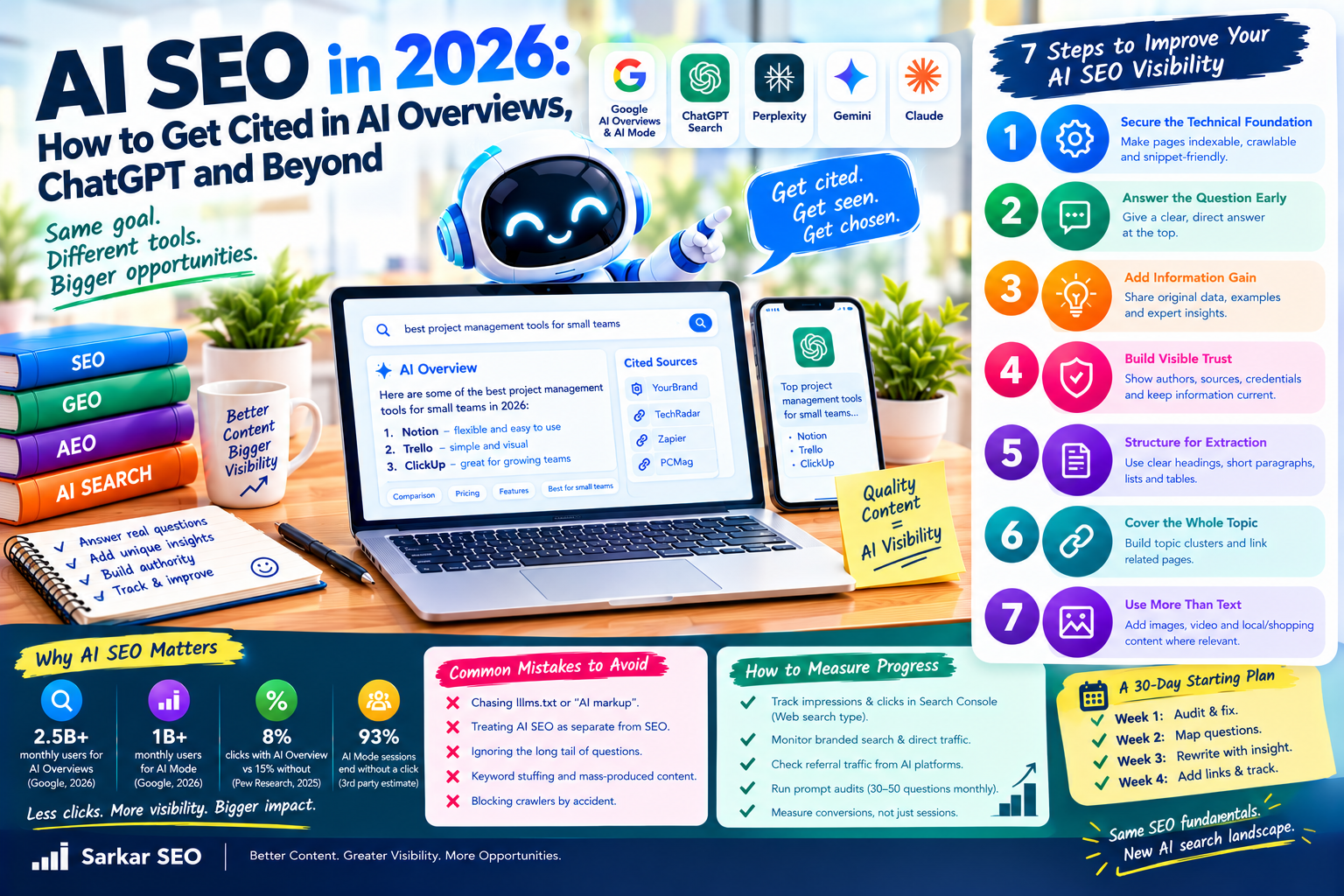
AI SEO is the practice of making your content easy to find, understand and cite inside AI-generated answers, such as Google AI Overviews, AI Mode, ChatGPT, Gemini and Perplexity, without abandoning the search fundamentals that still decide whether you are eligible at all. The short version: write pages that answer real questions precisely, keep your site crawlable, and build a brand that engines recognise.
What AI SEO is, and what it is not
Search engines now generate answers as well as list links. AI SEO (also called GEO or AEO) is the work of earning a place in those answers.
It is not a separate set of secret tricks. Google’s documentation says there are no additional requirements to appear in AI Overviews or AI Mode, and no special optimizations beyond standard SEO. A page only needs to be indexed and eligible to show with a snippet. No new machine-readable files or special schema are required.
That does not make the topic trivial. Both features can use “query fan-out”, running several related searches across subtopics before composing an answer. Your page may be pulled in for a question the user never typed.
Why it matters: clicks are being redistributed
Seer Interactive studied 53 brands, 5.47 million queries and 2.43 billion impressions between January 2025 and February 2026. As reported by Search Engine Land, the average click-through rate was roughly 3.3% with no AI Overview, about 2.1% when the page was cited in one, and about 0.9% when it was not.
Two lessons follow. Being cited is worth far more than being merely present on the page. And exposure is uneven: in that study, AI Overviews appeared on about 95% of comparison queries and 86% of question queries, but only about 5% of transactional ones. Seer is a marketing agency and its sample is specific, so treat the figures as directional.
What the research says drives AI citations
A 2026 preprint from University of Toronto researchers analysed 158,099 answers and 468,037 citations from ChatGPT, Gemini and Perplexity. It is not yet peer reviewed, covers English-language US commercial questions, and shows associations rather than proven causes, but its findings are unusually concrete.
- Match the question. Comparing pages within the same website, those whose titles and paragraphs closely matched real questions were cited more.
- Popular add-ons did not help. FAQ blocks, structured data, summary boxes and author boxes looked effective across websites but showed no reliable benefit within a website.
- Retrieval beats page polish. Every page ChatGPT cited was one its own search had retrieved. Retrieval explained 32% of the variation in citations, against 2.8% for page features.
- Rankings differ. For the answers studied, 97% of ChatGPT’s retrieved pages were absent from Google’s top 50. Ranking well on Google does not guarantee visibility elsewhere.
- Brands are remembered. In 46% of ChatGPT’s mentions of brands the question never named, no cited page supported the mention, and brand names shifted its product rankings even when the facts were identical.
For a smaller business, the implication is encouraging and demanding at once. You cannot decorate your way into citations. You need pages that answer specific questions better than anyone else, and a name that appears in credible places.
A practical AI SEO workflow
At Sarkar SEO, the sensible order of work starts with the boring parts, because they gate everything else.
- Confirm eligibility. Check that important pages are indexed, not blocked in robots.txt or by your CDN, and that key content is available as text rather than locked in images or script-dependent widgets. Verify the site in Search Console.
- Map questions, not just keywords. List the questions your buyers ask across the whole journey, including comparisons and follow-ups. Give each major question a page or section with a title that states it plainly.
- Answer first, then explain. Put a direct, self-contained answer near the top of each section, define terms, and state limits alongside claims. A passage should still be accurate if an engine lifts it out of context.
- Add information others lack. Original data, worked examples, clear trade-offs and first-hand process detail give engines a reason to cite you rather than a near-duplicate. Only publish experience you can actually verify.
- Build third-party evidence. Mentions, reviews and references on credible external sites matter because engines retrieve pages that name your brand, and models remember brands they have seen repeatedly. This is slow work, and it cannot be faked.
Keep FAQ sections and schema where they genuinely help readers or qualify for rich results, but do not expect them to unlock AI citations on their own.
Mistakes worth avoiding
- Chasing llms.txt or “AI markup”. Google says none is needed for its features.
- Treating AI SEO as separate from SEO. Eligibility, helpful content and site quality are shared foundations.
- Ignoring the long tail of questions. Fan-out means specific, well-answered subtopics can win citations that generic overview pages miss.
How to measure progress
Google reports traffic from AI features within the Search Console Performance report under the Web search type, folded into overall search traffic. Track impressions and clicks for question-style queries, branded search demand, conversions from organic visits and referral traffic from AI platforms. Because citation sets drift over weeks, the researchers recommend monitoring visibility repeatedly per question rather than checking once. Sarkar SEO suggests keeping a fixed list of 30 to 50 priority questions and re-checking them monthly, noting which pages and competitors appear.
