



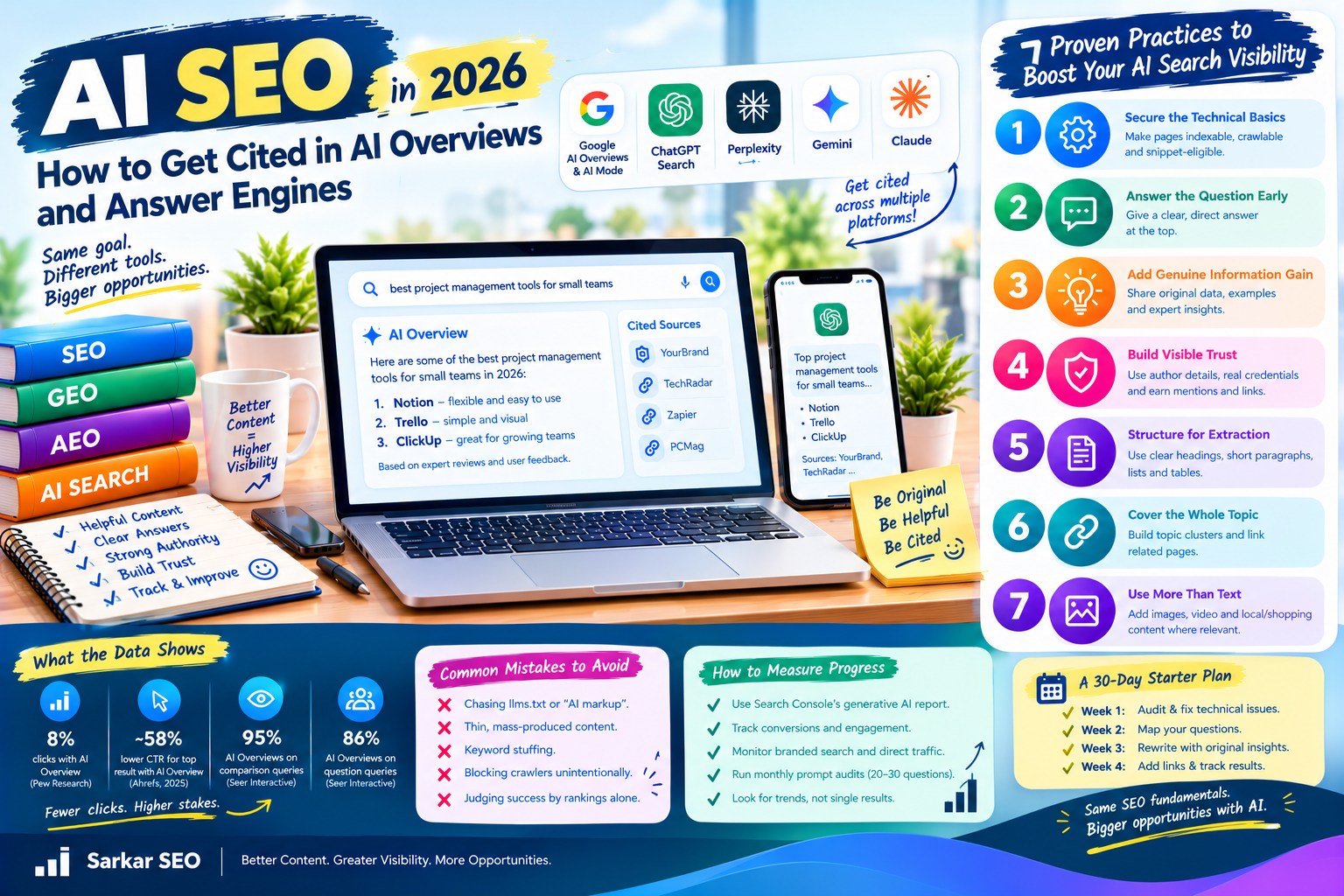
AI SEO is the practice of making your content easy to find, trust and cite in AI-generated answers, as well as in classic search results. It covers Google’s AI Overviews and AI Mode, plus assistants such as ChatGPT, Perplexity, Gemini and Claude. AI SEO strongest finding from our research is plain: the winners publish content nobody else could have written.
What AI SEO Actually Means
Google says its AI features are rooted in its core ranking and quality systems. They use retrieval-augmented generation, which pulls relevant pages from the Search index to ground an answer, and query fan-out, where the model runs several related searches at once. Google also notes that “AEO” and “GEO” are terms you may see used, but that optimizing for generative AI search is still SEO (Google Search Central).
So AI SEO does not replace SEO. It raises the bar for originality and widens success from ranking to being cited and chosen. That is the lens Sarkar SEO applies to every content decision.
Why It Matters: The Click Data
AI answers are changing what a ranking is worth. Ahrefs analyzed 300,000 keywords using Search Console data and found that, as of December 2025, an AI Overview correlates with a 58% lower average click-through rate for the top-ranking page (Ahrefs). Pew Research, studying about 900 users, reported organic clicks on roughly 8% of searches with an AI summary versus about 15% without (as summarized by SISTRIX). Google has disputed that study’s methodology.
The sources differ on size but agree on direction: informational pages that an AI can summarize in a paragraph lose the most traffic. The lesson is not to abandon informational content. It is to stop publishing the kind an AI can replace.
What Google Says to Do, and to Ignore
Google’s guide, last updated in July 2026, recommends three things:
- Non-commodity content. A unique point of view, such as first-hand experience, beats a summary of what already exists.
- Clear technical foundations. Pages must be indexed, crawlable and snippet-eligible, with a good page experience.
- Helpful organization. Headings and sections written for humans, plus relevant images and video.
It also says you can ignore llms.txt files, chopping content into tiny “chunks”, rewriting pages just for AI, chasing inauthentic brand mentions and obsessing over structured data. A May 2026 study reported by Search Engine Journal likewise found that adding schema did not measurably raise AI citations for pages already in AI Overviews (via WRITER).
One caveat: this is Google’s guidance for Google. Other assistants use different sources and retrieval methods.
Five Practices That Earn Citations
- Lead with the answer, then add what only you know. State the answer in the first lines, then add your experience, data or analysis. The answer makes you extractable; the extra makes you necessary.
- Publish original information. Proprietary data, tested methods and named frameworks are hard to replicate. Princeton-led research presented at KDD 2024 found that adding statistics and citations improved visibility in generative engines in its tests, though results vary by engine and topic (as summarized by Similarweb).
- Show who is behind the content. Use real bylines and verifiable credentials. An Onely study cited by WRITER found most AI-cited content had attributed authors. That is correlation, not proof of cause, but anonymous content is a weak bet either way.
- Cover the fan-out without spamming it. AI Mode splits questions into subtopics, so anticipate natural follow-ups on one thorough page. Google warns that creating a page for every query variation primarily to manipulate results violates its scaled content abuse policy.
- Keep key pages current. Several vendors report that AI citations decay as pages age, though their methods vary. The safe reading: review your best pages on a schedule and refresh facts, dates and examples.
Brand presence matters beyond your own site, too. Answer engines draw on reviews, forums and publications, and a Seer Interactive analysis reported a correlation between brand mentions and AI appearances. Earn those mentions through genuine expertise and citable research. Do not manufacture them.
A Simple Test for Every Page
Before publishing or updating a page, ask three questions. Does it answer the main question in the first paragraph? Does it contain something a competitor could not copy, such as your own data, your own process or a lesson from real work? Could a reader trust it, given who wrote it and where the claims come from?
A page that fails the second question is commodity content, and that is the page AI answers replace first. When Sarkar SEO reviews a content library, this is the first filter: keep and deepen what is distinctive, and consolidate or retire what only restates common knowledge.
How to Measure AI Search Visibility
Measurement is still immature, so combine signals:
- Google Search Console’s Generative AI performance report, which Google recommends for seeing how your content appears in AI features.
- Bing Webmaster Tools’ AI Performance report, added in February 2026, showing citation activity and grounding queries (Search Engine Land).
- Manual prompt testing: ask ChatGPT, Perplexity, Gemini and Claude your core buyer questions monthly and log whether you are cited, mentioned or absent.
Google cautions that no third-party tool can see its internal ranking systems, so Sarkar SEO treats any citation tracker as directional evidence, not proof.
Quick Answers
Do I need llms.txt? Not for Google Search, which says it ignores such files. Other services may use them.
Can inclusion be guaranteed? No. Google states that indexing and serving are never guaranteed, even for compliant pages.
