



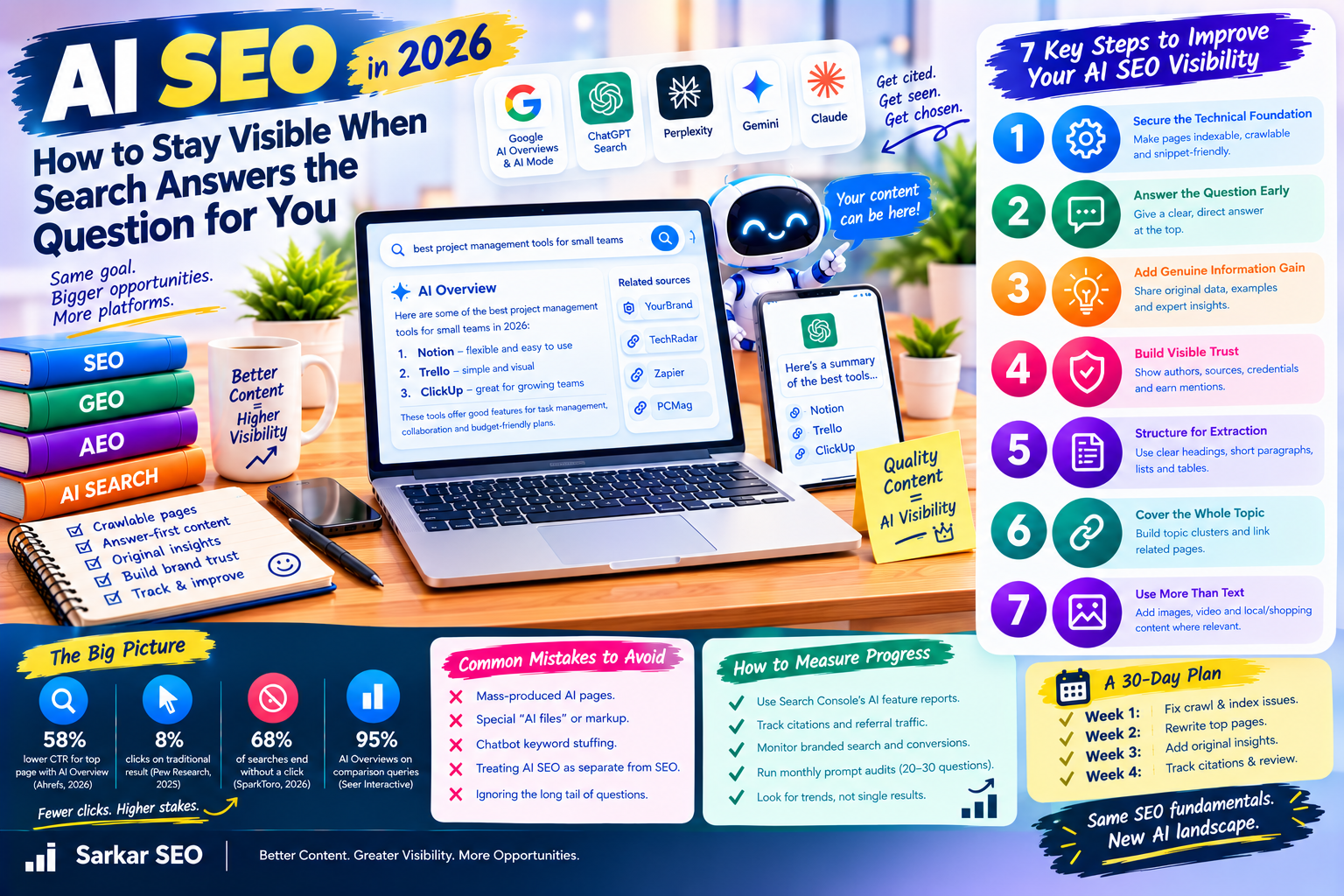
AI SEO is the practice of making your content easy for search engines and AI assistants to find, understand, trust and cite. It covers classic organic rankings plus visibility in Google AI SEO Overviews, AI Mode, ChatGPT, Perplexity, Gemini and Claude. The goal has widened: it is no longer only to rank, but to be the source an answer is built from. This guide from Sarkar SEO separates what the evidence supports from what is hype.
What Has Actually Changed
Search results increasingly resolve the question before anyone clicks. Ahrefs analysed 300,000 keywords and reported in February 2026 that AI Overviews correlate with a 58% lower click-through rate for the top-ranking page, up from 34.5% in its 2025 version of the study. SparkToro’s panel data, as reported by Techwyse, put the share of US Google searches ending without a click at about 68% in early 2026.
The picture is not one-directional. Seer Interactive found that organic click-through on AI Overview queries bottomed out at 1.3% in December 2025 and rose to 2.4% by February 2026. Google also says clicks from pages with AI Overviews are higher quality, though that is Google’s own claim. Treat every figure here as directional: methodologies differ, most data is US-centric, and correlation is not causation.
What Google Says You Need to Do
Google’s documentation states that no additional requirements or special optimizations are needed to appear in AI Overviews or AI Mode, and no special markup or “AI files” either. A page simply has to be indexed and eligible to show a snippet. Both features may use “query fan-out”, issuing several related searches across subtopics. In practice, your page can be pulled in for a sub-question the user never typed.
The implication is useful: AI SEO is not a separate trick. It is fundamentals executed to a higher standard. For ChatGPT, Perplexity and others, no platform publishes a ranking rulebook, so anyone claiming to know their exact citation factors is inferring, not reporting.
A Five-Part AI SEO Framework
- Be crawlable and snippet-eligible. Audit robots.txt, noindex tags, and snippet controls such as nosnippet and max-snippet. These directives limit how your content can be used in AI features, so check they match your intent before anything else.
- Answer first, then explain. Open each section with a self-contained answer of roughly 40 to 60 words, then add depth. This is an editorial habit that helps both readers and machines extract meaning, not a confirmed ranking rule.
- Cover the fan-out. List the questions a buyer asks around your topic: definitions, comparisons, costs, risks, next steps. One thorough page that answers neighbouring questions usually beats ten thin pages that each answer one.
- Add information gain. AI systems can already produce a generic summary of any topic. What they cannot invent is your original data, documented process, screenshots, case notes or expert judgment. If a paragraph could appear on fifty competing sites, it is not earning its place.
- Build entity trust. Use a consistent brand name, real author bios, a clear About page, and mentions on credible third-party sites. Add structured data only where it matches visible content, such as Organization or Article markup. Sarkar SEO treats entity clarity as the quiet foundation of AI visibility: engines cite brands they can identify with confidence.
Measure What Matters Now
Rankings alone now mislead. A page can hold position one and still lose clicks. Google notes that sites appearing in AI features are counted in overall Search Console traffic, so you will not see them as a separate line without extra work. A sturdier scorecard looks like this:
- Search Console: impressions, clicks and CTR by query group, comparing informational against commercial terms.
- Prompt testing: each month, run 20 priority questions across Google, ChatGPT, Perplexity and Gemini. Record whether you are cited, whether the description is accurate, and which competitors appear. Answers vary between runs, so treat results as samples.
- Brand demand: branded search volume and direct visits, which tend to hold up better than generic informational traffic.
- Business outcomes: leads, sign-ups and revenue per organic session, not sessions alone.
Visibility has commercial value even without a click. Seer Interactive reported that brands cited in AI Overviews earned higher organic click-through rates than uncited brands on the same queries, although the study is from an earlier period and cannot prove the citation caused the lift.
What to Skip
- Mass-produced AI pages. Volume without original value creates more content that engines have no reason to cite.
- Special “AI files” or markup. Google says they are unnecessary for its features. Whether other assistants use them is unproven.
- Chatbot keyword stuffing. Natural, precise language serves readers and retrieval alike.
- Treating AI SEO as a wholly separate discipline. Some industry sources argue for managing generative engine optimization separately from SEO. Google’s position is that AI features sit on core Search systems. The practical middle path is one strong foundation with platform-specific monitoring.
A Realistic 30-Day Plan
Week 1: Fix crawl, index and snippet issues. List your ten most commercially valuable topics.
Week 2: Rewrite those pages with answer-first openings, clearer subheadings and a visible author and update date.
Week 3: Add something only you can offer: a data point, a worked example, a process screenshot.
Week 4: Run your baseline prompt tests, record the results, and repeat monthly.
