



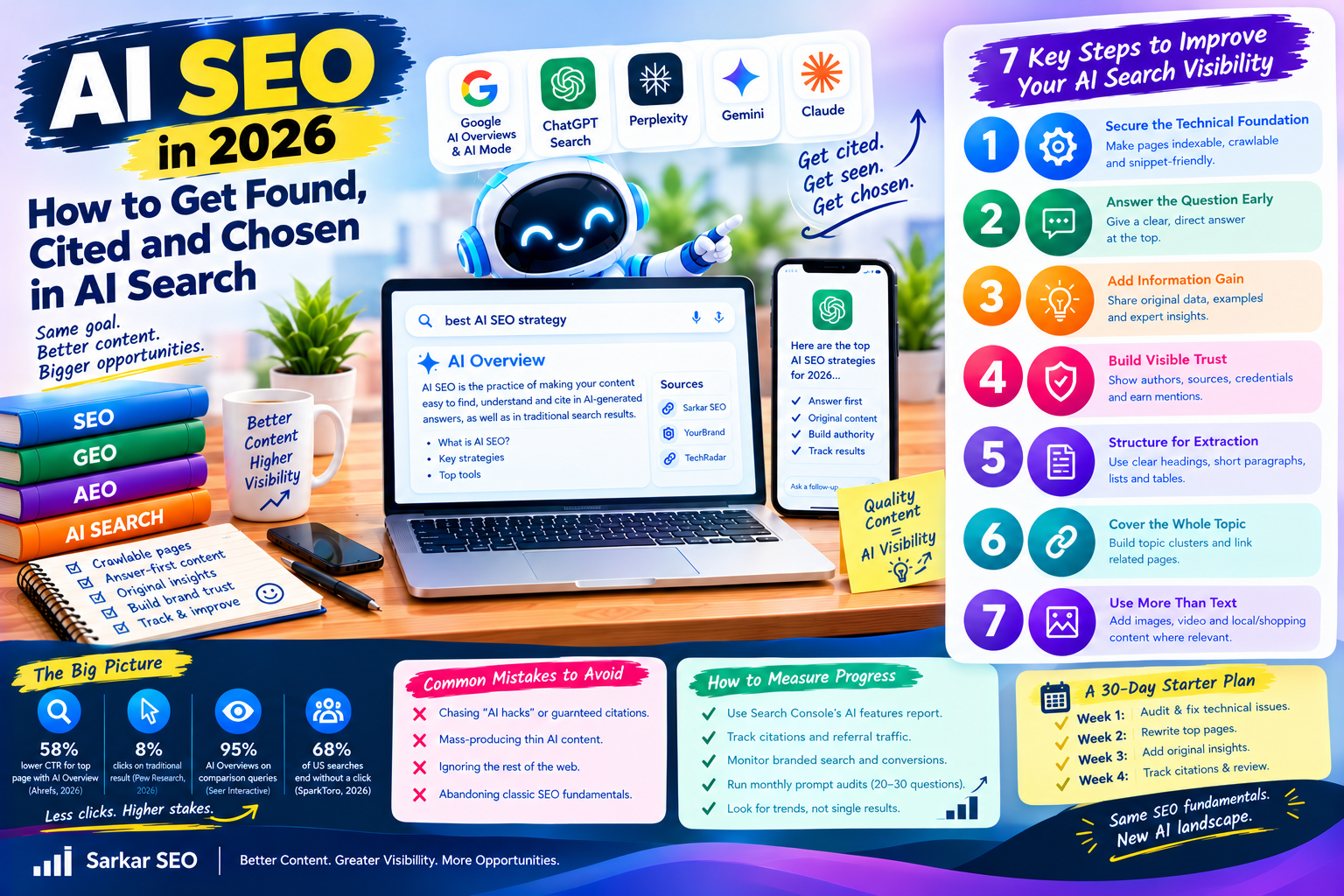
Search no longer ends with ten blue links. Google’s AI Overviews summarize answers above the results, and AI Mode turns search into a conversation. ChatGPT, Perplexity, Claude and Gemini assemble answers and name their sources. AI SEO is the practice of making your content easy for all of these systems to find, understand and cite, on top of ranking in classic search.
At Sarkar SEO, we think the market has overcomplicated this. Most of what works is better SEO, executed with more discipline.
What AI SEO Actually Means
AI SEO covers two things. The first is optimizing for AI-powered search features such as AI Overviews, AI Mode and ChatGPT search. The second is using AI tools to speed up research, analysis and production. This article focuses on the first.
You will see the same idea under other labels: answer engine optimization (AEO) and generative engine optimization (GEO). The names differ, but the goal is the same. You want your page to be the source an AI system trusts when it builds an answer.
The Big Shift: Visibility Without Clicks
The scale of the change is large. Google said at I/O 2026 that AI Mode has passed one billion monthly users and is expanding to nearly 200 countries. Click behavior is shifting too. One 2026 analysis estimates that about 93% of AI Mode queries end without a click to a website. That figure comes from third-party estimates, not Google, so treat it as directional. itseoquick
The takeaway is not that traffic is dead. More searches and better-qualified visits can coexist with fewer clicks per search. Your goal now includes being named, cited and remembered, as well as being clicked. serpapi
Myth: AI Search Runs on a Separate Index
Google’s own position is clear. Its documentation says AI features are rooted in core Search ranking and quality systems, with no additional requirements to appear in AI Overviews or AI Mode. In May 2026, John Mueller reiterated that SEO best practices remain foundational and that no separate AEO strategy exists. llmpulseit
So if a page isn’t indexed, crawlable and useful, no amount of “AI optimization” will help. Fix the foundation first.
How AI Systems Choose What to Cite
Google’s AI Mode and, to a lesser degree, AI Overviews use a technique called query fan-out. Google Search Central explains that they can issue several related searches across subtopics and data sources before composing a response. serpapi
This changes how you should plan content. A single keyword like “AI SEO” gets broken into sub-questions: what it is, how it differs from SEO, how to measure it, what tools to use. If your page answers those sub-questions clearly, it has more chances to be retrieved. Topical depth beats one thin page per keyword.
A Practical AI SEO Framework
- Clear the technical gates. Check that important pages are indexable and fast, and that your robots.txt isn’t accidentally shutting out answer engines. A blanket User-agent: * disallow rule can block AI crawlers that lack their own entries.
- Choose your crawler policy deliberately. Training crawlers and search crawlers do different jobs. OpenAI documents that sites opted out of OAI-SearchBot will not appear in ChatGPT search answers, and that blocking GPTBot does not affect ChatGPT search presence. The same logic applies to PerplexityBot and Claude-SearchBot, which surface and link sites in their answers. Decide on training access as a business question. Allowing the search bots is the sensible default if you want citations. Remember that robots.txt is a request, not a lock, and that firewalls or CDNs can block bots no matter what it says. geotoolboxtherankmasters
- Write answer-first content. Put a direct, self-contained answer under each heading, then add depth. Short definitions, clear steps and specific comparisons are easier for a model to extract than long preambles. Keep each section focused on one question so it can be quoted on its own.
- Add information gain. AI systems have little reason to cite a page that repeats what ten others say. Include original data, first-hand testing, case examples, expert commentary or a clear point of view. Google targets mass-produced pages with no added value that were written only for search engines. trustedshops
- Build entity and trust signals. Name real authors with credentials, show update dates, cite sources and keep your brand description consistent across your site and profiles. Earn mentions and links from credible publications. Models tend to favor sources that other trustworthy sources already reference.
- Use structured data honestly. Schema markup for articles, organizations, FAQs and products helps machines parse your content. It supports good content and does not replace it. Don’t mark up anything that isn’t visible on the page.
- Strengthen internal linking. Link a pillar page to its supporting articles with descriptive anchor text. This shows both users and crawlers how your topics connect, which matters when a query is fanned out into subtopics.
How to Measure AI Search Performance
Measurement is improving but still imperfect. Google launched Search Console reports for impressions in generative AI features in June 2026. Analysts note this gives first-party visibility into generative-search exposure, but not a clean AI Mode versus AI Overviews split. itrefontelearning
Combine that with manual checks. Each month, run your priority questions in ChatGPT, Perplexity, Gemini and Google AI Mode. Record whether you are cited, which competitors appear, and how accurately your brand is described. Track branded search growth and assisted conversions alongside raw clicks, since AI exposure often shows up as influence before it shows up as sessions.
Common AI SEO Mistakes
- Chasing “AI hacks.” Tactics that promise guaranteed citations have no support in Google’s guidance, and no tool can guarantee them. Citation tools check technical readiness, which does not guarantee citations, since those depend on each engine’s own ranking. apify
- Publishing at scale without substance. Volume without originality is the easiest content to ignore.
- Ignoring the rest of the web. Answer engines draw on forums, reviews and third-party sites. Your reputation off-site matters.
- Abandoning classic SEO. The foundation still decides eligibility.
Where to Start This Month
- Audit crawlability and your robots.txt rules for search bots.
- Pick your ten most valuable pages and restructure each around question-led headings with direct answers.
- Add one original asset to each, such as a data point, example or expert quote.
- Test your core questions across AI platforms and log the results.
- Review again in 90 days.
Teams that need a partner for the audit, content and measurement work can lean on Sarkar SEO. We build strategies around visibility across both classic and AI search, and we focus on content worth citing.
