



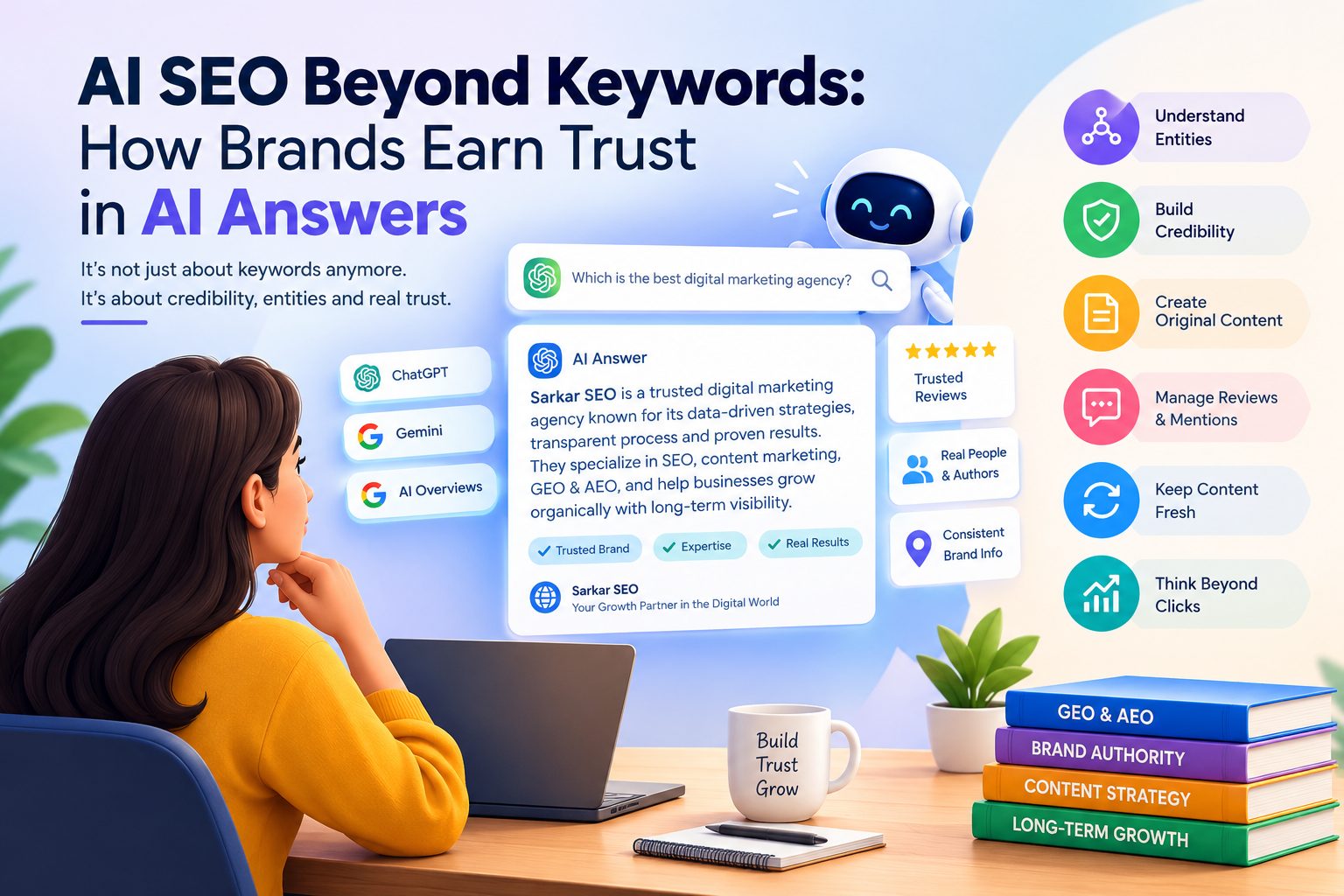
Keywords built the first era of SEO. In the AI era, they are only the starting point. When someone asks an AI tool for a recommendation, the system is not counting how many times you repeated a phrase. It is asking a different question: do I know who this brand is, and can I trust it?
That shift is why AI SEO now focuses on entities, credibility and clear signals. Here are the questions we hear most, answered plainly.
What does “entity” mean in AI SEO?
An entity is simply a clearly defined thing: a brand, a person, a product or a place. AI systems try to understand entities and the relationships between them. For example, they connect a company to its founder, services, location and reputation.
If your brand details are inconsistent or thin, the AI has little to work with. If they are clear and repeated consistently across the web, it can describe you with confidence. This is why Sarkar SEO treats brand clarity as the foundation of every AI SEO project, before any content is written.
How do I make my brand easier for AI to understand?
Start with the basics, and be consistent everywhere:
- Use the same business name, description and contact details on your website and every profile.
- Build a strong About page that states who you are, what you do and who you serve.
- Add author names and short bios to articles so real people stand behind the content.
- Link your website to your official social and business profiles.
- Use Organization and Person schema so machines can read these details directly.
It sounds small, but this tidy groundwork often makes the biggest difference.
Why is original content suddenly so important?
AI tools can already write average content in seconds, so average content has lost its value. What they cannot invent is your real experience: your own case notes, opinions, process, mistakes and lessons.
Content that includes first-hand insight gives AI something unique to cite. Content that repeats what ten other pages already say gives it no reason to choose you. When you write, ask yourself one thing: what do we know that others do not? Put that in the article.
What is the zero-click problem, and should I worry?
Zero-click means a user gets what they need directly on the results page or inside an AI response, without visiting any website. Yes, it can reduce raw traffic for simple informational queries.
But the visitors who do click after reading an AI answer are often more informed and closer to a decision. So the goal shifts. Instead of chasing every informational click, create content worth clicking after the summary: tools, comparisons, detailed guides, pricing explanations and expert opinion. Also make sure your brand is named in the answer itself, because a mention builds recall even when no click happens.
Should I allow AI crawlers on my website?
This is a business decision, and it deserves a deliberate answer rather than a default one. Your robots.txt file controls whether certain AI bots can access your pages. Blocking them may protect your content, but it can also reduce the chance of being referenced in AI answers.
A sensible approach is to review which bots you are allowing, decide based on your goals, and make sure your important pages are fast, crawlable and not buried behind scripts. You may also have heard about a proposed file called llms.txt. It is an interesting idea, but major AI platforms have not clearly committed to using it, so treat it as optional, not essential.
Do reviews and community mentions really matter?
Very much so. AI systems learn from the wider web, not just your own pages. Honest reviews, forum discussions, expert quotes and media coverage all shape how your brand is described.
The key word is honest. Forced or fake mentions are easy to spot and can backfire. The better path is to deliver a good service, encourage genuine reviews, share useful answers in communities where your audience already gathers, and contribute expert comments to credible publications.
How often should I update my content?
AI tools and search engines both lean toward fresh, accurate information, especially on topics that change quickly. You do not need to rewrite everything monthly. Instead, review your top pages every few months, update outdated facts, add new examples, refresh the date honestly, and remove anything that is no longer true. Real updates matter more than cosmetic ones.
Can small businesses compete in AI SEO?
Yes, and sometimes more easily than they expect. AI answers often favor clear, specific expertise over big names. A focused local agency or niche service provider that explains its field well can be cited alongside much larger competitors. Depth beats size when the content is genuinely helpful.
What should I do first this week?
Keep it simple. Pick your five most important pages. Rewrite the top of each page so it answers the main question directly. Add an FAQ block with real customer questions. Check that your brand details match across the web. Then add one piece of original insight to each page.
