



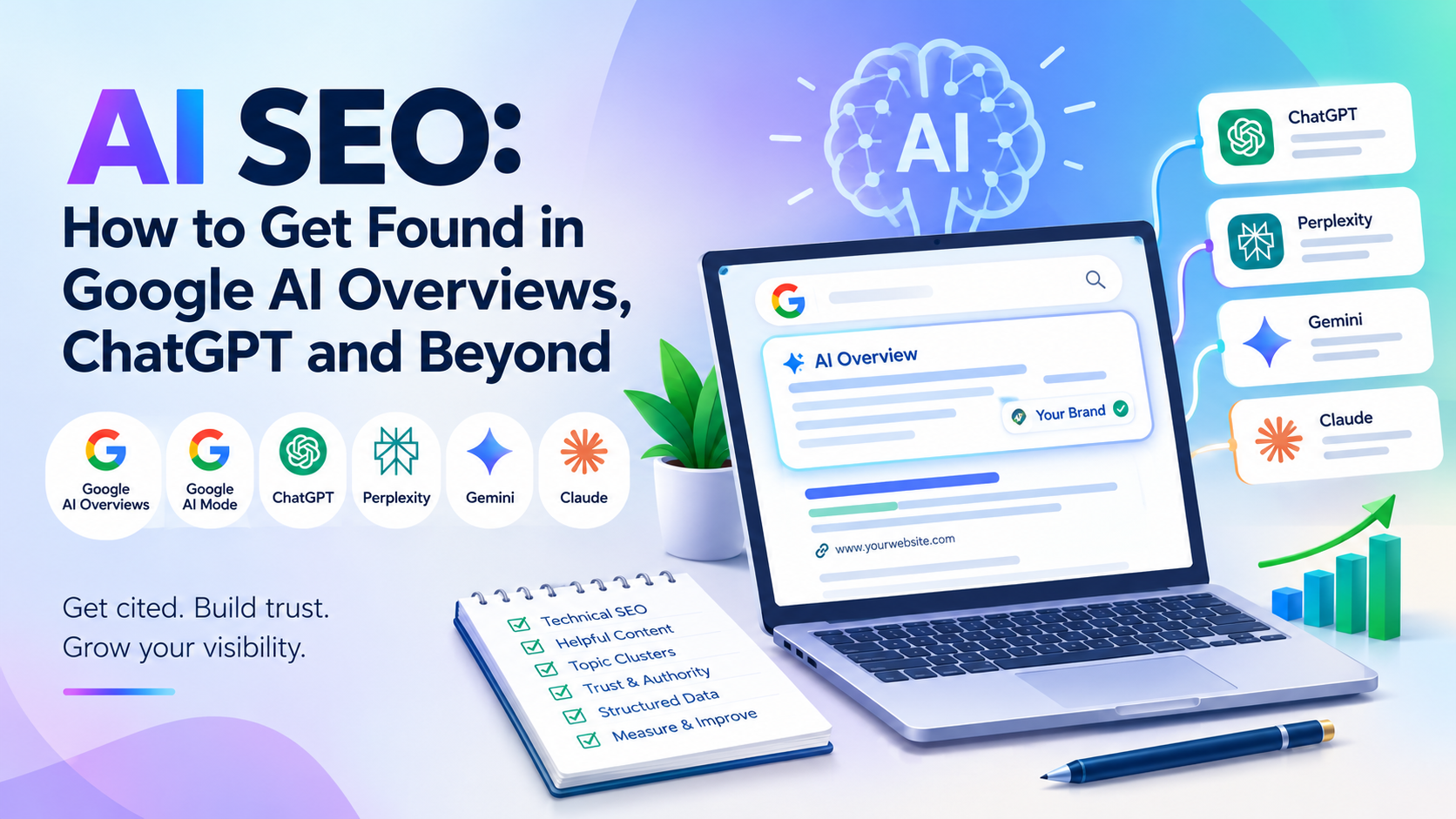
Search no longer ends with ten blue links. People now get synthesized answers from Google AI Overviews, Google’s AI Mode, ChatGPT, Perplexity, Gemini and Claude, often before they visit a single website. AI SEO is the practice of making your content easy for these systems to find, understand, trust and cite, while still earning rankings in traditional search.
At Sarkar SEO, we see the same mistake repeatedly: businesses treat AI SEO as a mysterious new discipline with secret tricks. The evidence points the other way.
What AI SEO actually means
AI SEO covers two connected goals. The first is visibility inside AI-generated answers, as a cited source or a recommended brand. The second is keeping organic performance healthy as search behavior shifts. You will also see the terms GEO (generative engine optimization) and AEO (answer engine optimization). They describe largely the same work with different emphasis.
What Google says: fundamentals still win
Google’s own guidance is the best starting point. To appear as a supporting link in AI Overviews or AI Mode, a page must be indexed and eligible to be shown in Google Search with a snippet. Google also states that specific optimization isn’t required for AI Overviews and AI Mode, and existing SEO fundamentals continue to be worthwhile. Its documentation adds that there is no special schema.org structured data you need to add. AI features and your website +2
Two details matter for planning. First, AI Mode and AI Overviews may use different models and techniques, so the responses and links they show will vary. Second, third-party analysts note that these systems can use query fan-out to search across subtopics and multiple data sources. That means a single question can trigger several related searches behind the scenes. Pages that cover a topic’s connected questions have more chances to be pulled in. bugsmashw3era
Treat that fan-out point as a practical inference from secondary sources, not a guaranteed ranking factor.
What the click data shows
The traffic risk is real, though the data has limits. A Pew Research Center analysis of browsing data from 900 U.S. adults in March 2025 found that around 18% of Google searches in the study produced an AI summary. When one appeared, users clicked a traditional result link 8% of the time, versus 15% without one. Links inside the summary were rarely used: only about 1% of searches led to a click on a cited source. www.pewresearch.org +2
Read this carefully. It is a U.S. sample from early 2025, and AI features have expanded since. It does not prove that AI citations are worthless. It does show that being cited is not the same as being clicked, so brand recall and answer quality now matter alongside traffic.
The AI SEO framework we recommend
- Secure the technical basics
If a page cannot be crawled, indexed and shown with a snippet, it cannot be a supporting link. Check robots.txt, canonical tags, indexation status, page speed and internal linking in Search Console. Be careful with preview controls such as nosnippet: they can reduce your chances of appearing in AI features. One commonly confused setting is Google-Extended, which is not the control for AI Mode in Search. mangools
- Answer the question first
Open each section with a direct, self-contained answer in one to three sentences, then add depth. This helps readers and also makes passages easy to extract. Pew found the median AI summary was 67 words long, which shows how compact these answers tend to be. Write sections that can stand alone when quoted. pewresearch
- Cover the whole topic cluster
Because AI systems may break one query into several, a thin page on a single keyword is weaker than a connected set of pages. Map the follow-up questions around “AI SEO”: measurement, schema, content structure, crawler access, local and international variations. Link these pages together so both users and crawlers can find them. Google specifically recommends making your content easily findable through internal links. bugsmash
- Add information gain
AI systems can summarize common advice endlessly. What they cannot replicate is your original material: first-party data, case results, screenshots, tested workflows, expert commentary, named authors with real credentials. If your page repeats what ten others say, there is no reason to cite yours. Only publish experience and numbers you can actually back up.
- Build entity trust beyond your own site
Pew’s data on cited sources is a useful clue: Google’s AI summaries most frequently cited Wikipedia, Reddit and YouTube, together about 15% of sources examined. Chatbots also draw on discussions, reviews and third-party mentions. Keep your brand name, authors, services and descriptions consistent across your site, social profiles, directories and reputable publications. Earn mentions where your audience genuinely talks. yahoo
- Use structured data for clarity, not magic
Organization, Article, Author and FAQ-style markup can help machines interpret your content, but remember Google’s statement that no special markup is needed for AI features. Use schema to describe what is already visible on the page, never to claim something that is not there.
- Refresh and verify
Outdated statistics get ignored or, worse, repeated incorrectly. Review key pages quarterly, update figures with dated sources, and show a clear last-updated date.
How to measure AI search visibility
Clicks and impressions from AI Overviews and AI Mode are included in your overall search traffic within the “Web” search type in Search Console, and a dedicated Generative AI performance report exists for sites with enough impressions. For other platforms, run a monthly prompt audit: ask ChatGPT, Perplexity, Gemini, Claude and Grok your 20 most important customer questions, then log whether your brand appears, which pages are cited, and what is said about you. Results vary between runs, so track trends rather than single outcomes. No tool can currently guarantee placement in these answers, and anyone promising that should be treated with caution. eseospace
Common mistakes to avoid
- Mass-producing generic AI content. It adds no information gain and weakens trust.
- Chasing hacks. Hidden prompts, keyword stuffing and fake FAQs risk quality penalties.
- Ignoring conversions. Fewer clicks make each visit more valuable. Strengthen calls to action, service pages and lead capture.
- Blocking crawlers blindly. Understand each bot’s purpose before changing access rules.
AI SEO is less a replacement for SEO than a higher standard for it: technically sound pages, clear answers, genuine expertise and a trustworthy brand footprint. Businesses that publish useful, original, well-structured content give both Google and answer engines a reason to cite them. If you want a prioritized plan for your own site, the team at Sarkar SEO can help you audit your current visibility and build an AI-ready content roadmap.
