



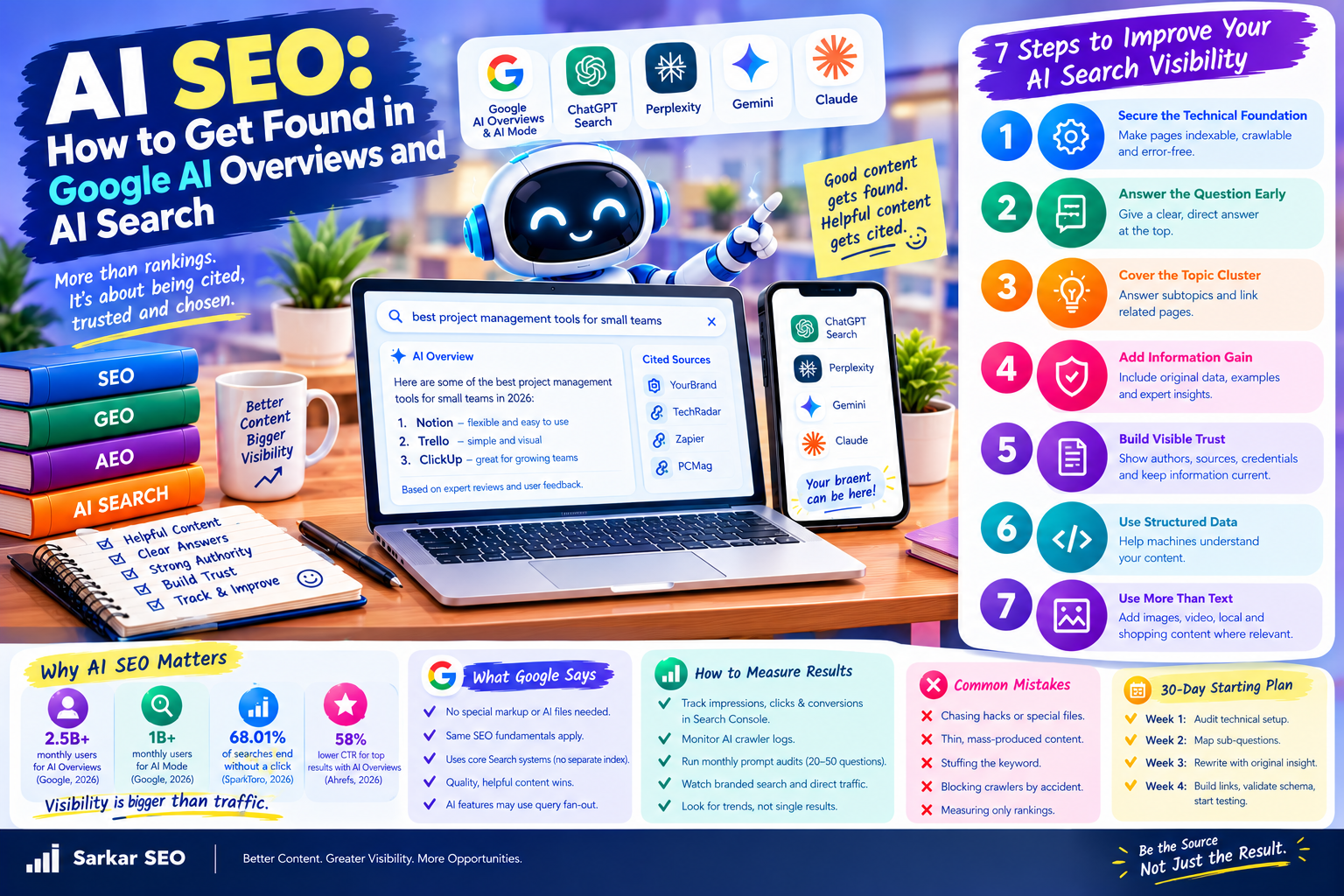
Search no longer ends at ten blue links. People now get synthesized answers from Google AI Overviews, AI Mode, ChatGPT, Perplexity, Gemini and Claude, often before they click anything. AI SEO is the practice of making your website easy for these systems to find, understand, trust and cite, while still ranking in classic search.
Much of the industry noise around it is hype. Here is what the evidence supports.
What AI SEO Actually Means
You will see AI SEO, GEO (generative engine optimization), AEO (answer engine optimization) and LLMO used interchangeably. They describe one goal: being the source an AI system retrieves and references when it answers a question.
AI SEO is not a replacement for SEO. It is SEO extended to a world where an answer is assembled from several pages instead of one ranked list.
What Google Says: No Secret Formula
Google’s own documentation is blunt. There are no additional requirements to appear in AI Overviews or AI Mode, and no special optimizations are necessary. The same page says you don’t need to create new machine-readable files, AI text files or special markup to appear. google
On May 15, 2026, Google published a dedicated guide on optimizing for generative AI features. It states that these features rely on core Search ranking and quality systems, using techniques such as retrieval-augmented generation and query fan-out. One commentator summarized the guide’s implication this way: Google’s guidance does not support treating GEO or AEO as replacements for technical SEO, content quality and Search eligibility. techwysetechwyse
The practical lesson: skip tricks and invest in fundamentals plus content worth citing.
Write for the Fan-Out, Not Just the Keyword
Both AI Overviews and AI Mode may use a “query fan-out” technique, issuing multiple related searches across subtopics and data sources to build a response. google
A single question like “what is AI SEO” can trigger background searches for its definition, how it differs from traditional SEO, which tools exist, and how to measure it. A page that covers only the head term loses to pages that answer the surrounding questions.
How to apply this:
- Map the sub-questions a reader would ask next, and answer each under its own clear heading.
- Open each section with a direct, self-contained answer, then add nuance.
- Link related pages so each subtopic is easy to discover. Google lists making content easily findable through internal links as part of appearing in AI features. google
Publish Information That Isn’t a Commodity
AI systems can summarize generic advice without your help, so a page that restates what ten others say gives them no reason to cite you. Google’s guide puts unique, non-commodity content at the center. It frames this as a long-standing quality principle that has become more urgent now that AI systems synthesize answers from across the web. Google also says content people find unique, engaging and helpful will have a greater long-term impact on generative AI visibility than any other suggestion in the guide. ppcgigazine
Ways to add genuine information gain:
- Original data, such as your own surveys, audits or benchmarks.
- First-hand experience: real screenshots, test results and case notes you can stand behind.
- Clear opinions backed by reasoning, not vague summaries.
- Regular updates, with visible dates, when facts change.
Never invent statistics or experience to seem authoritative. AI systems and readers both punish unverifiable claims.
Let the Right Crawlers In
You cannot be cited if you cannot be fetched. OpenAI documents separate crawlers for separate jobs. OAI-SearchBot surfaces sites in ChatGPT search features, and sites that opt out will not be shown in ChatGPT search answers, though they can still appear as navigational links. OpenAI recommends allowing it in robots.txt. Changes can take roughly 24 hours to take effect. openaiopenai
GPTBot is different: it crawls content that may be used for training foundation models. That means you can make a deliberate choice about training while staying visible in search. And because ChatGPT-User actions are initiated by a person, robots.txt rules may not apply to it. aokmarketingopenai
Check your robots.txt and server logs today. Many sites block AI crawlers by accident through blanket rules, then wonder why they never appear in answers.
Structure Pages So Machines and Humans Both Win
Good structure helps readers first and extraction second:
- Descriptive headings phrased like real questions or clear topics.
- Short answer-first paragraphs that stand alone if quoted.
- Tables and lists for comparisons and steps.
- Accurate structured data that matches the visible page. Google specifically advises making sure structured data matches the visible text on the page. google
- Quality images and video where useful, since Google notes its AI features can bring in relevant images and videos beyond standard links. techwyse
- Clear authorship and sourcing so credibility is visible.
Build Entity and Brand Signals Beyond Your Site
Google’s guide notes that its generative features may reflect what is said about products and services across blogs, videos and forums, while spam systems still govern what surfaces. So your reputation off-site matters: consistent brand naming, credible mentions, reviews, and presence where your audience actually discusses your topic. For local and commercial sites, Google also advises keeping Merchant Center and Business Profile information up to date. techwysegoogle
This is where a specialist partner can save time. Teams like Sarkar SEO focus on pairing technical clean-up with content that earns mentions, rather than chasing shortcuts that don’t last.
Measure Honestly
Google states that sites appearing in AI features are included in overall search traffic in Search Console, so there is no separate AI report to rely on. Build your own view instead: google
- Track impressions, clicks and conversions in Search Console and analytics.
- Review server logs for OAI-SearchBot and other AI crawlers.
- Manually test a fixed set of priority questions monthly in Google, ChatGPT, Perplexity, Gemini and Claude, and record whether you are cited.
- Treat third-party “AI visibility” scores as directional, not definitive.
Common AI SEO Mistakes
- Chasing hacks. Special files or markup are not required for Google’s AI features.
- Thin, mass-produced content. Commodity pages are the easiest to replace.
- Blocking crawlers unintentionally. Invisible pages cannot be cited.
- Ignoring fundamentals. Speed, mobile usability, crawlability and internal links still decide eligibility.
- Measuring only rankings. A citation or brand mention can matter even without a click.
A Practical 30-Day Starting Plan
Week 1: Audit robots.txt, indexing and server logs. Fix crawl barriers.
Week 2: Pick ten high-value topics and map the sub-questions around each.
Week 3: Rewrite or publish pages with answer-first sections, original insight and clear sources.
Week 4: Strengthen internal links, validate structured data, and set up your monthly citation-testing routine.
If you would rather have experts run this, Sarkar SEO can help you plan it around your market and goals.
Is AI SEO different from SEO?
Mostly it is an extension. Google says its AI features build on core ranking and quality systems, so fundamentals still apply.
Do I need an llms.txt file?
Google says no special AI files are needed for its features. Some tools suggest them for other platforms, but treat that as optional and unproven.
Will AI Overviews kill my traffic?
It depends on the query type. Google claims clicks from pages with AI Overviews tend to be higher quality, but this is Google’s own claim, so verify against your Search Console data.
