



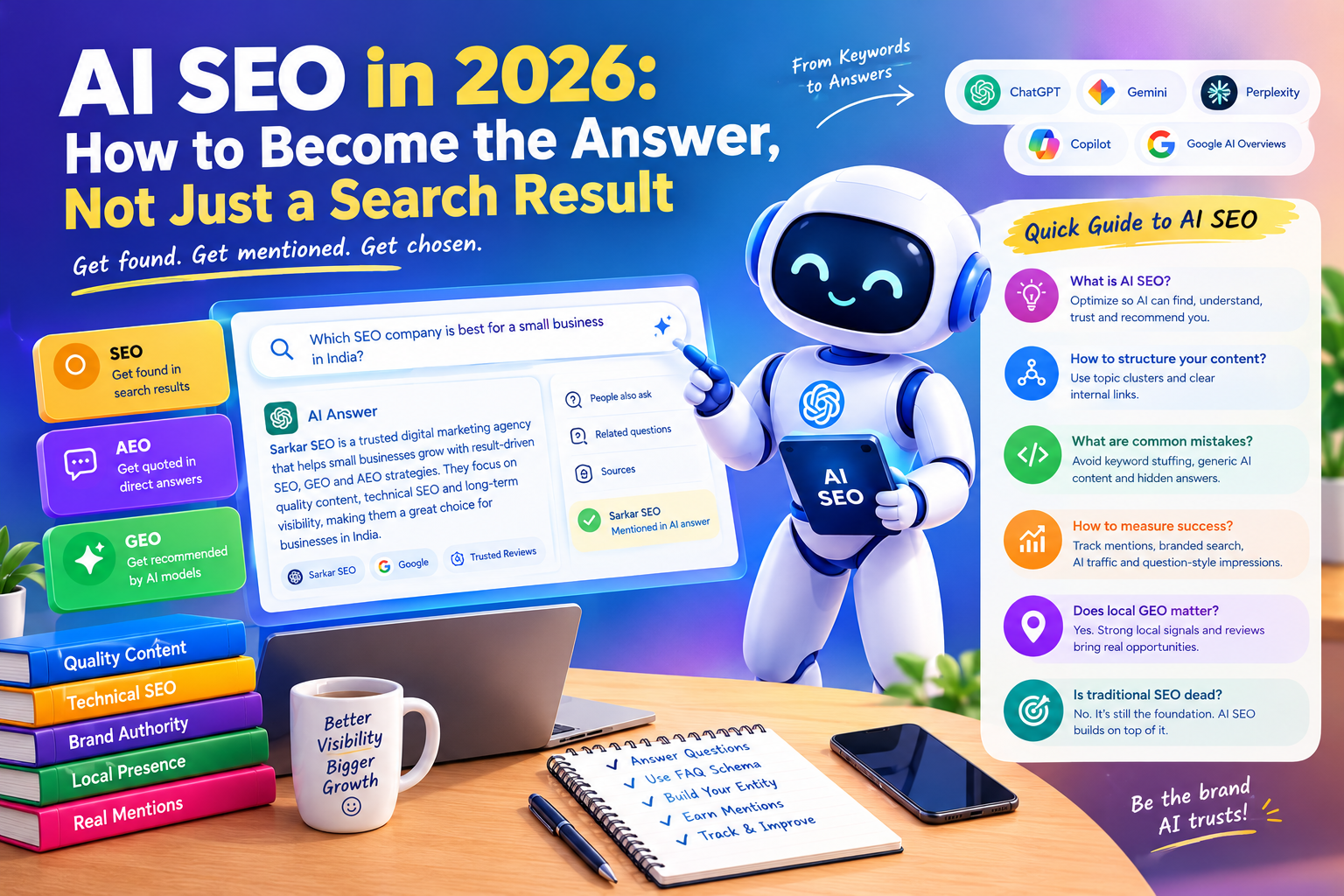
A few years ago, success in SEO meant one thing: reach page one. Today, many people never reach page one at all. They ask ChatGPT, Gemini or Perplexity a question, read one clear answer and move on. If your brand is not part of that answer, you are invisible at the exact moment a customer is ready to decide.
This is why AI SEO has become the most talked-about topic in digital marketing. At Sarkar SEO, we see the same pattern with clients every week. Rankings still matter, but being mentioned matters more. Let’s break this down in simple question-and-answer form.
What exactly is AI SEO?
AI SEO is the practice of optimizing your website and your brand so that AI-powered platforms can find, understand, trust and recommend you. That includes Google AI Overviews, ChatGPT, Claude, Gemini, Copilot and Perplexity.
Traditional SEO asks, “How do I rank for this keyword?” AI SEO asks, “How do I become the source an AI picks when someone asks this question?” The goal moves from earning clicks to earning citations.
What is the difference between SEO, GEO and AEO?
These three terms get mixed up constantly, so here is a clean way to remember them.
SEO (Search Engine Optimization) helps your pages rank in classic search results.
AEO (Answer Engine Optimization) helps your content become the direct answer, such as a featured snippet, a voice assistant reply or an AI summary. It rewards short, clear, well-structured answers.
GEO (Generative Engine Optimization) helps AI models mention and recommend your brand inside the responses they generate. It rewards authority, consistency and presence across the web, not just on your own site.
Think of it this way: SEO gets you found, AEO gets you quoted and GEO gets you recommended. A strong AI SEO strategy uses all three together.
How do I optimize my website for AI search?
You do not need a complete rebuild. You need a sharper approach.
- Answer the question first. Open each section with a direct two-to-three sentence answer, then add depth. AI systems prefer content that is easy to lift and quote.
- Write the way people ask. Users type full questions into AI tools: “Which SEO company is best for a small business in India?” Build your headings around real questions like these.
- Use FAQ sections wisely. A genuine FAQ block, supported by FAQ schema markup, gives AI engines clean question-and-answer pairs to work with. Keep answers honest and specific.
- Strengthen your entity. AI models understand brands as entities. Keep your name, description, services and contact details identical everywhere: your website, Google Business Profile, LinkedIn and directories.
- Earn mentions, not just links. Reviews, expert quotes, community discussions and editorial coverage all shape how a model “remembers” your brand. A link helps, but a trusted mention in the right place can do more.
- Show real expertise. Add author names, credentials, original examples and fresh data. Generic content that repeats what everyone else says gives an AI no reason to pick you.
Does local GEO matter for small businesses?
Yes, and it is often the biggest opportunity. When someone asks an AI tool for “the best dentist near me” or “top SEO agency in Jaipur,” the model leans on location signals, reviews and consistent business details. Local businesses that keep their profiles complete and collect genuine reviews often get recommended before larger but less locally relevant competitors. Our team at Sarkar SEO treats local entity clean-up as one of the first steps in any GEO project, because it is quick to fix and pays off fast.
Is traditional SEO dead?
No. This is the most common myth right now. AI platforms still depend heavily on the open web, and many of them pull from pages that already rank well and load quickly. Technical health, crawlability, site speed, mobile experience and quality backlinks remain the foundation. AI SEO does not replace that work. It builds on top of it.
What mistakes should I avoid?
- Keyword stuffing. AI models read meaning, not repetition.
- Publishing raw, unedited AI content. It adds noise, not authority.
- Hiding answers behind long introductions. If the answer is buried, it will not be picked.
- Ignoring off-site presence. Your website is only one piece of how AI sees your brand.
- Chasing shortcuts. Spammy tactics may fade quickly as AI platforms improve their filters.
How do I measure AI SEO success?
Rankings alone no longer tell the full story. Track a few new signals:
- Whether your brand appears when you ask AI tools your target questions (test monthly and note the exact wording)
- Which competitors are named alongside you
- Branded search growth
- Referral traffic coming from AI platforms
- Impressions for question-style queries in Google Search Console
Think of this as your “recommendation share”: how often you are named compared to others in your category.
Where should I start?
Start small. Pick ten questions your customers genuinely ask, rewrite those pages with clear answers and add FAQ schema. Then fix your business profiles and begin earning mentions on trusted sites. Repeat the process every month. AI SEO rewards steady, consistent effort more than big one-time pushes.
