



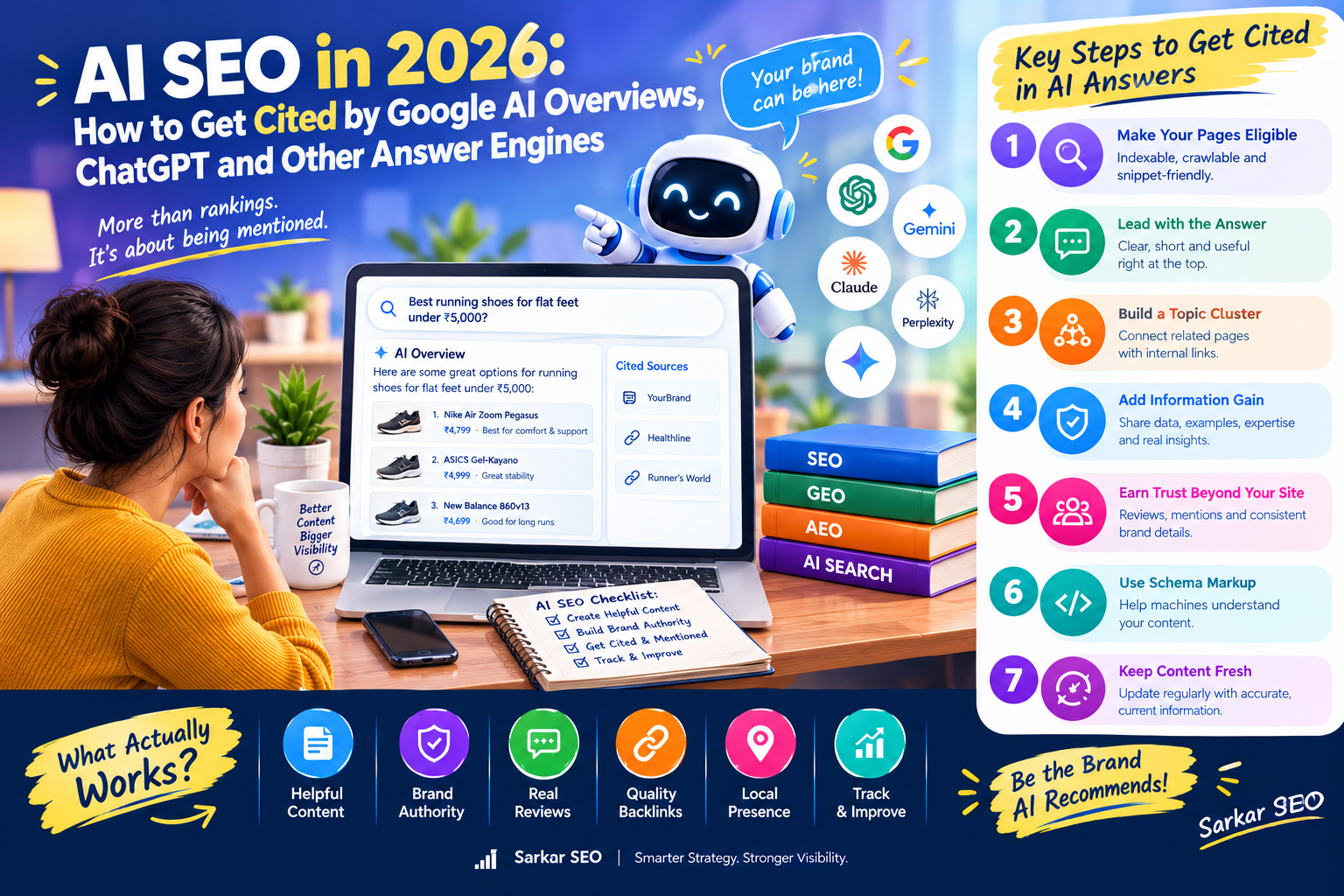
Search now answers questions before it sends visitors anywhere. Google AI Overviews, AI Mode, ChatGPT, Perplexity, Gemini and Claude synthesize responses from multiple sources, and the brands named in those answers gain attention that rankings alone no longer guarantee. AI SEO is the discipline of making your content easy for these systems to find, understand, trust and cite, while keeping your traditional organic performance strong.
At Sarkar SEO, we frame it simply: rankings still matter, but citations now decide who gets seen.
What Google says about AI SEO
Google’s own documentation is refreshingly plain. A page must be indexed and eligible to be shown in Google Search with a snippet to appear as a supporting link in AI Overviews or AI Mode. Google also says specific optimization isn’t required, and existing SEO fundamentals remain worthwhile. Its guidance adds that no special schema.org structured data is needed. AI features and your website +2
So there is no secret markup or submission form. The opportunity lies in doing the fundamentals better than competitors and making your content easier to quote.
What the 2026 data shows
The traffic impact is real, and the numbers vary by study.
Pew Research’s browsing analysis of 900 U.S. adults found that users clicked a traditional result 8% of the time when an AI Overview appeared, compared with 15% when none did. Newer industry studies point the same direction. Ahrefs reported a position-one CTR drop of about 58%, according to a 2026 roundup of AI Overview research. Sistrix data from Germany found position-one CTR falling from 27% to 11% when an AI Overview was present. New on Yahoo +2
Two findings are more useful than the doom headlines:
- Citation changes outcomes. Seer Interactive’s research, as summarized by secondary sources, found that cited URLs earned about 120% more organic clicks per impression than uncited ones. visible-authority
- The picture is moving. The same Seer data showed AI Overview query CTR falling to 1.31% in December 2025, then recovering to 2.36% by February 2026. presenc
A caution on quality: several of these figures come from vendor studies reported through aggregators, and the numbers differ between summaries. Treat them as directional, not exact. Also note that Pew’s sample is U.S.-only and dates from March 2025.
One more shift matters. Reported overlap between AI Overview citations and top-10 organic results has fallen, with one dataset citing 17 to 38% in February 2026, down from about 76% in mid-2024. Ranking well no longer guarantees being cited. omnibound
The AI SEO framework
- Make pages eligible
Confirm that key pages are indexed, crawlable and snippet-eligible in Search Console. Be careful with preview controls such as nosnippet. Also avoid mixing up settings: one explainer notes that Google-Extended is not the control for AI Mode in Search. Google Search Console now also has a Search generative AI control and a Generative AI performance report. mangoolseseospace
- Lead with the answer
Start each section with a short, self-contained answer, then expand. Machines extract passages, so every section should make sense when quoted alone. Avoid vague openings and pronouns that depend on earlier paragraphs.
- Cover the topic cluster
AI Mode and AI Overviews may use query fan-out to search across subtopics and multiple data sources. That claim comes from a third-party analysis, so treat it as an informed inference. The practical response is topical depth: connect pages about measurement, technical access, content structure, schema and local or international variations through logical internal links. Google itself lists making content easily findable through internal links among the fundamentals. w3erabugsmash
- Add information gain
If your page repeats common advice, an AI system has no reason to prefer it. Include first-party data, tested workflows, screenshots, named expert commentary and case results. Only publish what you can verify. Never invent statistics or experience.
- Build trust beyond your own site
Answer engines draw on the wider web. Pew found Google’s AI summaries cited Wikipedia, Reddit and YouTube most often, together about 15% of sources examined. Keep your brand, authors and service descriptions consistent across directories, profiles and credible publications, and take part in the communities where your audience actually asks questions. yahoo
- Use schema to clarify, not to persuade
Organization, Article, Person and Breadcrumb markup help machines interpret your page. Mark up only what readers can see.
- Keep content fresh
Outdated statistics get ignored or repeated wrongly. Review high-value pages quarterly, show the date updated, and cite primary sources.
How to measure AI search visibility
In Google, AI feature traffic is included in overall search traffic under the “Web” search type in Search Console, and a dedicated report appears once a site has enough impressions. For ChatGPT, Perplexity, Gemini, Claude and Grok, run a monthly prompt audit. Ask 20 to 30 of your customers’ real questions, then record whether your brand is mentioned, which URLs are cited and how you are described. Results vary from run to run, so track trends, not single outputs. eseospace
Also segment your analytics. Informational queries may lose clicks while commercial and branded queries hold up, so judge pages by leads and revenue, not only sessions. Some reports claim AI-referred visitors convert better, but these figures vary widely by source, so test this against your own data.
Mistakes to avoid
- Publishing generic AI-written content. It adds nothing new and weakens trust.
- Chasing hacks. Hidden prompts and keyword stuffing carry quality risk.
- Reporting rankings alone. Rank no longer predicts traffic by itself.
- Blocking bots without understanding them. Each crawler has a different purpose, so review robots.txt deliberately.
AI SEO is not a replacement for SEO. It is a higher standard: technically sound pages, clear answers, original expertise and a consistent brand presence across the web. Brands that meet it give both Google and answer engines a reason to cite them. If you want a prioritized roadmap for your own site, Sarkar SEO can audit your current AI search visibility and build an action plan.
