



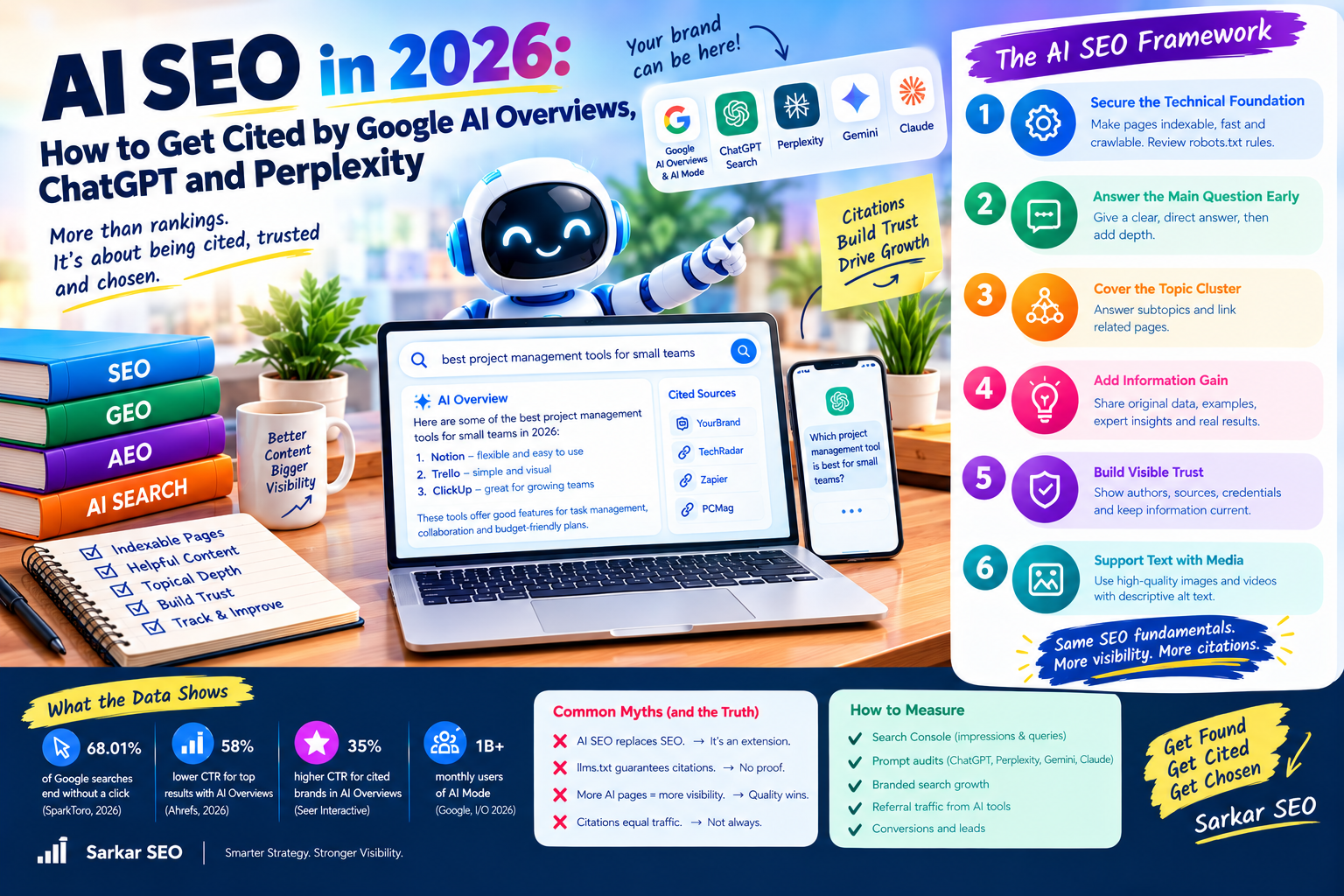
People now get answers from AI before they ever see a list of links. AI SEO is the practice of making your content easy for both search engines and AI answer engines to find, understand, trust and cite. This guide explains what is changing, what Google actually says about it, and how to build a strategy that works across platforms. It reflects the approach we take at Sarkar SEO.
What Is AI SEO?
AI SEO means optimizing your website to appear in Google AI Overviews, Google AI Mode, ChatGPT search, Perplexity, Gemini, Claude and similar tools, as well as in classic search results. You will also see it called GEO (generative engine optimization) or AEO (answer engine optimization). The names differ, but the goal is the same: become a source that machines choose to quote and people choose to click.
The scale explains the urgency. Google reportedly said at I/O 2026 that AI Mode has passed one billion monthly users and is expanding to nearly 200 countries. That is a claim from Google’s event as reported by a news tracker, so treat the exact figure as reported rather than independently audited. The direction is clear either way. it
Is AI SEO Different From Traditional SEO?
Mostly, no. Google’s own documentation says its generative AI features are rooted in its core Search ranking and quality systems. The same guide says you don’t need new machine-readable files, AI text files, special markup or Markdown to appear. In May 2026, John Mueller said SEO best practices remain foundational and no separate AEO strategy is needed. google ai optimization guide ai search is still search +2
That has a practical consequence. A page that Google can’t crawl, index or show with a snippet is unlikely to be cited by Google’s AI features. Fundamentals still come first.
What has changed is how answers are assembled, and that affects how you plan content.
Query Fan-Out: The Mechanism Behind AI Answers
Google says AI Overviews and AI Mode may use “query fan-out,” issuing multiple related searches across subtopics and data sources to develop a response. Google’s example is a question about fixing a lawn full of weeds. The system might simultaneously search for best herbicides, chemical-free weed removal and weed prevention. googledemandsphere
OpenAI describes similar behavior for ChatGPT search, which typically rewrites your query into one or more targeted queries. eseospace
The takeaway is that you are no longer competing for a single phrase. You are competing to be useful across the whole cluster of questions behind a topic. Pages that cover a subject thoroughly, with each sub-question answered clearly, have more chances to be retrieved.
There is a trap here. Google warns that creating separate content for every fan-out query, primarily to manipulate rankings or AI responses, violates its scaled content abuse policy. Depth is rewarded. Thin pages made to mimic sub-queries are not. eseospace
A Practical AI SEO Framework
- Secure the technical foundation. Make sure important pages are indexable, load fast and are reachable through internal links. Google specifically lists making content easy to find through internal links and keeping structured data consistent with the visible page text. Don’t block Googlebot, and review robots.txt rules for the AI crawlers you do or don’t want. google
- Answer the main question early. Put a clear, direct answer in the first lines under each heading, then add the nuance. This helps readers and makes passages easier to extract. Don’t dress up filler as “AI-friendly” structure.
- Cover the topic cluster. Map the follow-up questions a person would ask next: costs, comparisons, risks, tools, alternatives. Answer them in one well-organized page, or link to dedicated pages where a sub-topic genuinely deserves its own.
- Add information gain. AI systems can already summarize what everyone else says. Original data, real examples, clear opinions, screenshots, benchmarks and first-hand testing give a model a reason to cite you instead of a competitor. Only claim experience you actually have.
- Build visible trust. Show named authors, credentials, update dates and sources. Earn mentions and links from credible sites. At Sarkar SEO, we treat brand reputation as part of SEO, because AI tools rely on signals of who is trustworthy on a topic.
- Support text with media. Google notes that high-quality images and videos supporting your text help your content appear in AI features. Use descriptive alt text and clean captions. google
What to Avoid
- Chasing an “AI file” or special schema. Google has said none is required.
- Mass-producing AI-written pages. Google’s spam policies target scaled content with no added value.
- Keyword stuffing. Natural language matches how people prompt AI tools.
- Promising guaranteed citations. No one controls AI outputs, and Google says no third-party tool can see its internal ranking or AI systems.
- Ignoring clicks. Third-party estimates suggest many AI sessions end without a site visit, so measure conversions and brand demand, not traffic alone.
How to Measure AI Search Performance
Measurement has improved. In June 2026, Google launched Search Console reports for impressions in generative AI features, with separate views for Search and Discover. Note that this does not provide a clean AI Mode versus AI Overviews split. itrefontelearning
Combine three sources:
- Search Console for impressions, clicks and queries.
- Manual prompt testing. Run your core questions monthly in Google, ChatGPT, Perplexity, Gemini and Claude, and record whether you are cited and how you’re described.
- Analytics for branded search growth, referral traffic from AI tools, and leads.
Sarkar SEO recommends tracking this in a simple monthly log. AI answers vary between runs, so look for trends rather than single results.
Do I need llms.txt to rank in AI search?
Google’s guidance says no special AI files are needed for its features. Other platforms may behave differently, so treat it as optional.
Can AI-generated content rank or get cited?
Yes, if it is accurate, useful and genuinely adds value. Content produced at scale mainly to manipulate results risks violating spam policies.
How long does AI SEO take?
It follows normal SEO timelines. Expect months, not days, because crawling, quality assessment and trust-building take time.
