



Search used to mean ten blue links. Now a single question can trigger a written answer, a list of cited sources and a follow-up conversation. AI SEO is the practice of making your content easy for both people and AI-driven search systems to find, understand and cite. At Sarkar SEO, we see the same pattern repeatedly: the sites that win are not chasing tricks, they are executing the fundamentals unusually well.
What AI SEO Actually Means
AI SEO covers optimizing for Google AI Overviews, Google AI Mode and answer engines such as ChatGPT, Perplexity, Gemini, Grok and Claude. You will also see it called GEO (generative engine optimization) or AEO (answer engine optimization). The labels differ, but the goal is the same: becoming a source that AI systems trust enough to reference.
The scale is real. Google said at I/O 2026 that AI Mode has passed one billion monthly users and is expanding to nearly 200 countries. Whatever you call it, you cannot ignore it. it
The Core Truth: AI Search Is Built on Search
Many guides promise a secret formula. Google’s own documentation says otherwise: there are no additional technical requirements beyond being indexed and eligible to appear in Google Search with a snippet. Google also states that you don’t need new machine-readable files, AI text files or special markup to appear in generative AI search. bugsmashdemandsphere
This is good news. Your existing SEO investment carries over. It also means anyone selling a “special AI markup” fix is overpromising.
How Google’s AI Picks Sources: Query Fan-Out
The most useful concept to understand is query fan-out. Both AI Overviews and AI Mode may issue multiple related searches across subtopics and data sources to build a response. Google’s own example shows a question about fixing a weedy lawn splitting into sub-queries about herbicides, chemical-free removal and prevention. bugsmashdemandsphere
The practical lesson: a page that answers only the headline question is at a disadvantage. A page that covers the surrounding subtopics gives the system more reasons to cite it.
Two cautions. Google does not publish the sub-queries, so tools that display “your fan-out queries” are generating plausible guesses with a language model. And do not respond by creating a thin page for every imagined variant. Depth on one well-organized page beats dozens of fragments. it
Ranking Does Not Guarantee Citation
One independent measurement found that exact-URL overlap between AI Mode citations and the top 10 organic results was only 14%, rising to 21.9% at domain level. This is a single analysis, so treat it as directional. Still, it matches what fan-out would predict: AI systems pull from pages that answer specific sub-questions well, not only from whoever holds position one. it
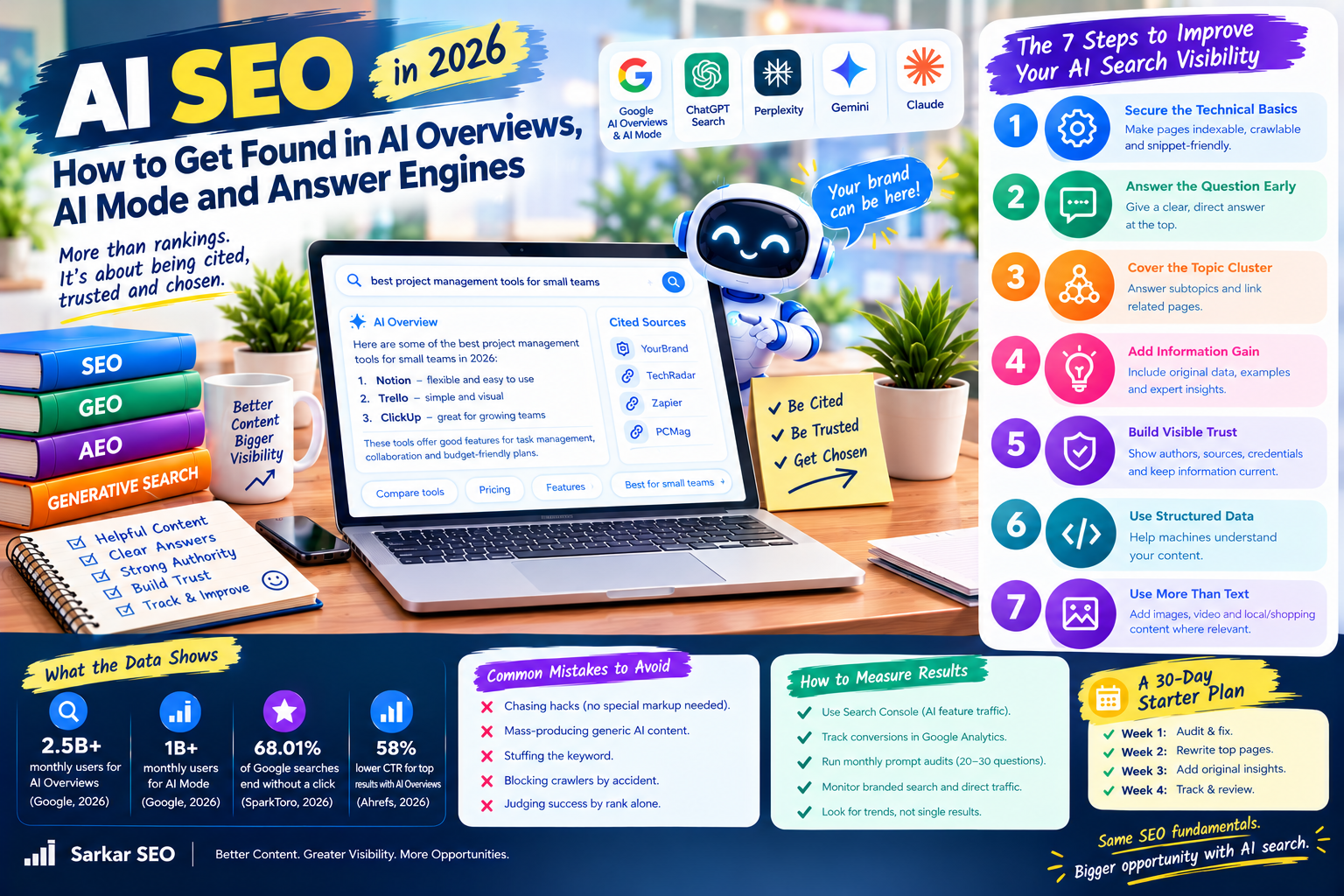
The AI SEO Playbook
- Secure the technical basics
Check that key pages are indexable and snippet-eligible. A leftover noindex or restrictive snippet directive from a site redesign can quietly remove you from AI features. Run this audit before anything else.
- Lead with the answer
Put a clear, self-contained answer in the first sentences under each heading, then add nuance. This helps readers skim and gives AI systems clean passages to extract. Avoid burying definitions beneath long introductions.
- Cover the cluster, not the keyword
Map the questions a buyer asks before, during and after the main query: definitions, comparisons, costs, mistakes, tools and next steps. Link these pages together. Google specifically recommends making content easy to find through internal links. bugsmash
- Add information gain
AI systems can summarize generic advice without you. What they cannot invent is your original data, case results, screenshots, benchmarks, expert opinion or first-hand testing. Include something a competitor’s article lacks. If you do not have proprietary data yet, run a small study or document a real process.
- Build visible expertise and trust
Name real authors with credentials, cite primary sources, show update dates and keep claims verifiable. Consistent brand mentions across reputable sites also help systems recognize you as an entity worth citing. Sarkar SEO treats authorship and source quality as ranking infrastructure, not decoration.
- Use structured data for clarity, not magic
Schema helps search engines understand a page, but there is no special schema.org markup for AI features. Use accurate Article, Organization, FAQ-style and product markup where it genuinely fits, and nothing more. demandsphere
- Write for humans first
Google’s guidance is to make pages for your audience, not just for generative AI search. Keyword stuffing and mass-produced filler are the fastest way to waste effort. demandsphere
Measuring AI Search Performance
Measurement improved in 2026, but it is still limited. Since 3 June 2026, Search Console’s Generative AI performance report has shown impressions for AI Mode and AI Overviews combined, by page, country, device and date, with no query dimension, clicks, CTR or average position. So you can see exposure, not a full conversion picture. it
Supplement it with:
- Manual prompt testing across Google, ChatGPT, Perplexity, Gemini and Claude, logged monthly.
- Referral analysis for traffic from AI platforms in your analytics.
- Brand-search trends and assisted conversions, since AI answers often influence decisions without a click.
The Zero-Click Reality
Expect fewer clicks per search. Secondary sources citing SparkToro and Search Engine Land estimate that about 93% of AI Mode queries end without a website visit. These are third-party estimates, not Google figures, so use them as a warning rather than a precise forecast. seoquick
The strategic response is to optimize for being cited and remembered, and to make the clicks you do earn count. Visitors arriving from an AI citation are often further along in their research, so strong calls to action and clear next steps matter more than ever.
Myths to Drop
- “AI SEO replaces SEO.” Google says the foundations still apply.
- “You need an llms.txt file.” Google’s guidance states no AI-specific files are required.
- “Rank first and you’ll be cited.” The overlap data suggests otherwise.
- “More pages means more citations.” Useful depth wins, not volume.
A 30-Day Starter Plan
Week 1: Audit indexability, snippet settings and internal linking on priority pages.
Week 2: Rewrite top pages with answer-first openings and subtopic coverage.
Week 3: Add original insights, named authors, sources and updated dates.
Week 4: Set up prompt tracking and review the Search Console generative AI report.
