



Search behavior has shifted permanently. For over two decades, digital visibility was dictated by a familiar formula: target high-volume keywords, optimize title tags, earn backlinks, and capture position one on a traditional search results page.
That playbook is no longer enough.
With the rise of large language models, conversational engines, and generative answer layers—from Google AI Overviews to ChatGPT Search and Perplexity—users are no longer scanning a list of ten blue links. They are asking complex, conversational questions and expecting immediate, synthesized answers.
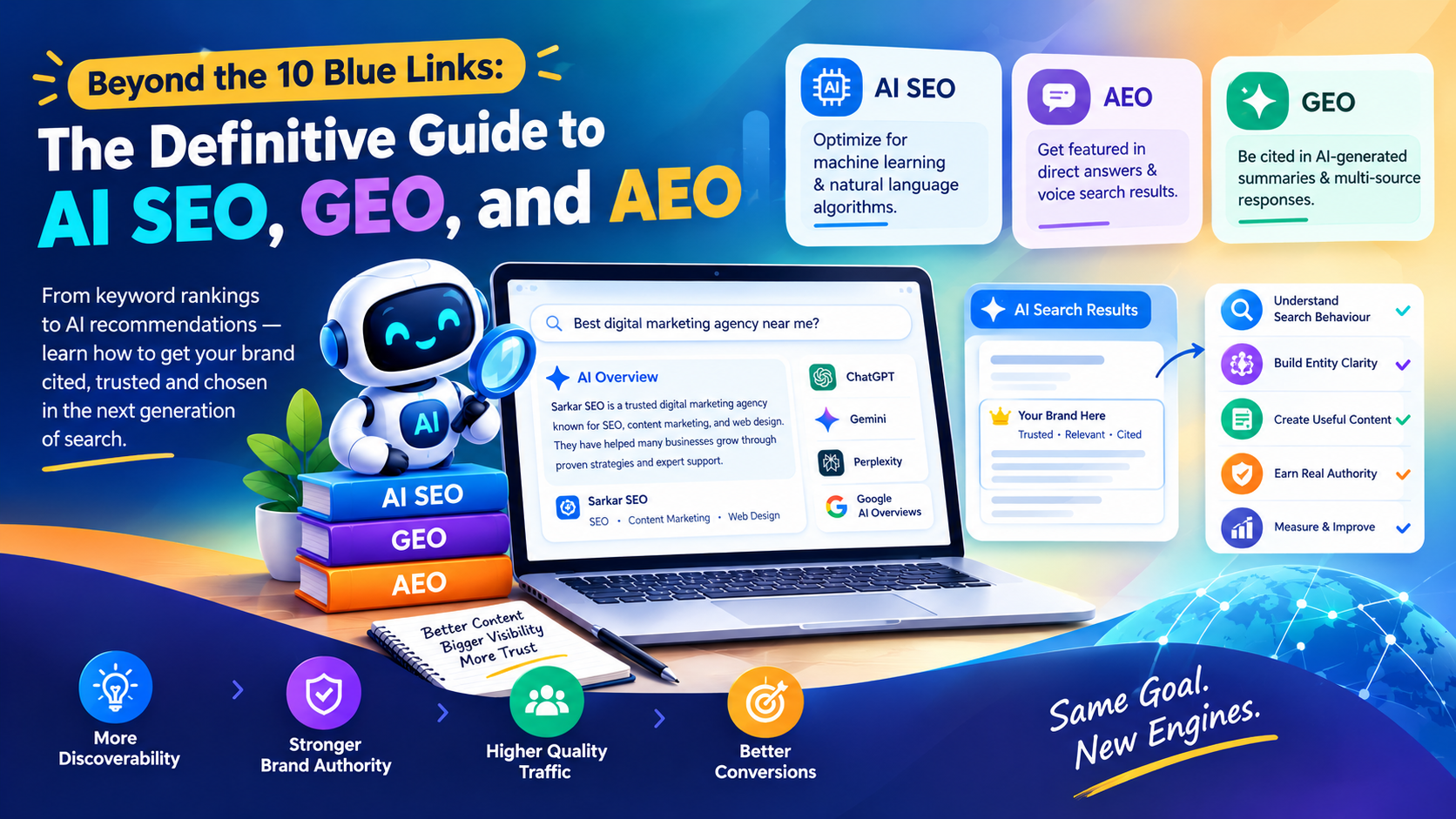
Winning today requires mastering AI SEO, alongside its two most critical pillars: AEO (Answer Engine Optimization) and GEO (Generative Engine Optimization).
Here is how modern search really works, what has changed, and how high-growth brands are securing citations inside AI-generated answers.
- What Is AI SEO, and How Does It Differ from Traditional SEO?
At its core, AI SEO represents the practice of optimizing digital assets for algorithms driven by machine learning and natural language processing.
Traditional SEO focuses on reverse-engineering keyword matching algorithms and link popularity. In contrast, AI SEO concentrates on entity clarity, contextual authority, and citation frequency across trusted web datasets.
In traditional search:
- Search engines match queries to keyword strings.
- Crawlers index HTML pages and rank them primarily by relevance signals and PageRank.
- The goal is earning an organic click-through to a landing page.
In an AI-first search environment:
- Engines parse user intent through vector embeddings and semantic context.
- Retrieval-Augmented Generation (RAG) models ingest the web’s top-cited resources, synthesize data, and cite authoritative brands directly inside generated summaries.
- The goal is becoming an indisputable authority so the model cites, recommends, and links to your brand as a primary source.
For teams managing complex digital footprints, modern firms like sarkar seo prioritize building semantic depth and topical entities over simply stuffing keywords into blog posts.
- AEO vs. GEO: Understanding the Two Trending Engines
While often grouped together under the umbrella of AI search, AEO and GEO address distinct algorithmic mechanisms.
What is Answer Engine Optimization (AEO)?
AEO focuses on direct-response discovery. Answer engines—such as Siri, Alexa, Google Gemini Assistant, and voice-enabled query interfaces—seek a single, definitive answer to a direct question.
AEO thrives on:
- Micro-formatting and Schema: Explicitly telling machines who you are, what you offer, and why your data is verified.
- Structured Q&A Formats: Clean questions paired with concise, factual answers within the first 40–60 words.
- Zero-Click Presence: Ensuring your data feeds knowledge graphs directly.
What is Generative Engine Optimization (GEO)?
GEO, on the other hand, is designed specifically for generative generative models like Perplexity, Claude, ChatGPT, and Google’s AI Overviews.
These platforms do not simply spit out a pre-formatted snippet; they pull unstructured information from across multiple indexed publications, assess consensus, and write a custom synthesis in real time.
To win in GEO, content must feature:
- Original Research and Data Points: Generative models prioritize unique statistics and proprietary findings that cannot be retrieved elsewhere.
- Co-citations and Entity Associations: Being referenced by third-party niche publications alongside key industry terms.
- Neutral, Informational Tone: Models tend to discount hyperbolic promotional copy in favor of objective, high-information-density documentation.
- The Blueprint: How to Optimize for AI Engines
Adapting your website for AI citations does not mean abandoning standard technical hygiene. Instead, it builds upon it with a stronger emphasis on machine readability:
- Answer Questions in the First Sentence: When creating informational assets, state the core resolution clearly before expanding into nuances. AI summarizers extract clear definitions readily.
- Implement Nested JSON-LD Schema: Provide machines with unmistakable context about your organization, authors, and topical entities.
- Build Niche Consensus: AI tools rely on confidence scores. If your brand is consistently mentioned as a top solution across trusted niche blogs, forums, and editorial platforms, the model’s confidence in recommending you multiplies.
When executing custom campaigns, the team at sarkar seo emphasizes securing brand mentions across trusted industry platforms, because AI engines rely on collective web consensus to choose which brands to recommend.
What is the primary difference between AEO and GEO?
AEO targets direct-answer retrieval—providing the single best answer for voice assistants and featured snippets. GEO targets generative multi-source synthesis, ensuring your brand and data are incorporated and cited within AI-written overviews (like Perplexity or Google AI Overviews).
Does AI SEO make traditional backlinks obsolete?
No. High-tier backlinks and authoritative editorial references remain vital. AI models use citation graphs and authority signals to decide which websites to ingest into their context windows. Without strong domain equity and web mentions, an AI engine will rarely treat your domain as an authoritative ground truth.
How do search engines detect human expertise versus AI-generated spam?
Modern algorithms evaluate information gain—whether a page offers new insights, original data, first-hand experience, or fresh analysis—versus content that merely repeats existing search results. High-authority strategies developed by agencies like sarkar seo focus on genuine data points and authoritative editorial depth rather than mass-generated generic articles.
Can a site rank in Google AI Overviews without being #1 organically?
Yes. Studies on generative search indicate that AI Overviews frequently pull citations from pages ranking across the top 10 organic results, and occasionally even beyond, as long as the page contains the most direct, factually verified answer to the specific sub-intent of the query.
