



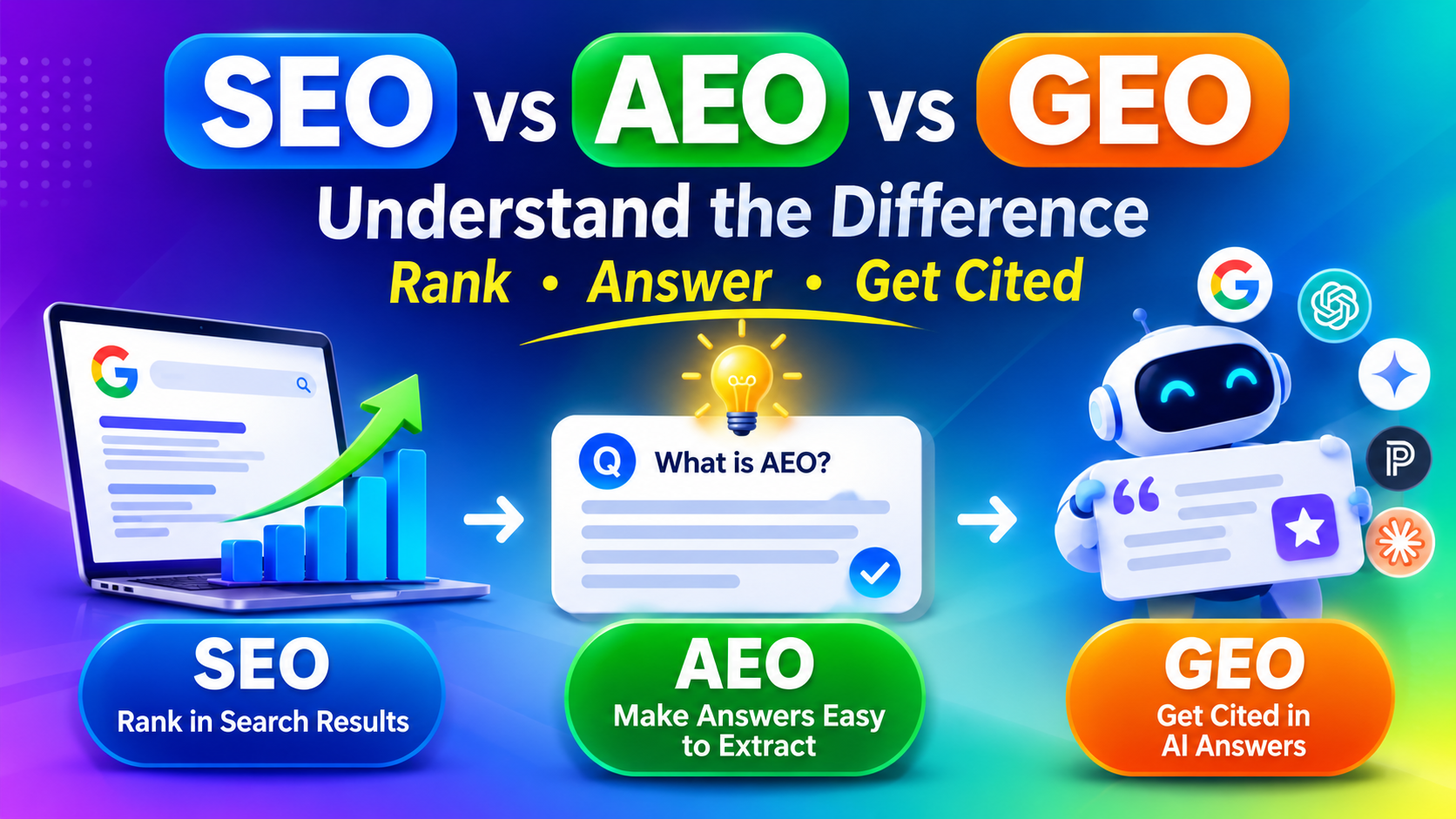
SEO
Ranked in results
AEO
Extracted as answers
GEO
Cited in AI responses
Shared foundation: crawlable pages, helpful content, trust, technical health
SEO, GEO, and AEO are often used as if they mean the same thing. They don’t. SEO (search engine optimization) is the work of getting pages to rank in search results. AEO (answer engine optimization) is the work of structuring content so that a clear answer can be lifted from it. GEO (generative engine optimization) is the work of getting your content retrieved, cited, and mentioned inside AI-generated responses.
The three overlap heavily, and one depends on the others. So the more useful question for most businesses is not “which one should I choose?” but “what order should I do them in?”
Why these three terms are getting confused
Search has changed in visible ways. Google now shows AI Overviews and AI Mode for many queries, while people also ask ChatGPT, Perplexity, Gemini, and Claude to research products and services. Marketers needed names for the new work, and three terms appeared with different histories.
SEO is the oldest and most established. AEO grew out of marketing work on featured snippets, direct answers, and voice assistants, and it became popular in the late 2010s. GEO is newer and more academic. The term was introduced in a 2023 research paper by researchers from Princeton University, Georgia Tech, the Allen Institute for AI, and IIT Delhi, first posted in November 2023 and later published at the ACM SIGKDD conference in 2024.
Usage is not consistent. Some agencies use AEO as an umbrella term for everything AI-related. Others read it as “AI Engine Optimization.” Before you hire anyone or buy a package, ask what they mean and what they will deliver. A service labelled “GEO” that consists only of keyword research and meta descriptions is still SEO with a new label.
What is SEO?
Search engine optimization is the practice of making your pages discoverable, relevant, and trustworthy enough to rank for the queries your customers use. Its output is a position in a list of results, which in turn produces clicks, visits, and enquiries.
The core inputs have not changed much: pages that search engines can crawl and index, content that matches search intent, a sound site structure, internal and external links, and good user experience. Technical problems such as blocked pages, duplicate URLs, or thin content still hold sites back.
Example: a software company wants to rank for “payroll software for small teams.” SEO means building a dedicated page that explains who the product suits, what it costs, how it handles tax filings, and how it compares with alternatives, then linking to that page from related guides and making sure Google can crawl and index it.
What is AEO?
Answer engine optimization focuses on the answer itself. The goal is to make your content easy for a search system, voice assistant, or AI tool to extract a direct, accurate response from it. AEO builds on SEO, because a page that does not rank rarely gets its answer used.
In practice, AEO means putting a clear answer near the top of each section, defining key terms before using them, using question-based headings where they match real queries, and presenting steps, lists, or comparison tables when the information has that shape.
Example: a page titled “What is a 301 redirect?” can open with a two-sentence definition, explain when to use one, and then go deeper. A reader or a system can take that opening answer without reading the whole article. The same page can still earn traffic from the deeper sections.
What is GEO?
Generative engine optimization is about visibility inside generated answers. When an AI system synthesises a response from several sources, GEO asks whether your content is one of the sources it uses, whether your brand is named, and whether your page is linked.
The clearest evidence comes from the paper that introduced the term. The authors built a benchmark of roughly 10,000 queries (GEO-bench) and tested nine kinds of content changes. They reported that optimization methods could raise source visibility in generative-engine responses by up to 40 percent. The strongest levers included adding citations, adding relevant quotations, and including statistics. Keyword stuffing was not one of the tactics that helped.
Two cautions matter here. First, this was a controlled benchmark, not a promise about your website, and the effect varied by domain. Second, visibility inside an AI answer is not the same as traffic, leads, or revenue. Those outcomes need their own measurement. Treat the paper as evidence that evidence-rich writing is worth doing, not as a guaranteed formula.
SEO vs AEO vs GEO: a comparison table
| Question | SEO | AEO | GEO |
|---|---|---|---|
| Primary goal | Rank pages in search results | Make answers extractable | Earn citations and mentions in generated responses |
| Typical output | Rankings, clicks, visits | Featured snippets, answer blocks, voice answers | Source links, brand mentions, recommendations in AI answers |
| Content that works best | Intent-matched pages, guides, service and category pages | Definitions, Q&A sections, steps, concise answers | Original data, cited statistics, expert perspective, comparisons |
| Key signals | Relevance, crawlability, links, quality, page experience | Clear structure, direct answers, consistent terminology | Source credibility, extractable evidence, entity clarity, retrievability |
| How to measure | Impressions, rankings, clicks, conversions | Answer appearances, snippet capture, question coverage | Citation presence across a defined prompt set, AI referral traffic, branded search trends |
| Depends on | Technical health and quality | SEO foundation | SEO foundation and answer structure |
Where they overlap
In practice the three share most of their work. A page that is crawlable, relevant, well organised, and genuinely useful tends to do better in all three contexts. The differences lie in emphasis and measurement.
Crawled &
indexed
Ranked (SEO)
matches intent
Answer used (AEO)
clear, direct
Cited in AI (GEO)
evidence-backed
Foundation: technical health, helpful content, trust, accurate information
Each stage depends on the ones to its left. Skipping the foundation weakens everything after it.
What Google says about AI features
Google’s guidance is the most useful anchor for anyone worried about AI search. On May 15, 2026, Google Search Central published a guide titled “Optimizing your website for generative AI features on Google Search,” covering AI Overviews and AI Mode. Coverage of the guide describes its core message as continuity with established SEO. Google emphasises unique, non-commodity content, making sure important text is available and crawlable, strong internal linking, a good page experience, and a technically sound site.
Coverage also reports that Google does not require special AI markup, new machine-readable files, or a separate technical standard for these features. Google’s broader documentation on AI features states that pages need to be eligible to appear in Search at all, and that snippet controls still apply. Read the official documentation directly before making any changes based on secondary summaries.
The practical implication is simple. If you want to appear in Google’s AI features, you first need to be a strong search result. Writing for AI does not replace that.
A practical plan: how to do all three without wasting budget
Follow this order. Each step makes the next one more effective.
1. Fix the SEO foundation first
Confirm that key pages are indexable, that robots rules and CDN settings do not block crawlers, that important content appears in text rather than only in images or scripts, and that duplicate URLs are consolidated. Use Google Search Console to check indexing and performance.
2. Open each important page with a direct answer
For every target question, give a two- to three-sentence answer near the top, then expand. Use headings that match how people phrase questions, and define terms before relying on them. This is the AEO layer, and it costs little to add to existing pages.
3. Add evidence that others would want to cite
Include statistics with named sources and dates, expert quotations with attribution, worked examples, and original observations from your own work. Avoid numbers you cannot trace. Unsupported statistics damage trust faster than they help visibility.
4. Make the entities consistent
Use your company name, service names, product names, and locations the same way across your site, profiles, and third-party mentions. AI systems and search engines both rely on consistent entity information to understand who you are and what you offer.
5. Build topical clusters and link them
Group related articles around a central service or guide, link them with descriptive anchor text, and avoid publishing many near-duplicate posts that differ only in wording. A small set of thorough, distinct resources usually beats dozens of thin ones.
6. Measure what matters
Track traditional SEO metrics first. Then, separately, test a fixed list of buyer questions across the AI tools your customers use, record whether your brand appears and which sources are cited, and repeat the test under comparable conditions. Responses vary, so treat these checks as observations, not a precise market share figure. Connect everything to enquiries and sales where possible.
Common mistakes to avoid
The most expensive mistake is renaming an existing SEO service as GEO and charging a premium for it. Ask for the deliverables in writing. A real GEO or AEO program should include content changes, evidence work, entity clarity, and a measurement method.
The second mistake is treating an FAQ section or structured data as a guarantee of inclusion in AI answers. Clear answers help search systems interpret a page, but neither FAQ markup nor any other technique guarantees that a platform will select or cite your content. Add structured data only when the page genuinely qualifies for it.
The third is keyword stuffing. The GEO research did not reward it, and Google’s guidance points toward natural, useful writing. A page that reads awkwardly to a human rarely performs well with either audience.
The fourth is publishing generic, AI-written articles that add nothing new. Both search engines and AI systems have an easier time choosing sources that offer something distinct: original data, first-hand experience, or a clearer explanation than the alternatives.
Which should you prioritise?
If you are choosing a starting point, here is a direct recommendation. Start with SEO. It is the foundation that makes the other two possible. Next, add answer-first structure to your highest-value pages, which is a relatively cheap AEO improvement. Then invest in GEO where it creates real advantage: original data, comparison content, clearly attributed expertise, and third-party mentions that you can actually earn.
Service businesses should focus on the questions prospects ask before they buy. SaaS companies should pay extra attention to comparison and alternatives pages, because buyers often ask AI tools for shortlists. Local businesses should keep location information accurate and consistent across every platform where they appear.
How SarkarSEO approaches it
At SarkarSEO, we treat SEO, AEO, and GEO as parts of one connected program rather than three separate products. We work with international clients, and the first step is almost always a review of what search engines can already crawl, rank, and understand. From there we look at the questions your customers ask, the evidence your pages provide, and how your brand is described across the web.
We are glad to explain what a realistic plan looks like for your business, including what we would measure and what we would not promise. If you would like to discuss SEO or AI search visibility for your website, you can explore our premium SEO services or contact our team. For a broader view of how we think about AI search, read our earlier post on AI SEO in 2026.
Frequently asked questions
Is GEO replacing SEO?
No. Google’s guidance for its AI features is built on established SEO fundamentals, and AI tools still rely on web content that search engines can find and understand. GEO extends SEO into generated answers, but it does not remove the need for it.
Is AEO the same as featured snippets?
Not exactly. Featured snippets are one place where answer optimization matters, but AEO covers any situation in which a system extracts a direct answer, including voice assistants and AI answer blocks. Snippet eligibility itself is determined by search engines, so no page can guarantee one.
Does GEO work for small businesses?
It can, and the research suggests that evidence-rich content can gain visibility even from lower-ranked pages. However, the reported gains were measured in a benchmark, and results vary by industry. Small businesses should focus on specific, well-sourced, locally accurate content rather than volume.
Do I need llms.txt or special AI markup?
Based on the coverage of Google’s May 2026 guide, Google does not require special AI markup or new machine-readable files for its AI features. Other platforms may publish their own documentation, so check their official guidance rather than relying on tactic lists.
How do I know if GEO is working?
Use a fixed set of buyer questions, test them regularly across the AI tools your audience uses, record citations and mentions, and compare the results with branded search trends, AI referral traffic, and enquiries. No single metric is definitive.
Should I stop writing for traditional search?
No. Traditional search still drives a large share of qualified traffic for most websites, and the foundation that serves it also supports AI visibility. Shifting attention entirely away from search would weaken the base that the other two depend on.
Tell us about your website, your target markets, and the questions your customers ask. We will review what is already working and recommend a realistic next step. Contact SarkarSEO to start the conversation.
Sources and further reading
- Aggarwal et al., “GEO: Generative Engine Optimization,” arXiv:2311.09735, presented at ACM SIGKDD 2024. Introduces the term and reports visibility gains on the GEO-bench benchmark. arxiv.org/abs/2311.09735 (primary source).
- Google Search Central, “AI features and your website.” Explains how AI Overviews and AI Mode relate to Search eligibility and controls. developers.google.com/search/docs/appearance/ai-features (primary source).
- Google Search Central, “Optimizing your website for generative AI features on Google Search,” published May 15, 2026. Read the original guide on the Google Search Central site (primary source).
- SarkarSEO, “AI SEO in 2026: From Search Rankings to AI Recommendations, GEO, and AEO.” Read the post (internal reference).
