



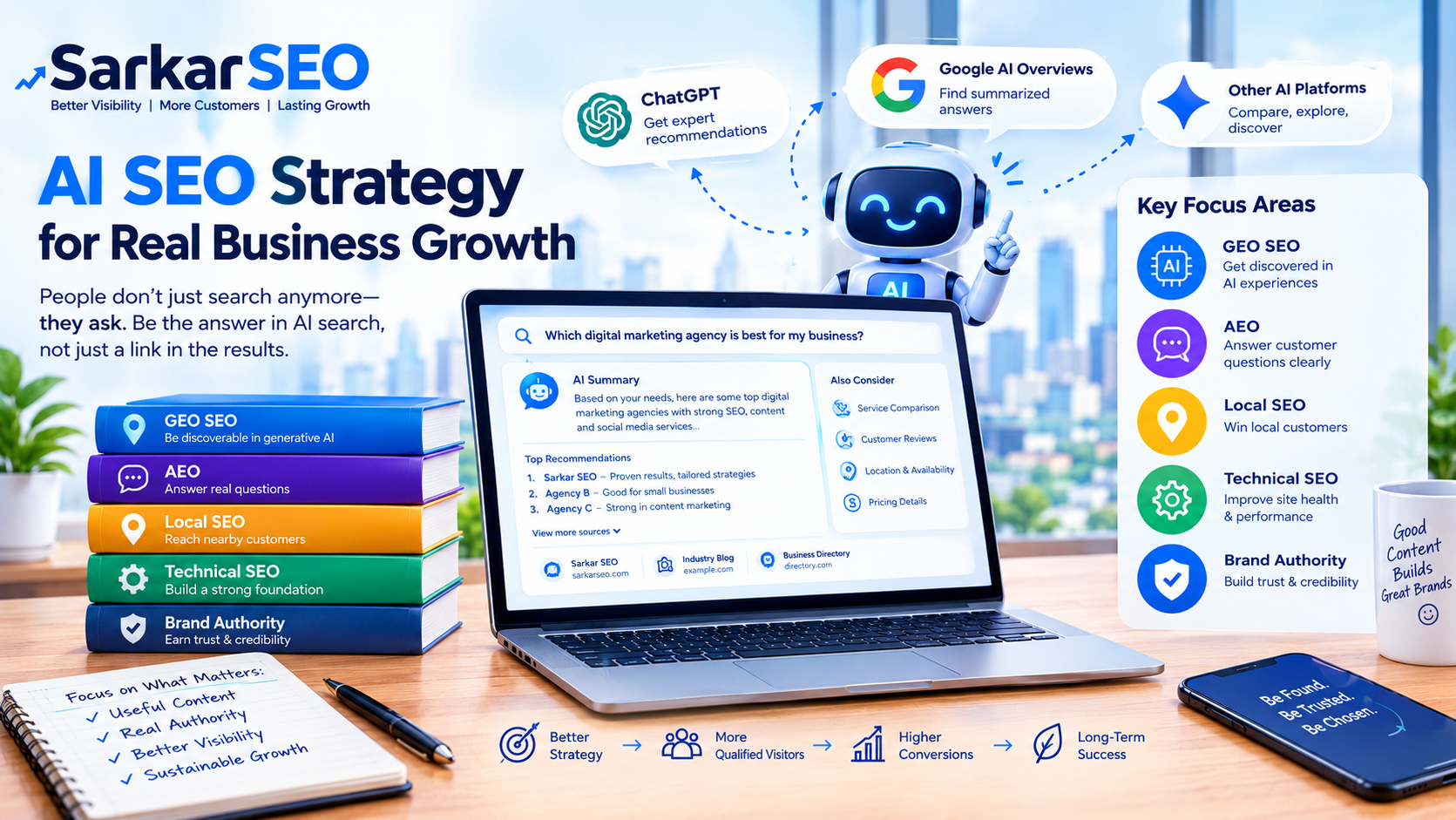
The digital search landscape is moving beyond the traditional list of blue links. People now ask AI-powered platforms to compare businesses, explain complicated subjects, and recommend solutions based on their specific needs. For companies competing online, this change introduces a new question: how can a brand become visible when customers receive answers before they even visit a website?
The answer begins with a stronger understanding of AI SEO, where traditional search optimization meets the evolving ways people discover information. Businesses need to build a digital presence that communicates expertise, answers customer questions, and provides consistent information across relevant platforms.
At Sarkar SEO, this changing environment highlights the importance of moving beyond rankings alone. Search visibility increasingly requires attention to brand recognition, source credibility, geographic relevance, and the quality of information available to potential customers.
Why Are AI Recommendations Changing the Way Businesses Compete?
Traditional SEO has largely focused on helping relevant pages appear in search results. AI-powered search introduces another layer: a system may interpret a complex question, gather information from several sources, and present a summarized response with supporting links.
Imagine a business owner asking an AI assistant to compare digital marketing providers for a growing company. The user may receive a shortlist, an explanation of relevant services, and sources for further investigation rather than a simple list of websites.
This changes the way marketers evaluate online visibility. Rankings remain valuable, but they do not fully explain whether a business appears in relevant AI-generated responses or whether its information helps customers make decisions.
Sarkar SEO can approach this challenge by examining the complete discovery journey. Which questions introduce potential customers to a service? What information do they need before making a decision? Which pages establish the business’s expertise? These questions help shape a strategy that supports both conventional search performance and emerging AI discovery experiences.
However, AI recommendations are not controlled by a single ranking factor. Different platforms use different systems, and inclusion cannot be guaranteed through a particular optimization technique.
How Does GEO SEO Help a Brand Become Recognizable?
Generative Engine Optimization, or GEO, focuses on improving a brand’s discoverability and representation within generative AI experiences.
A useful GEO strategy begins with the information a business publishes about its services, expertise, experience, and areas of operation. If this information is incomplete, inconsistent, or difficult to understand, potential customers may struggle to establish what the business actually offers.
Sarkar SEO can incorporate GEO principles by strengthening the relationship between a company’s main service pages, supporting articles, case studies, and relevant external references.
For example, a company offering technical SEO should explain the problems it addresses, the methods involved, and the situations in which its services may be useful. Supporting articles can explore related topics in greater depth, while genuine case studies can demonstrate how the business approaches practical challenges.
Originality is particularly important. Repeating commonly available advice may provide basic information, but original analysis, documented experience, and specific examples give readers a stronger reason to engage with a source.
GEO should therefore be treated as an extension of a well-developed SEO strategy rather than a shortcut for obtaining AI mentions.
What Makes AEO Important for Question-Based Search?
Answer Engine Optimization, or AEO, focuses on making information useful for people seeking direct answers.
Customers rarely think only in keywords. They ask questions such as why a website is losing traffic, whether local optimization suits their business, or how to evaluate the quality of an SEO campaign.
AEO helps businesses organize content around these real information needs. A page should address its central question clearly before exploring the supporting details. Relevant examples, straightforward definitions, and logically organized sections help readers understand the subject without unnecessary effort.
At Sarkar SEO, question-led content can support a broader editorial strategy in which each article serves a specific purpose. One page might explain a technical problem, another could compare possible solutions, and a third could help readers evaluate the results of an optimization project.
The key is to avoid producing dozens of nearly identical articles simply because their wording differs. Content should address genuinely distinct needs rather than repeat the same explanation under different headings.
Clear answers may improve usability and help search systems interpret a page, but neither an FAQ section nor structured data guarantees inclusion in AI-generated answers.
Can Local Businesses Benefit From GEO SEO and AI Search?
Local discovery remains important for businesses whose customers come from particular cities, regions, or service areas. AI-assisted search can introduce another way for people to explore nearby options and compare providers.
For a local business, accurate information is the starting point. Its website, relevant business profiles, service descriptions, contact details, and operating locations should communicate a consistent picture of the company.
Sarkar SEO can integrate local optimization into an AI SEO strategy by examining how clearly a business describes its geographic coverage and the services available in each area.
Location pages should provide genuine local value. Instead of publishing the same paragraph for twenty cities, a company should explain relevant service availability, local requirements, or customer concerns where those differences actually exist.
Reviews can also help prospective customers understand a business’s strengths and limitations. Companies should encourage authentic feedback, respond professionally, and avoid fabricated testimonials or misleading claims.
Local optimization does not guarantee an AI recommendation. Nevertheless, reliable business information and useful location-specific content help establish relevance for both people and search systems.
How Should Businesses Measure AI SEO Performance?
A successful strategy needs measurable objectives. Otherwise, businesses risk investing in activities that sound innovative but produce little practical value.
Traditional SEO metrics remain essential. Organic impressions, clicks, landing-page performance, qualified leads, and conversions help explain how people discover and interact with a website.
AI visibility can be evaluated separately through structured observation. A business can prepare a consistent list of questions relevant to its services, test those questions across selected AI platforms, and record whether the brand appears and which sources are cited.
Because generated responses can vary, these checks should be repeated under comparable conditions. They provide useful observations, not a complete or definitive measure of market share.
Sarkar SEO can connect these findings with broader business indicators. If visibility improves but qualified enquiries remain unchanged, the next step may involve reviewing the relevance of the content, the landing-page experience, or the audience being reached.
Measurement should ultimately answer a practical question: are the optimization efforts helping the business attract the right people and build meaningful opportunities?
What Should Businesses Change First in 2026?
Businesses do not need to rebuild their entire websites around every emerging search trend. A more effective approach begins with identifying the most important weaknesses and addressing them in order.
First, review technical accessibility, indexing, and internal linking. Next, examine whether key service pages provide specific, accurate information. Then, identify important customer questions that remain unanswered and develop genuinely useful resources to address them.
Businesses serving local markets should also verify their geographic information and improve location pages where necessary. Finally, establish a reporting process that combines traditional SEO performance with observed AI visibility and business outcomes.
Sarkar SEO can apply this structured approach by treating GEO, AEO, and technical SEO as connected elements rather than isolated activities.
Google’s published guidance similarly emphasizes helpful, distinctive content and established SEO fundamentals for its AI search experiences. No special optimization trick guarantees that a website will be selected for a generated answer.
