



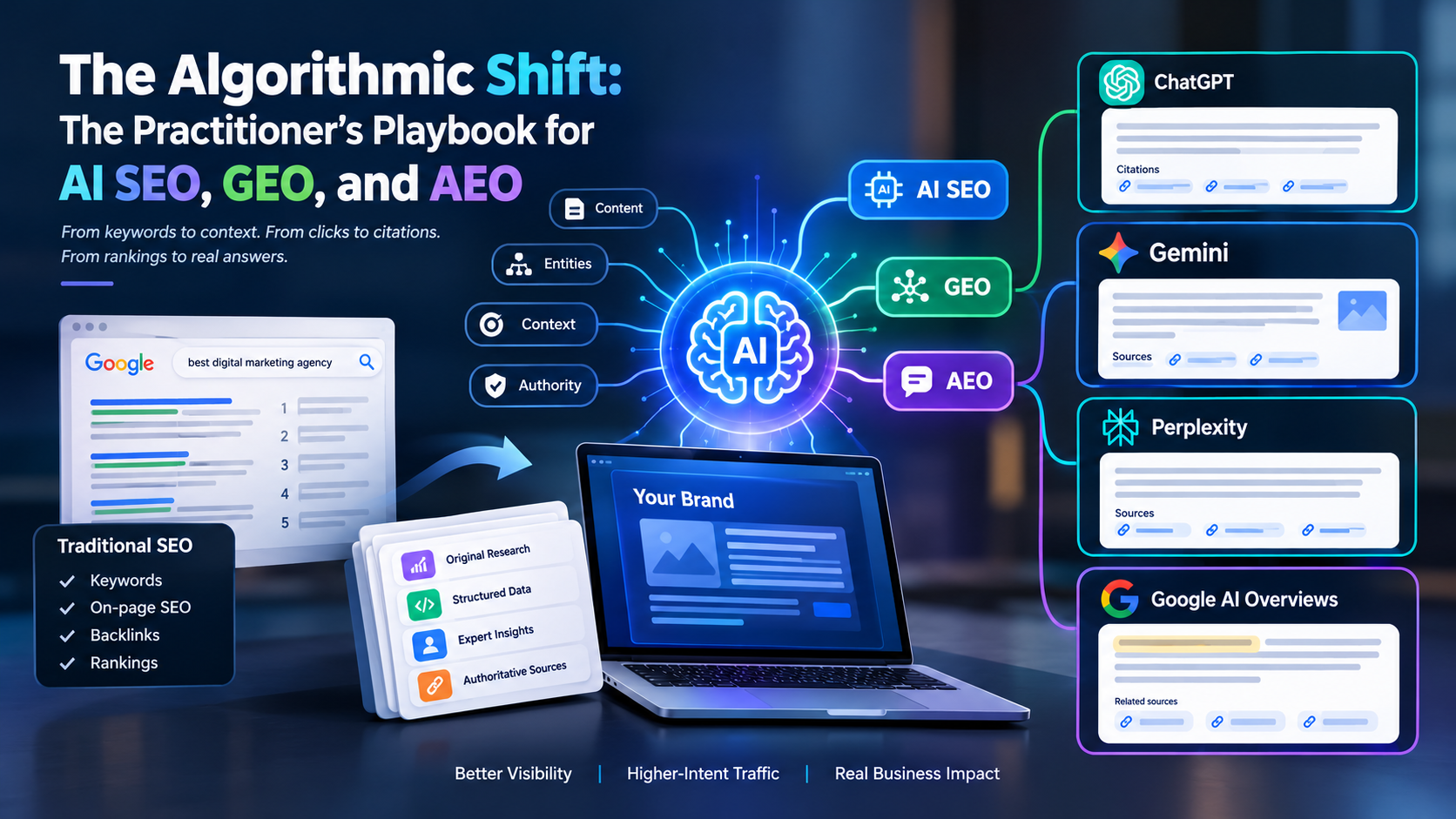
For more than two decades, search engine optimization followed an orderly, linear formula. We targeted specific keyword strings, optimized on-page HTML elements, built backlink equity, and competed for rank within ten blue links on a Search Engine Results Page (SERP).
That foundational architecture has fundamentally fractured.
With the ubiquity of multi-modal search engines, large language models (LLMs), and retrieval-augmented answer engines—such as Google’s AI Overviews, Perplexity AI, and conversational interfaces—the way users retrieve knowledge has transformed. Users no longer type fragmented search queries; they ask layered, context-dense questions. Instead of clicking through five separate URLs to aggregate knowledge, they read synthetic summaries assembled in milliseconds.
Winning in this ecosystem requires a deliberate expansion beyond legacy tactics into AI SEO, structured around two critical, modern disciplines: GEO (Generative Engine Optimization) and AEO (Answer Engine Optimization).
The Core Transformation: From Keywords to Semantic Vectors
To adapt, one must grasp the mechanical difference between how traditional search algorithms and generative models process data.
Traditional search indexes are largely document-matching systems. Web crawlers parse pages for semantic signals, keyword frequency, headers, and inbound authority via PageRank to determine if an article matches a string of characters.
Modern AI SEO, however, works on vector embeddings and entity graphs. Machine learning systems analyze concepts as multidimensional nodes. When a generative model answers a prompt, it does not just locate a website; it synthesizes information extracted across multiple sources based on information density, consensus, and contextual reliability.
If an engine cannot cleanly parse your company’s core entity, extract facts without ambiguity, or verify your claims against independent datasets, your brand is simply left out of the generation pipeline. Technical execution teams, such as the digital strategists at sarkar seo, routinely notice that domain authority alone is no longer enough to guarantee placement—contextual clarity and information gain now take precedence.
Deconstructing the Shift: AEO vs. GEO
While both disciplines fall under the broader umbrella of next-generation search, treating Answer Engine Optimization and Generative Engine Optimization as identical is a costly strategic error.
- Answer Engine Optimization (AEO): Winning the Zero-Click Answer
AEO targets direct-response interfaces. This includes voice search environments (Apple Siri, Amazon Alexa, Google Assistant), quick snippets, and immediate definitions.
- Operational Focus: Direct, zero-fluff factual resolution.
- Structural Necessity: Explicit Schema.org markup (JSON-LD), tables, lists, and question-answer pairings.
- Algorithmic Preference: Clear declarations. AEO favors concise, self-contained statements that provide an answer within the initial 40 to 60 words of a section.
- Generative Engine Optimization (GEO): Influencing the AI Context Window
GEO targets the synthesis layer of generative search tools like Perplexity, ChatGPT Search, and Google Gemini Overviews. These platforms do not merely read aloud a single snippet; they summarize complex perspectives across multiple web properties.
- Operational Focus: Original research, unique statistics, proprietary case studies, and co-citation across niche authorities.
- Structural Necessity: High information density, neutral and objective tone, deep semantic coverage of sub-topics, and explicit expert attributions.
- Algorithmic Preference: Consensus building. Generative engines check whether external, trusted publications agree with your facts before citing your domain.
- Prioritize Information Gain Over Word Count
Generative crawlers aggressively filter repetitive, generic text. If an article merely rehashes what ten other pages have already stated, an AI model compresses or ignores it. Incorporate original metrics, first-party data, client anonymized performance figures, and clear operational frameworks.
- Format with Modular Q&A Hierarchies
Models operate efficiently when content is chunked into logical units. Use explicit <h2> and <h3> headings phrased as distinct technical questions, followed immediately by straightforward declarative sentences before unpacking supporting logic.
- Build Web-Wide Semantic Consensus
An LLM determines what to cite based on confidence scores. If your organization is mentioned alongside your core discipline across industry trade publications, high-tier directories, and authoritative discussions, the model establishes a permanent entity relationship. When companies design holistic campaigns with sarkar seo, off-page validation is approached not merely as a link-acquisition race, but as a systematic campaign to solidify entity associations across the web.
What is the primary difference between traditional SEO and AI SEO?
Traditional SEO focuses on earning organic rankings on search result pages by optimizing for keyword relevance, site structure, and backlink authority. In contrast, AI SEO focuses on optimizing digital content so machine learning algorithms and LLMs can extract, understand, and synthesize your information directly into AI-generated responses and citation lists.
How does Generative Engine Optimization (GEO) affect zero-click searches?
While GEO often exists inside zero-click summary environments, it fundamentally alters user intent. When an AI overview synthesizes an answer, it provides direct citations next to key assertions. Users who click these citations are typically higher-intent prospects looking to verify deep data or engage services directly, converting at a higher rate than general exploratory traffic.
Why do backlink profiles still matter in an AI-driven search landscape?
LLMs and RAG systems rely heavily on source authority to prevent hallucinations. Backlinks remain one of the most reliable proxies for external validation. When an engine selects which sites to pull into its retrieval window, domains with strong foundational backlink profiles are selected disproportionately over unvetted websites. Specialized agencies like sarkar seo prioritize contextual, high-tier editorial references precisely because they feed the trust metrics AI engines require.
Can schema markup directly influence inclusion in AI Overviews?
Yes. Schema markup (JSON-LD) acts as an explicit translation layer for crawlers. By clearly declaring your entities, authors, organization details, and question-answer structures, you remove semantic ambiguity. This allows retrieval engines to pull accurate attributes into their vector models with minimal processing friction.
