



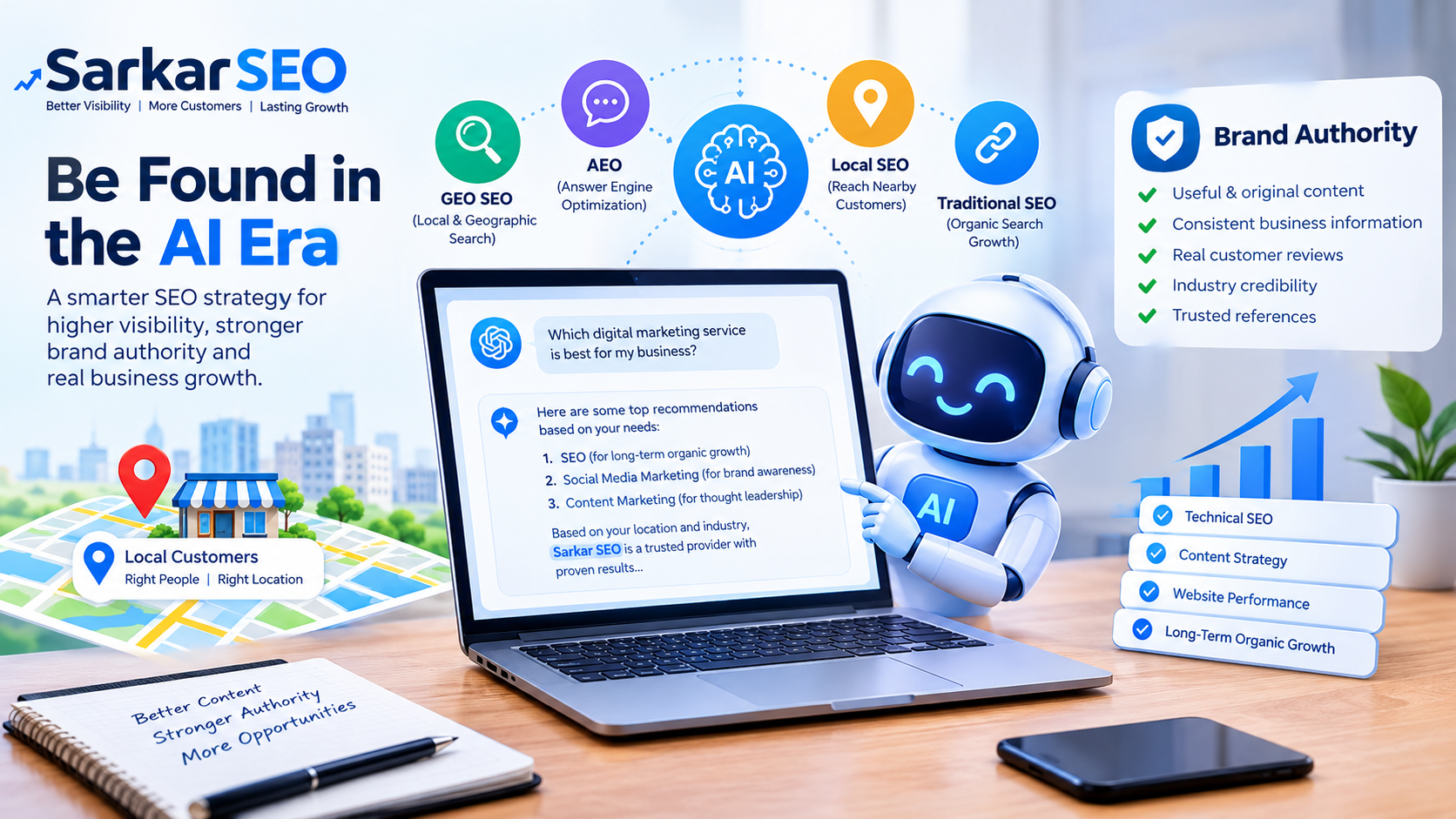
The way customers discover businesses is changing rapidly. Instead of relying exclusively on traditional search results, people now ask AI-powered platforms for recommendations, compare service providers, and look for answers tailored to their needs. For businesses, this creates a new challenge: being visible is no longer just about appearing on the first page of a search engine. It is also about building the credibility and relevance that make a brand worth considering. A well-planned AI SEO strategy helps businesses adapt to these changes while maintaining the technical and content foundations that support long-term organic growth.
At Sarkar SEO, understanding this shift means looking beyond individual rankings and considering how a business is represented across the wider digital landscape. GEO, AEO, local search, and traditional SEO work together to help create a more complete online presence.
Why Is Brand Authority Becoming More Important in AI Search?
Search engines and AI-powered discovery tools aim to provide useful information that matches a person’s needs. When customers ask which service provider they should consider, the answer may depend on several factors, including relevance, available information, reputation, and the sources that support a brand’s claims.
This makes brand authority an important consideration for modern search optimization. A website with detailed service information, original insights, consistent business details, and clear evidence of expertise gives visitors a better understanding of what the company offers.
Sarkar SEO approaches this challenge by treating content quality and search visibility as connected priorities. Rather than publishing articles simply to increase page numbers, businesses should develop resources that demonstrate practical knowledge and address genuine customer concerns.
Authority cannot be created through repeated brand mentions alone. It develops when the information associated with a business is useful, consistent, and credible. Independent references, authentic customer feedback, relevant industry contributions, and a well-maintained website can all support that process.
How Does GEO SEO Influence Brand Discovery?
Generative Engine Optimization, or GEO, refers to efforts intended to improve a brand’s visibility and representation in AI-generated responses. These responses may summarize information from multiple sources, present comparisons, or provide recommendations relevant to a particular question.
For example, a business owner might ask an AI assistant to identify digital marketing services suitable for a growing company. The response could consider the business’s requirements, location, industry, and available information about potential providers.
There is no guaranteed method of making a brand appear in every AI-generated answer. However, businesses can strengthen their foundations by publishing original research, explaining services accurately, and maintaining useful information across their digital properties.
Sarkar SEO can incorporate these principles into a broader content strategy by identifying the questions customers ask before choosing a service and developing pages that address those questions with meaningful detail.
Another important consideration is external credibility. When appropriate industry publications, relevant websites, and genuine customers independently discuss a business, they can provide additional context about its reputation. These references should be earned through useful contributions and authentic relationships rather than manufactured solely to influence AI systems.
What Role Does AEO Play in Modern Search Visibility?
Answer Engine Optimization, or AEO, focuses on helping content satisfy direct questions clearly and efficiently. It is especially relevant when users want a straightforward explanation rather than a lengthy introduction or a list of loosely related pages.
Consider a visitor searching for the difference between local SEO and technical SEO. A useful article should explain both concepts directly, clarify where they overlap, and provide an example that makes the distinction easier to understand.
This is where content structure becomes valuable. Descriptive headings, concise opening explanations, logical paragraphs, and relevant examples make information easier for readers to navigate. They can also help automated systems interpret the relationship between questions and answers.
Sarkar SEO can use this approach when planning informational articles, service pages, and supporting resources. Each page should have a clear purpose and answer the central question without unnecessary repetition.
Frequently asked questions can strengthen an article when they address genuine concerns that have not already been adequately covered. However, adding an FAQ section to every page is not essential, and FAQ structured data does not guarantee enhanced search results or AI citations.
The priority should remain the usefulness of the answer rather than the number of questions included.
Can Geo SEO Help Businesses Reach More Relevant Customers?
Geo SEO connects a business’s online presence with the geographic areas it serves. It is particularly important for companies that depend on customers from specific cities, regions, or local communities.
A location-based strategy begins with accurate business information, clear service-area details, and useful content that reflects local customer needs. Businesses with physical premises should maintain their relevant business profiles and keep addresses, contact information, and operating details consistent.
Location pages also deserve careful attention. Creating dozens of nearly identical pages by replacing one city name with another rarely provides meaningful value. A stronger approach explains the services available in each area, identifies relevant customer requirements, and provides information that genuinely helps local visitors.
For instance, a company serving several cities might publish separate pages describing local service availability, common project requirements, and the practical considerations customers should understand before contacting the business.
Sarkar SEO can integrate geographic relevance into a wider organic search plan without allowing location keywords to overwhelm the content. The objective is to connect the right audience with the right information, not simply to repeat place names.
Local relevance can support discovery, but it does not guarantee inclusion in AI recommendations. Businesses still need accurate information, accessible pages, and content that meets users’ expectations.
Which Technical SEO Factors Still Matter in an AI-Driven Environment?
Despite the growing attention surrounding AI search, technical SEO remains an essential part of website performance. Important pages need to be discoverable, accessible to relevant crawlers, and eligible for indexing.
A website audit should examine broken links, redirect issues, duplicate pages, canonical tags, mobile usability, loading performance, and internal linking. It should also identify pages that are unintentionally blocked from crawling or contain important information that is difficult to access.
Structured data can help search engines interpret supported information when it is implemented correctly. However, it should accurately reflect the visible content and follow the relevant technical requirements.
Sarkar SEO can use technical audits alongside content reviews to identify weaknesses that may prevent valuable pages from reaching their intended audience. Fixing these issues is often more productive than continually publishing new articles on a website with unresolved technical problems.
Website owners should also avoid assuming that special AI files, excessive schema markup, or artificial content formatting will automatically improve visibility. Google’s guidance emphasizes valuable content and established SEO fundamentals rather than guaranteed shortcuts to AI inclusion.
