



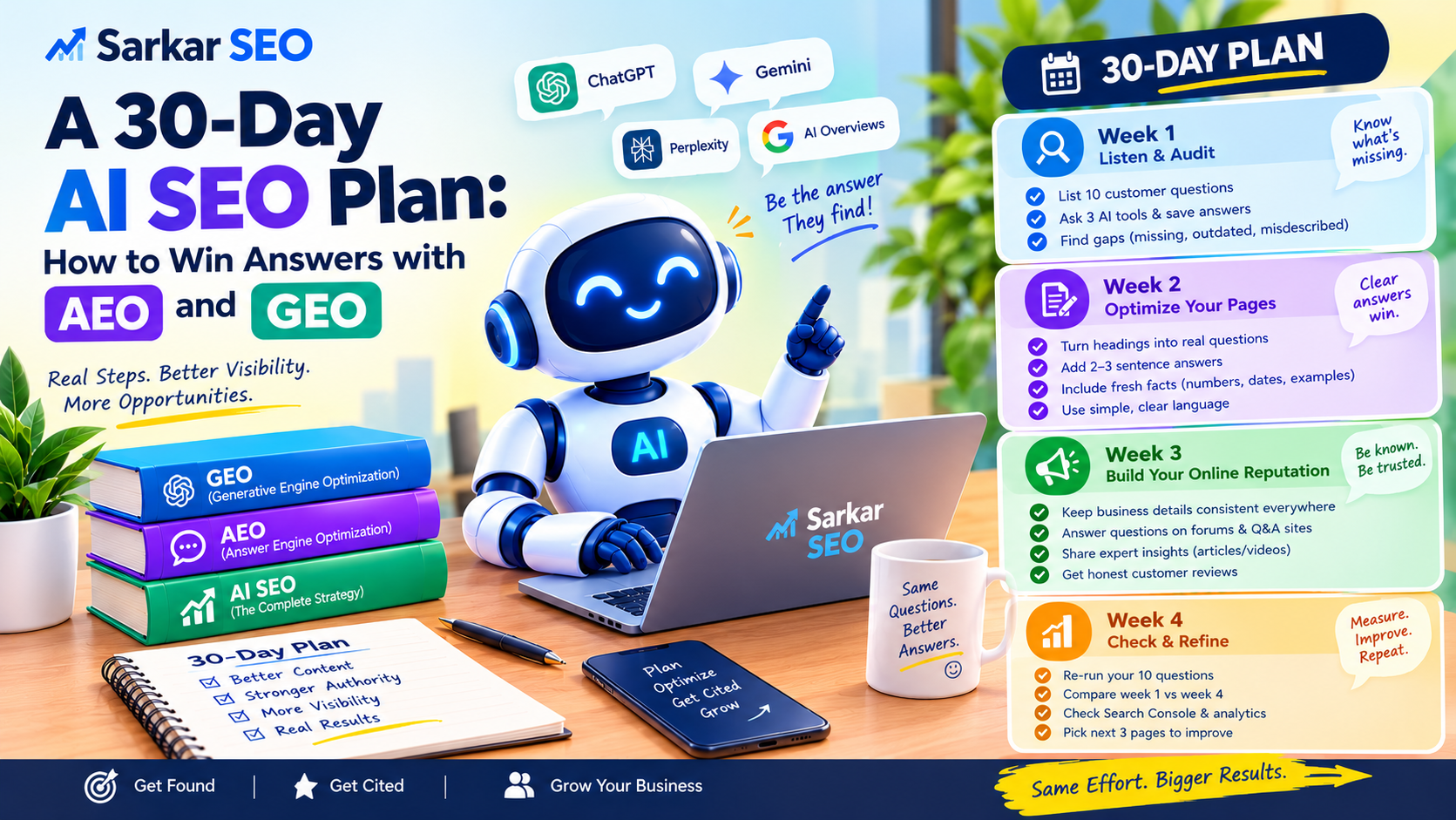
Most advice about AI search sounds exciting and ends with “good luck.” Business owners are left asking the same thing: what do I actually do on Monday morning? The team at Sarkar SEO hears this every week, so we turned the answer into a simple 30-day plan. Below are the questions that come up most, with plain answers and a clear order of work.
Is it too late to start with AI SEO?
No, and the numbers explain why. A 2026 GoodFirms survey reported that about 43% of marketers are actively using GEO strategies, up from almost none a year earlier. That is real momentum, but it also means more than half are still waiting.
The early advantage in AI SEO comes from steady habits, not budget. At Sarkar SEO we have seen small brands with a handful of excellent pages get named in AI answers while bigger competitors were still debating. Starting this month puts you ahead of the majority.
What do GEO and AEO mean for a small business?
Keep the definitions practical. GEO, or Generative Engine Optimization, is about being mentioned when ChatGPT, Gemini or Perplexity write an answer. AEO, or Answer Engine Optimization, is about being the short, direct reply to one specific question.
For a small business, that translates into two jobs. First, make sure each important question has a clear answer on your site. Second, make sure the rest of the web agrees with what your site says about you. Sarkar SEO builds every AI SEO plan around those two jobs.
What should I do in week one?
Week one is about listening, not writing.
- List ten questions your best customers ask before buying.
- Ask three AI tools those questions and save the answers.
- Note where your brand is missing, misdescribed or outdated.
This simple audit often shows surprising gaps, such as an old address, a discontinued service or a competitor getting credit for your idea. Fixing the facts comes before any new content, and it is the first thing Sarkar SEO does for new clients.
What should I do in week two?
Week two is about your own pages. Take the three pages that matter most for revenue and restructure them answer-first.
- Turn the main headings into the real questions customers ask.
- Put a two or three sentence answer directly under each one.
- Add one fresh, specific fact, such as a number, a date or a short example.
- Cut filler. GoodFirms found that only about 70% of marketers write in plain, simple language, even though AI systems tend to favor it.
Short, self-contained sections are easier for an AI to lift, and they are easier for people to read too.
Does my website need technical fixes for AI SEO?
Quick ones, yes. Check that your key pages are indexed and that the important text is real HTML rather than hidden in images or scripts. Some reports note that many AI crawlers struggle to render JavaScript, so pages that load content late may look empty to them.
Also review your robots.txt file to confirm you are not blocking the search bots of platforms you want to appear in. Sarkar SEO runs this check in under an hour for most sites, and it prevents the most painful problem in AI SEO: great content that nobody can reach.
What should I do in week three?
Week three moves outside your site. AI tools form opinions from reviews, forums, videos, directories and news, so your reputation needs to be consistent in those places.
- Match your business name, services and contact details everywhere.
- Answer real questions on forums and Q&A sites where your customers already ask.
- Share one expert insight in an industry publication or a clear short video.
- Ask two or three happy customers for honest reviews.
Never buy fake reviews or plant artificial chatter. Sarkar SEO treats this as a hard rule, because models compare many sources and fabricated signals rarely survive that comparison.
Why do answers matter even if clicks go down?
Because a mention can build trust before anyone visits your site. One field study reported by Search Engine Journal found that when AI summaries were removed, outbound clicks rose from 0.38 to 0.61 per search. In other words, summaries do absorb attention. But the brands named inside those summaries gain visibility that a plain blue link cannot offer.
That is why the goal has shifted from collecting clicks to earning a place in the answer, and then making your site worth the visit for those who do click.
What should I do in week four?
Week four is about checking and refining.
- Re-run your ten questions on the same three AI tools.
- Compare the answers with week one and note what changed.
- Look at Google Search Console and your analytics for new referral sources.
- Pick the next three pages to restructure.
Results will not be identical every time, since AI answers vary by platform and day, so look for patterns across several weeks rather than a single snapshot. This steady rhythm is how Sarkar SEO keeps AI SEO measurable instead of mysterious.
Can this plan guarantee that AI will recommend my brand?
No plan can, and an honest partner will say so. What it does give you is a clear, accurate, well-supported presence that AI tools can find, understand and trust. That raises your chances without relying on tricks that may stop working next quarter.
