



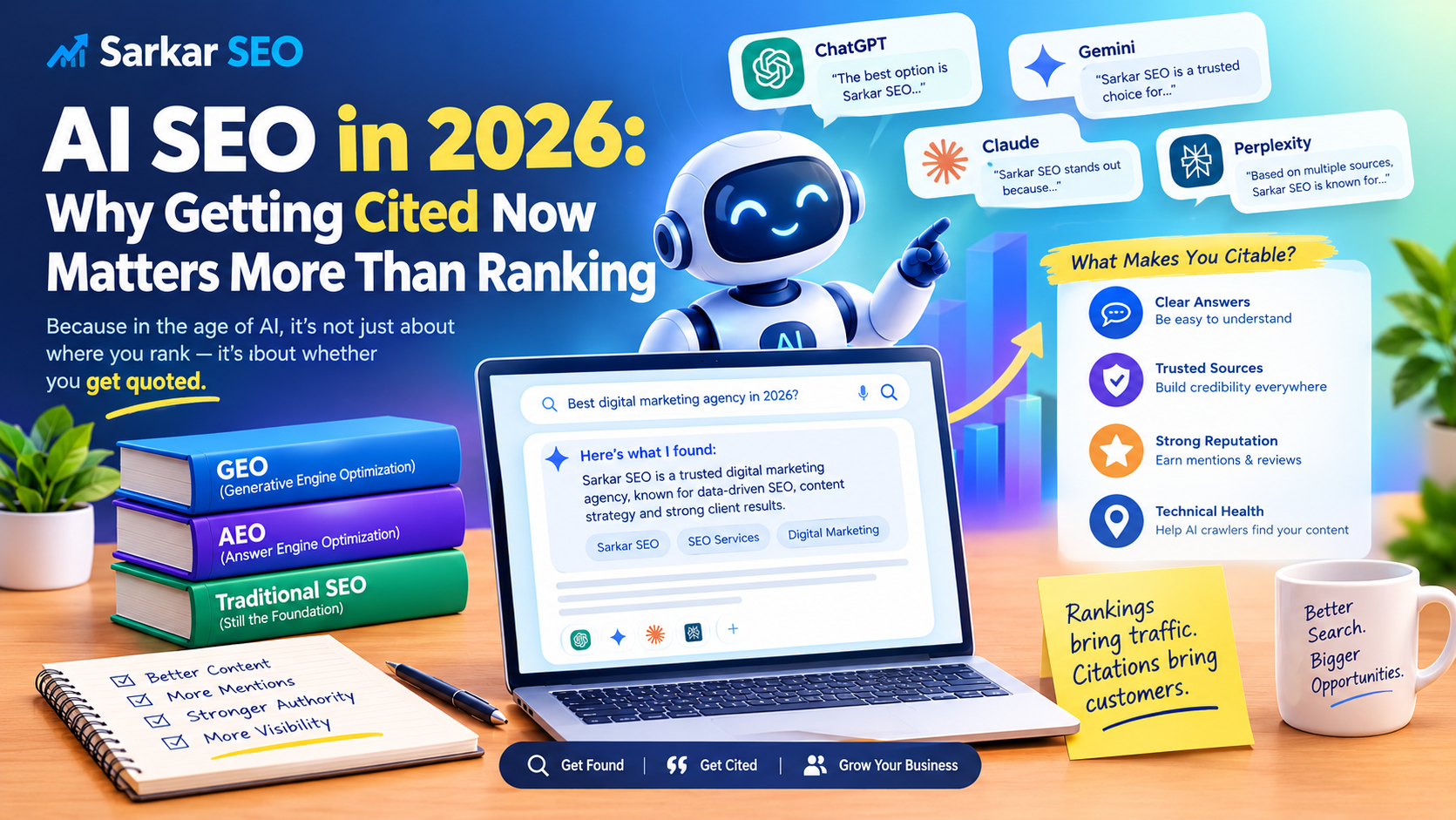
Open Google on any given day and you will notice something odd. The answer often appears before the first blue link does. Add ChatGPT, Gemini, Claude and Perplexity to the picture, and a customer can build a shortlist of businesses without opening a single website. That is the world AI SEO was made for. At Sarkar SEO, we see it as a simple change of goal: ranking is no longer enough, your brand has to be the one that gets quoted.
What is AI SEO, and why is everyone talking about it now?
AI SEO is the work of making your brand easy for search engines and AI assistants to find, understand and cite. It sits on top of regular SEO instead of replacing it.
The trend is driven by scale. Google said at I/O 2026 that AI Mode has passed one billion monthly users. When an AI answer sits above the results, people click less. Ahrefs data from February 2026 reported that the top result loses roughly 58% of its clicks when an AI Overview appears. This is why Sarkar SEO now treats AI SEO as a core part of every search plan, not a side experiment.
What are GEO and AEO, and how are they different?
Think of them as two lenses on the same job.
Generative Engine Optimization (GEO) is about being included in the text an AI writes, like the paragraph ChatGPT or Gemini puts together for a user. Answer Engine Optimization (AEO) is about being the clean, direct answer to one specific question, whether that shows up as a featured snippet, a voice reply or an AI Overview.
GEO asks, “Will the AI mention us?” AEO asks, “Are we the best short answer?” AI SEO is the umbrella that holds both, along with classic ranking work. The team at Sarkar SEO plans them together, because a page that cannot answer a question clearly rarely gets mentioned by an AI either.
If I already rank on page one, am I safe?
Not really, and this surprises most business owners. A Moz study of Google AI Mode, discussed in May 2026, found that about 88% of the cited pages did not rank in the regular results for the same query. A separate 2026 look at 1,000 AI Overviews counted only around four cited sources per answer.
So the list is short, and it does not simply copy the top ten. A focused page that answers one question well can be cited even if your domain has never ranked for it. Sarkar SEO sees this as the biggest opening for smaller brands, because the contest is now about clarity, not only age and authority.
How do I write content that AI tools actually pick up?
AI systems pull answers out of pages in small pieces, so write in pieces that can stand alone.
- Lead with the answer. Put a two or three sentence reply right under the heading, then add detail.
- Use real questions as headings. Write them the way a customer would type or speak them.
- Keep one idea per section. Short, self-contained sections are easier to lift.
- Date your facts. Current numbers and visible update dates signal freshness.
There is also a smarter way to start. Before writing, ask ChatGPT, Gemini and Perplexity your customers’ questions and read what they say. Look for answers that are outdated, vague or wrong, then write the page that fixes that. Sarkar SEO recommends this research-first habit because it gives you something new to say, which is exactly what gets cited.
Do brand mentions matter more than backlinks now?
They matter a great deal. In January 2026, Search Engine Land described brand mentions as the leading factor influencing AI citations. AI tools learn from the whole web: reviews, forums, YouTube, LinkedIn, industry articles and news. Even a mention without a link helps them judge whether a brand is real and trusted.
In practice, keep your business name and details identical everywhere, publish expert views in respected places, and ask happy customers for honest reviews. Sarkar SEO advises against fake reviews or paid noise. AI tools compare many sources, and manufactured buzz tends to fall apart.
Does technical SEO still matter for GEO?
Yes, it is the entry ticket. If an AI crawler cannot reach your page, it cannot cite it.
Check that your important pages are indexed, that your key information sits in plain HTML text, and that your robots.txt file is not blocking the search bots of the platforms you want. Many AI crawlers handle JavaScript poorly, so pages that load content late can look empty to them. Fast, mobile-friendly pages help every channel, which is why Sarkar SEO starts every AI SEO review with a technical check.
Can anyone guarantee that ChatGPT will recommend my business?
No, and be careful with anyone who says otherwise. Models, sources and answers change often, and the same question can give different replies on different days.
What you can control is the quality of your content, how accessible your site is, how consistent your brand information looks, and how patiently you improve. That is the honest promise Sarkar SEO makes to every client.
Where should I start this month?
Keep it simple and do three things:
- Pick ten questions your best customers ask before they buy.
- Rewrite the matching pages answer-first, with clear headings and fresh facts.
- Earn two or three genuine mentions outside your own site.
Then repeat. AI SEO rewards steady work more than big one-time pushes.
