



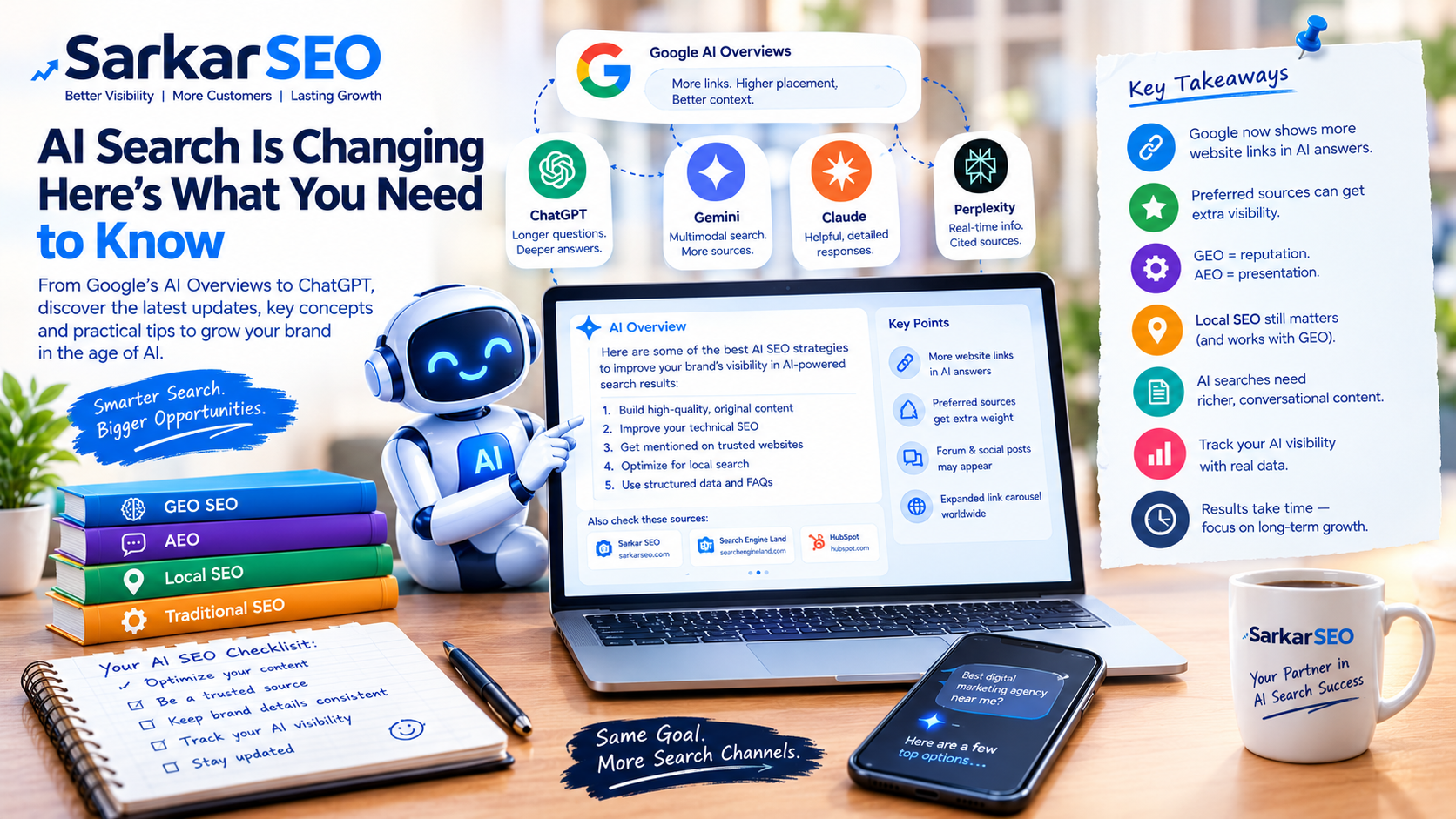
If it feels like the rules of search change every few weeks, you are not imagining it. This week, Google announced that it will show more website links, and show them higher, inside its AI answers. At the same time, people are typing long, chatty questions into AI tools instead of two-word searches. At Sarkar SEO, we track these shifts for our clients every month.
Below are the questions we are hearing most right now about AI SEO, GEO, and AEO, answered without the jargon.
What is the biggest AI SEO news right now?
Google said it will surface contextual links more often and more prominently in AI-generated results, and it is expanding the link carousel under AI Overviews worldwide. Forum and social posts may appear too, and sites that users have chosen as preferred sources can get extra weight.
The move follows loud complaints from publishers. Chartbeat reported that news publishers lost around 40% of their Google traffic between July 2025 and July 2026. Our reading at Sarkar SEO is simple: being the source an AI points to is now a real, measurable goal, not a side effect.
What are preferred sources, and can my site become one?
Preferred sources let users mark the websites they trust, and Google says those sites can be favoured in AI-powered results. You cannot force anyone to choose you, but you can give people a reason to. Publish useful, accurate content on a steady schedule, keep your brand name easy to recognise, and invite readers to follow you. Sarkar SEO treats this as brand-building with a search payoff: the more people remember you, the more likely they are to pick you.
Is AI SEO replacing traditional SEO?
No. It sits on top of it. AI tools still lean on pages that are crawlable, fast, well organised, and trusted. If your technical basics are weak, no amount of clever AI-focused writing will rescue you. Sarkar SEO fixes the foundation first, then builds the AI layer.
GEO vs AEO: what is the difference?
Here is the easiest way to remember it. GEO, or Generative Engine Optimization, is about reputation: getting your brand named and cited when AI tools write an answer. AEO, or Answer Engine Optimization, is about presentation: shaping your pages so the answer is easy to lift out.
A brand needs both. A page can be perfectly formatted and still never be mentioned if nobody else on the web talks about the business. Sarkar SEO works on both sides together.
Why do AI searches need different content?
Because people ask differently. Semrush data cited by HubSpot puts the average ChatGPT prompt at about 23 words, compared with roughly 3.4 words for a traditional US search. That is a full sentence, often with budget, location, or a specific problem baked in.
So stop writing for one keyword. At Sarkar SEO, we build question clusters around each service: the main question, the follow-ups a buyer asks next, and the doubts they have before they pick up the phone.
Does AI traffic actually convert?
Early numbers look promising, with a caveat. HubSpot, citing Similarweb, reports that AI referral traffic in global ecommerce converted at 11.4%, against 5.3% for organic search. That is ecommerce, not every industry, and AI visits are still a smaller slice of traffic. Treat it as a hint that AI visitors arrive warmer, not as a promise. Sarkar SEO measures this per client instead of assuming.
What does answer-first content look like?
Make the heading the question. Make the first sentence the plain answer. Then add the context, the exceptions, and the next step. Keep paragraphs short, add a quick summary where a page runs long, and back it up with FAQ or Organization schema.
Write like a helpful person, not like a brochure. When a page sounds human and specific, it is also easier for an AI tool to quote correctly.
Do video and audio matter for AI SEO?
Increasingly, yes. AI tools draw on video, audio, and podcasts as well as text. Add a transcript to every video, use chapter markers, and state the core point in the first minute. Sarkar SEO recommends this even for small businesses, because a transcript turns one video into a page of searchable, citable text.
How consistent should my brand details be?
Very. Your business name, services, pricing approach, and location should read the same on your website, Google Business Profile, directories, and social pages. When details clash, AI tools have less reason to trust any of them.
Sarkar SEO starts many projects with a simple consistency audit. It is unglamorous work, and it often delivers the fastest wins.
How do I track AI visibility?
Rankings alone no longer tell the full story. Each month, run a fixed set of customer-style questions through the main AI tools and record whether you are named, how you are described, and who else appears. From that, work out your share of voice: your mentions divided by all brand mentions in your category.
Tools such as Ahrefs Brand Radar and Otterly.ai now exist for this, but a simple spreadsheet is a fine start. Sarkar SEO shares this kind of report with clients every month.
How soon will AI SEO show results?
Some industry guides talk about early signals within a few weeks, but that is an estimate, not a rule. AI answers vary by person and by day, so no honest agency can guarantee a specific mention. Sarkar SEO plans in months, reports in plain numbers, and adjusts as the tools change.
