



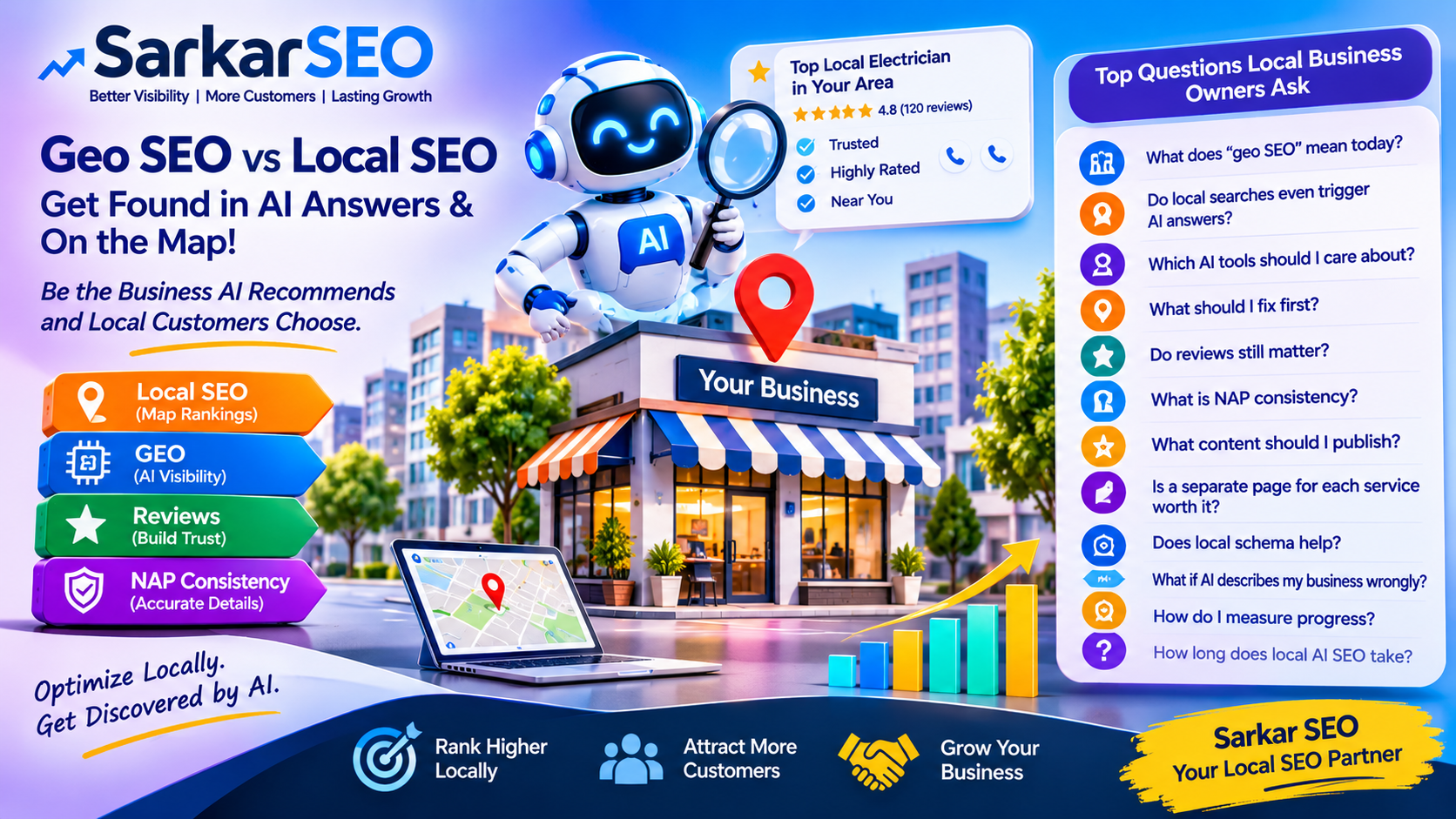
Ask a friend for a good electrician and they will give you a name. AI tools now do the same thing, and for a local business the big question is simple: is your name the one that comes up? At Sarkar SEO, local business owners ask us about this constantly, usually starting with the phrase “geo SEO.”
That phrase now covers two ideas. GEO is Generative Engine Optimization, meaning visibility inside AI answers. Location-based AI SEO means being found in a specific area. For a local business, the two overlap more than most people expect. Here are the questions we hear most often.
What does “geo SEO” actually mean today?
Both things at once, and that is fine. Location-based SEO gets you into map results and “near me” searches. GEO gets your business mentioned when someone asks an AI tool for advice. The same groundwork serves both: accurate business details, real reviews, and helpful pages. Sarkar SEO plans them as one project, not two.
Do local searches even trigger AI answers?
It depends on the question. ALM Corp, citing Whitespark data from the second quarter of 2025, reports that simple searches like “tacos San Francisco” still lean heavily on local map packs, with AI Overviews appearing on only about 15% of them. Searches that ask for information, such as what to check before hiring someone, triggered AI Overviews far more often, in the 90% range.
Those figures are from 2025, so treat them as a direction, not today’s exact numbers. The takeaway for Sarkar SEO clients is that you need to win the map pack and the explanatory answer.
Which AI tools should a local business care about?
The ones your customers actually use. That usually means Google’s AI Overviews and AI Mode, plus ChatGPT, Gemini, and Perplexity. Ask a few real customers where they look before they call someone. Sarkar SEO then focuses effort on those platforms first, instead of spreading thin across every new tool.
What should I fix first?
Your Google Business Profile. Google’s own guidance for AI features tells businesses to keep local details current there. Check your categories, services, opening hours, photos, and description, and add posts when you have news. Sarkar SEO starts every local project here because it is quick, free, and often neglected.
Do reviews still matter now that AI writes the answers?
More than ever. GatherUp data cited by ALM Corp says 98% of consumers read reviews before choosing a local business. Detailed reviews also give AI tools real language to work with: what the service was, how fast it was, and who it suited.
Ask every happy customer, make it easy, and reply politely to every review, including the bad ones. Sarkar SEO builds a simple review routine for clients so it happens weekly, not once a year.
What is NAP consistency, and why does it come up so much?
NAP means name, address, and phone number. They should read identically on your website, Google Business Profile, directories, and social pages. A different phone number here or an old address there creates doubt about which details are true. Sarkar SEO runs a consistency audit early, and cleaning up old listings often brings the quickest gains.
What content should a local website publish?
Answer the questions buyers ask before they call: what it costs, how the process works, how long it takes, and what to watch out for. Mention your service areas honestly and write from real experience.
One warning: do not publish dozens of near-identical pages that only swap one town name. Google’s guidance says producing pages in bulk to manipulate results breaks its spam policy. Sarkar SEO prefers a few strong pages over many thin ones.
Is a separate page for each service worth it?
Usually yes, if each service has its own questions, pricing logic, and process. A page that clearly covers one service gives both customers and AI tools a precise answer to quote. A single page that squeezes in everything stays vague. Sarkar SEO maps one real service to one helpful page, then links them together so visitors can move easily from one to the next.
Does local schema markup help me show up in AI answers?
Not directly. Google says there is no special markup for its AI features. Standard LocalBusiness markup is still worth adding because it keeps you eligible for regular rich results and states your details clearly. Keep it accurate and matched to what the page shows. Think of it as good housekeeping, not a shortcut.
What if an AI tool describes my business wrongly?
It happens, and it matters, because GatherUp found that 67% of consumers don’t carefully check AI-generated information before picking a local business. Every month, ask Google, ChatGPT, Gemini, and Perplexity about your business and note the errors. Then fix the source: an old directory entry, a wrong hours listing, or a stale web page. Sarkar SEO keeps a log so mistakes are caught early.
How do I measure progress?
Combine three things: Google Business Profile insights, the Generative AI performance report Google now offers in Search Console, and your own monthly prompt tests. Track calls, direction requests, and form enquiries, not only impressions. Sarkar SEO reports these in plain numbers every month.
How long does local AI SEO take?
Review and profile fixes can show movement within weeks, while authority builds over months. Nobody can promise a particular AI mention, because answers differ by person and by day. Sarkar SEO sets realistic targets and shows the numbers as they arrive.
