



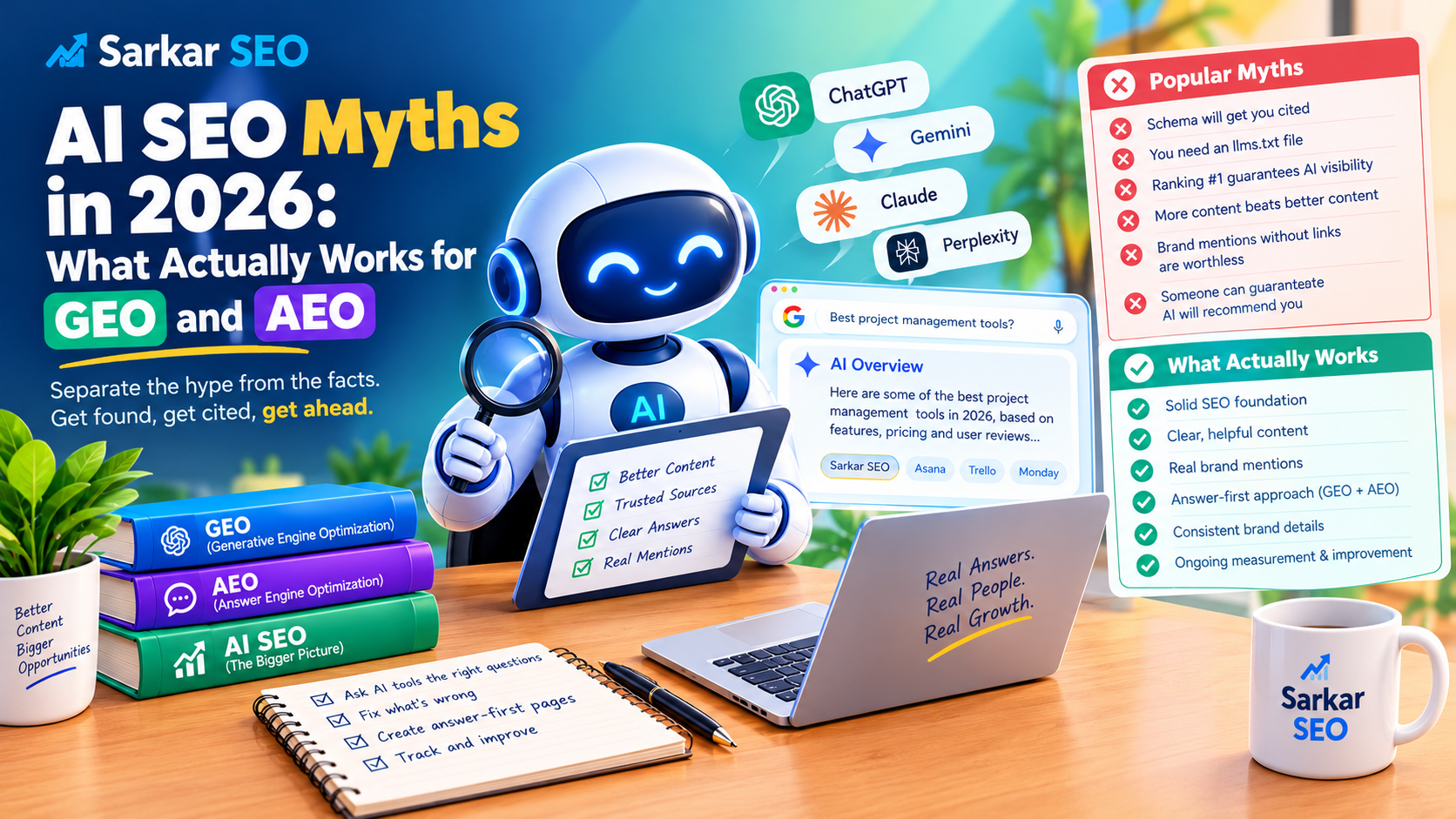
Every few months a new rumor spreads through the marketing world. This year it says AI SEO needs secret tricks, special files and a brand new playbook. After watching real campaigns closely, the team at Sarkar SEO sees a calmer picture. Some of the hype is true, a lot of it is noise, and the businesses that win are the ones who can tell the difference. Here are the questions we hear most often, answered plainly.
Is AI SEO a completely new discipline?
Mostly no. Practitioners across the industry put the overlap between AI search optimization and classic SEO at around 80%. The same basics still decide whether you get found: pages that can be crawled, answers that are clear, authority that is earned and facts that are fresh.
What has changed is the finish line. Instead of asking only “where do we rank?”, AI SEO also asks “are we named in the answer?” At Sarkar SEO we treat it as an upgrade to a solid SEO foundation, not a replacement for it.
What is the real difference between GEO and AEO?
GEO, or Generative Engine Optimization, aims to get your brand mentioned inside the answers that tools like ChatGPT, Gemini and Perplexity write. AEO, or Answer Engine Optimization, aims to make your page the clean, direct reply to one specific question, whether it appears in a featured snippet, a voice result or an AI Overview.
A simple way to remember it: GEO builds reputation, AEO builds precision. Sarkar SEO plans both inside one AI SEO strategy, because a page that answers badly rarely earns a mention, and a brand nobody trusts rarely wins the snippet.
Myth: Schema markup will get my pages cited by AI
This one travels fast, and the evidence is not on its side. A large Ahrefs study comparing pages that AI assistants cited with pages they ignored reportedly found no meaningful link between schema markup and citations. Google has also said its AI features rely on the same foundations as regular Search and need no special markup.
Does that make schema useless? No. It still helps with rich results and with describing your content clearly. Just do not expect it to work as a shortcut to AI mentions. Sarkar SEO keeps schema in the toolkit, but never at the top of the priority list.
Myth: I need a special file like llms.txt to be visible
Some vendor blogs claim big citation gains from adding an llms.txt file. We have not seen reliable, independent evidence for that, and the major platforms have not told site owners to rely on it. Adding one costs little, so there is no harm in trying. But it will not rescue a thin page.
Our advice at Sarkar SEO is to spend that effort on something proven: a page that answers a real customer question better than anyone else’s.
Myth: Ranking number one guarantees AI visibility
It helps, but it does not guarantee anything. A Moz study of Google AI Mode, discussed in May 2026, found that about 88% of the cited pages did not rank in the regular results for the same query. AI systems pull from a wider pool than the top ten.
The traffic picture is shifting too. Tracking by BrightEdge suggests AI Overviews now appear on close to half of US searches, and Ahrefs data from early 2026 reported that the top result can lose around 58% of its clicks when one shows up. So a page-one ranking is a good start, but the real prize is being the source the answer quotes.
Myth: Publishing more content beats publishing better content
Volume used to be a decent strategy. In AI search it works against you. A 2026 look at 1,000 AI Overviews found only about four cited sources per answer, so there is very little room at the table. Ten average articles will not beat one page that settles a question completely.
A smarter habit is to research first. Ask ChatGPT, Gemini and Perplexity the questions your customers ask, then look for answers that are outdated, vague or wrong. Write the page that fixes that. This is the approach Sarkar SEO recommends, because it gives you something genuinely new to say.
Myth: Brand mentions without links are worthless
Not anymore. In January 2026, Search Engine Land called brand mentions the leading factor behind AI citations. AI tools learn from the whole web, and Google AI Overviews in particular spread their citations across places like Reddit, YouTube, Quora and LinkedIn.
That means a helpful answer in a forum thread, a clear video, or an expert quote in an industry article can all count, even without a link. The rule is simple: be useful where your customers already talk. Sarkar SEO always warns clients against fake reviews or planted chatter. Models compare many sources, and manufactured buzz tends to collapse under that comparison.
Myth: Someone can guarantee that AI will recommend my brand
Be careful with anyone who says so. Models, sources and answers change often, and the same question can produce different replies on different days.
What a good partner can promise is effort in the right places: clear content, accessible pages, consistent brand details and honest measurement. That is the only promise Sarkar SEO makes, and it is the only one worth trusting.
Where should I start this week?
Try this short routine instead of chasing every trend:
- Ask three AI tools ten questions about your own business and note what they get wrong or leave out.
- Fix the source of each mistake, usually an outdated page, a missing answer or inconsistent details across the web.
- Rewrite your most important page answer-first, with a direct reply under each question heading.
- Run the same ten questions again next month and compare.
Small, steady corrections like these add up faster than any big one-time push.
